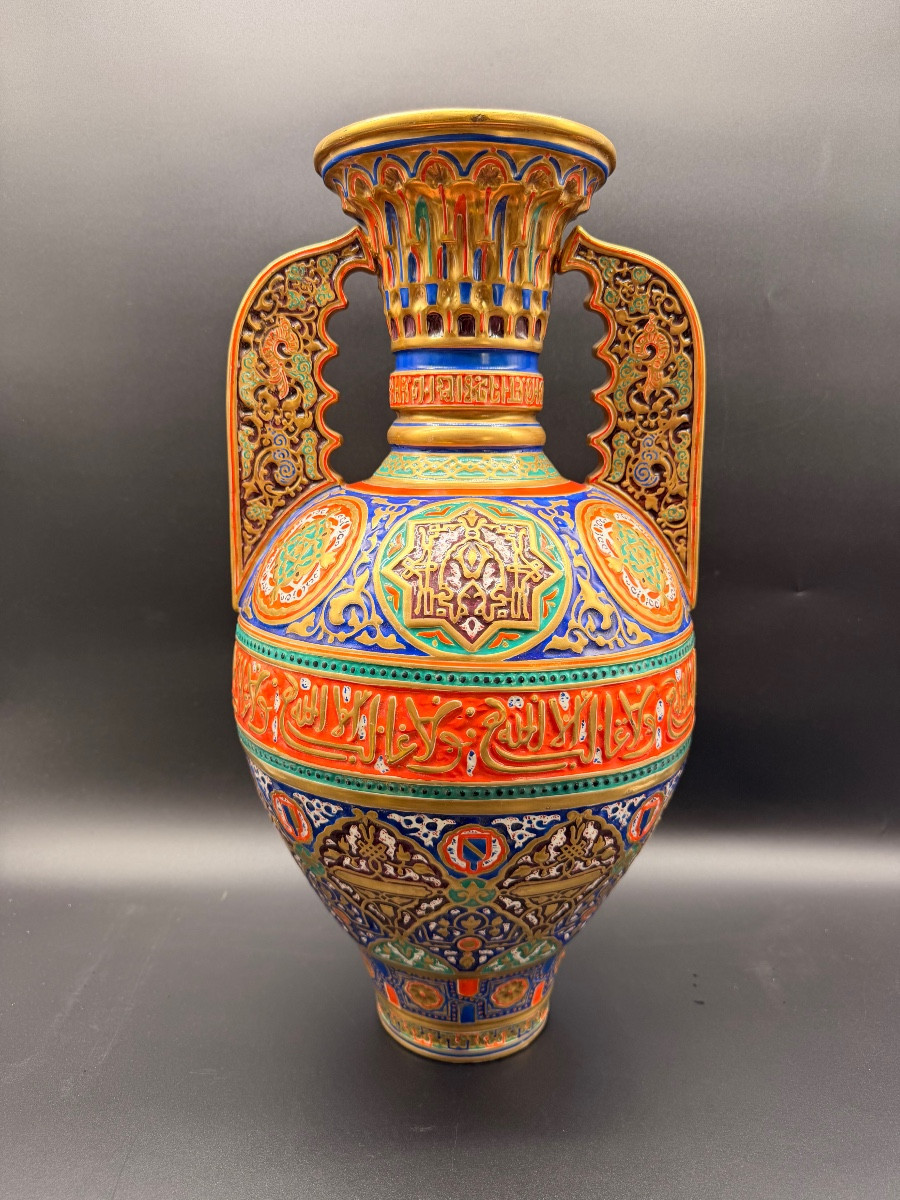


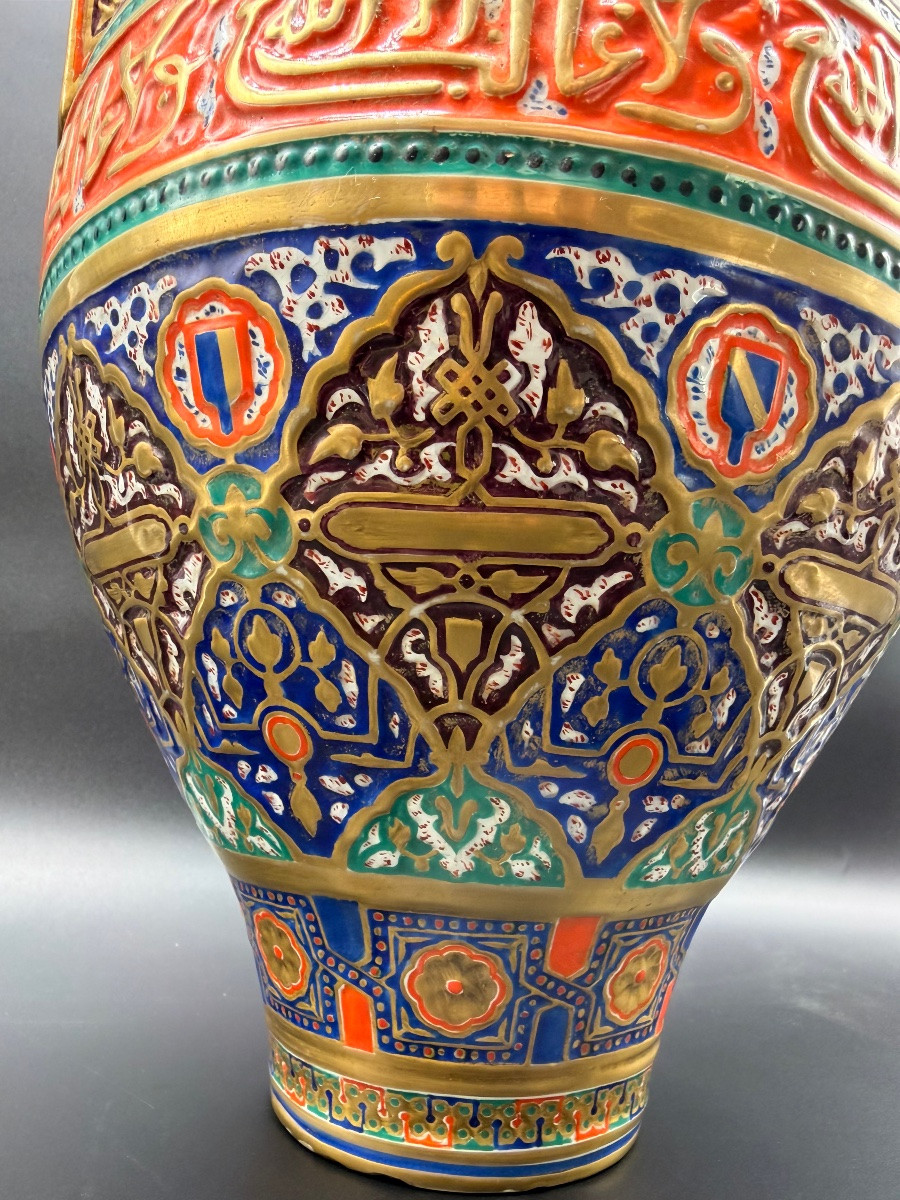


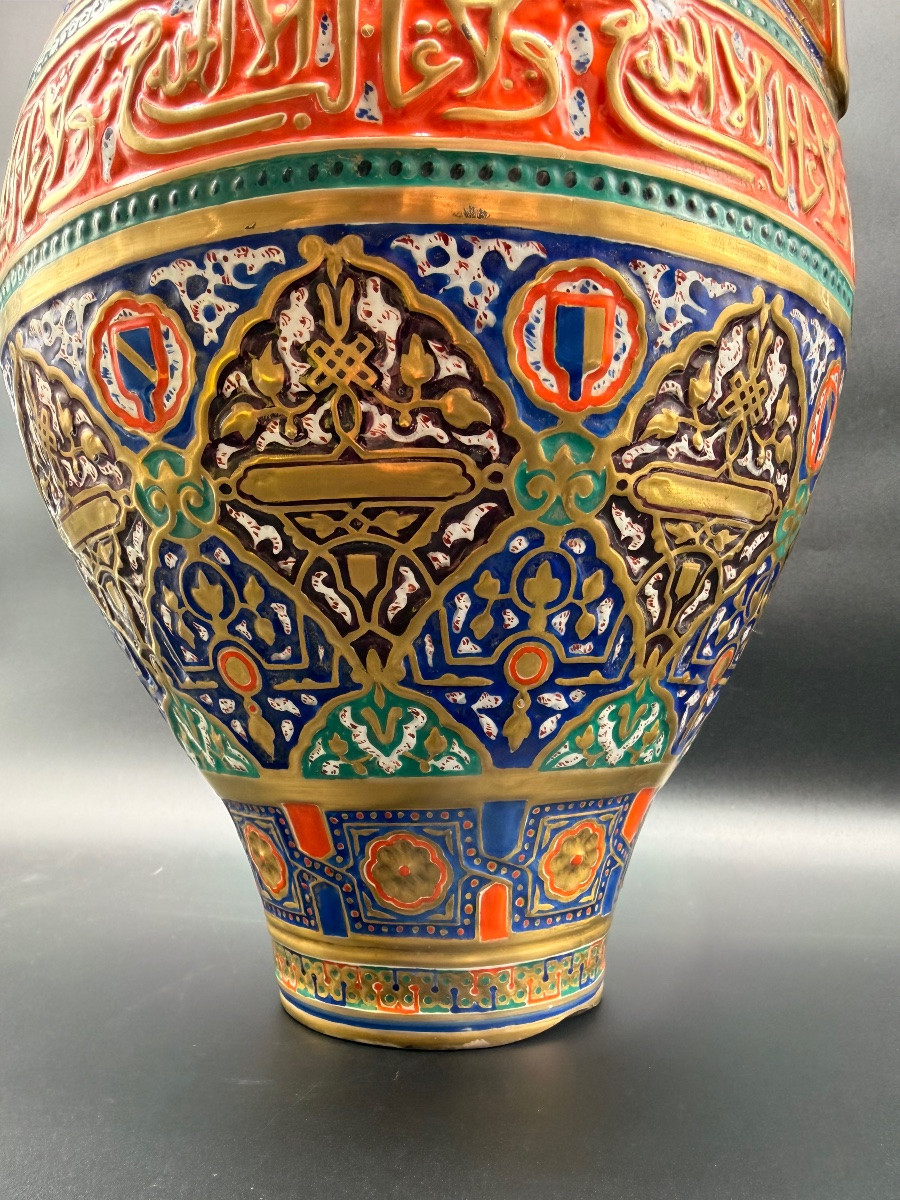
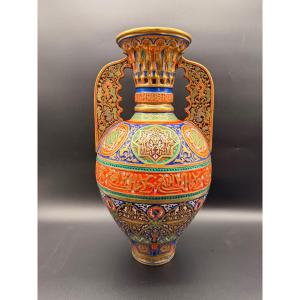


Alhambra Vase,orientalist Vase,large,vivid Colours,calligraphy XIXcentury
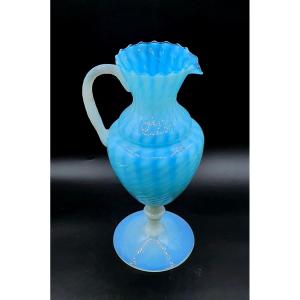
Exerreme Rare: Alhambra large vase has a distinctive shape: a wide body, a tall, flared neck, and two wings handles.in vivid colours.
This type of vase was produced in the 14th century around Granada (Spain). They are known as “Alhambra vases” because they decorate the Alhambra, a complex of palaces belonging to the Muslim Nasrid dynasty (1238-1492) which ruled the region at the time.
However, this piece does not feature the same technique as the 14th-century examples. It also bears the names of two rulers who reigned 70 years apart. It is actually a copy produced between the 17th and 19th centuries.
From the second half of the 18th century onwards, the Alhambra was studied and copied by many artists.
The palace and the objects it contains became references for architects and art historians of that period.
Vases in bright and unusual colors, decorated with relief patterns and molded hands, in keeping with Islamic art architecture.
Typical examples can be found in museums in Andalusia (Cordoba, Granada, Malaga, Seville), but also outside Spain. In Paris, London, Lisbon, not to mention the museums of Doha in Qatar.
From the early 19th century, certain private manufacturers attempted to reproduce the “Alhambra” vase model, fascinated by Spanish Moorish art and its ancient ceramics.
These included Sèvres, Théodore Deck, Coalport, Minton, Royal Worcester, and many others.
Examples of these manufacturers can also be found in museums.
. The development of French expeditions and attempts at annexation led to a better understanding of the arts of the Middle East. Orientalism, which became fashionable in painting in the 1820s, was a rich source of inspiration for ceramists and glassmakers from the 1860s onwards. Fifteenth-century Hispano-Moorish faience and Oriental ceramics, characterized by their turquoise color and stylized plant decorations, were reinterpreted by artists.
In 1858, French ceramist Théodore Deck opened a workshop in Paris specializing in this type of production and using the turquoise color typical of Iznik ceramics. At the 1862 World's Fair in London, he was highly acclaimed for his large Alhambra vase, inspired by the palace that had fascinated European ceramists for many years.
Period: 19th century
Style: Louis Philippe, Charles 10th
Condition: Perfect condition
Material: Porcelain
Reference (ID): 1697543
Availability: In stock