THIS OBJECT WAS SOLD
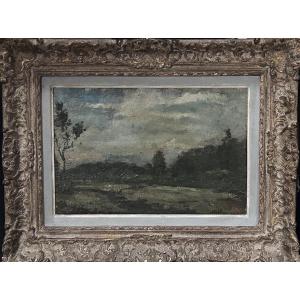
Moonlit Landscape With Mill, Village And Boat. Sebastian Pether (1793–1844)




Oil on panel.
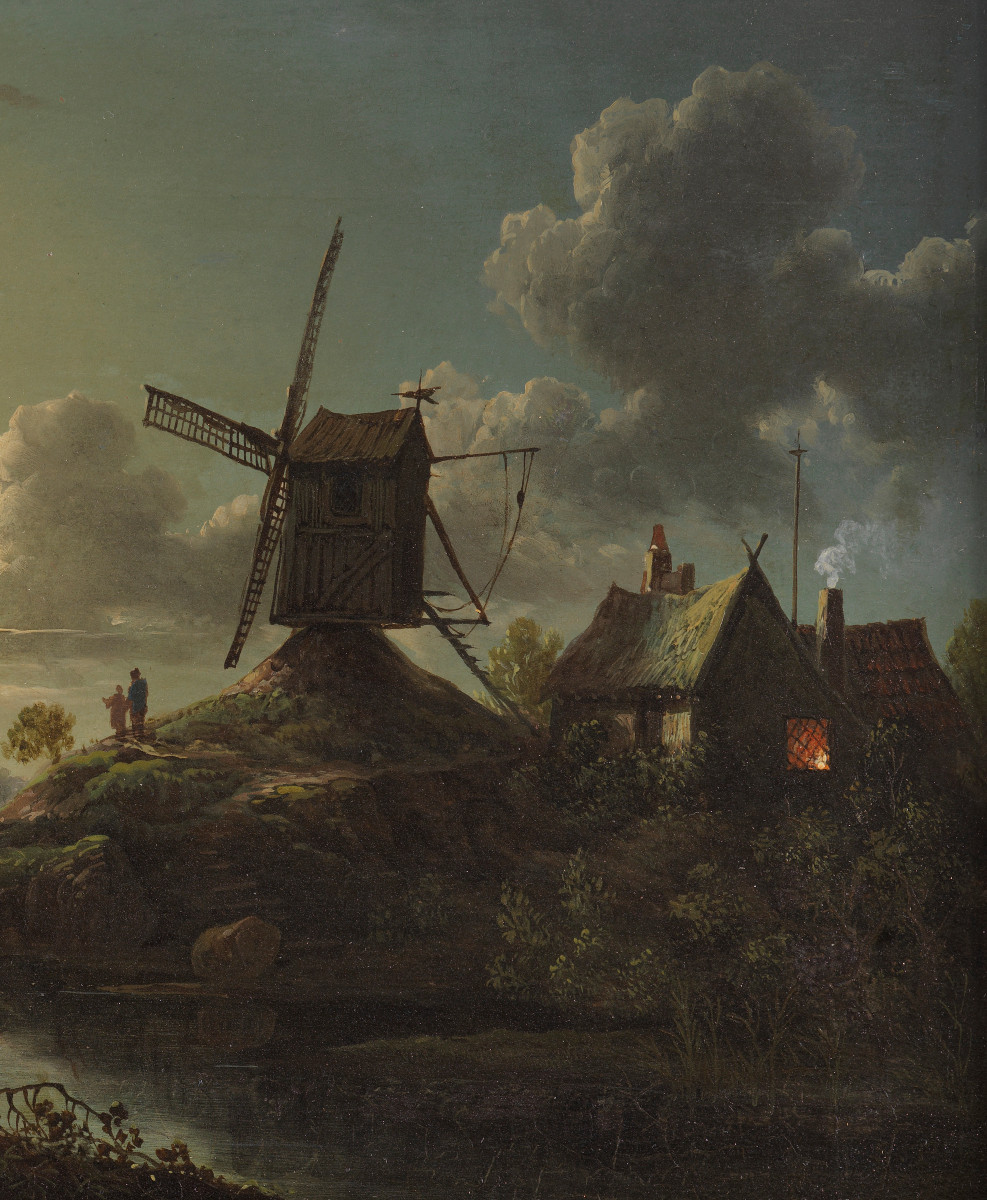
In this nocturnal composition, Sebastian Pether deploys the full subtlety of his lunar palette to orchestrate a rural scene imbued with mystery and serenity. At the center, a windmill with frozen sails stands out against a dramatic sky, bathed in the spectral light of the full moon. Beside it, two thatched cottages suggest human presence: one lets in a warm glow, while a wisp of smoke rises nto the still air. In the foreground, a moored boat, occupied by two indistinct figures, introduces a discreet narrative note, reinforcing the feeling of intimacy and suspended silence.
The opposite bank reveals a village dominated by church steeples, whose silhouettes fade into the silvery mist. The whole is framed by dense vegetation, notably a large tree on the left, whose branches seem to converse with the clouds. True to his taste for chiaroscuro effects and nocturnal scenes, Pether here composes a romantic vision of the rural world, where nature and architecture unite in a contemplative harmony. This painting perfectly illustrates Pether's art, heir to a family tradition of painting lunar landscapes, and is distinguished by his mastery of light, his attention to detail, and his enveloping atmosphere.
We have chosen to present this painting in an 17th-century pearwood veneer molded frame.
Dimensions: 21 x 30.5 cm – 30 x 40 cm with frame
Biography: Sebastian Pether (1793–1844) was born in Chelsea, a suburb of London, into a family of painters specializing in nocturnal landscapes. Trained by his father, Abraham Pether, he inherited a pronounced taste for chiaroscuro effects and scenes bathed in moonlight. Active primarily in London, he exhibited at the Royal Academy and the British Institution, while remaining outside the dominant academic circles. His compositions, often populated with windmills, ruins, and discreet figures, are distinguished by a limited palette and a melancholic atmosphere. Despite a sustained output, he experienced persistent financial difficulties. He died in Battersea, also on the outskirts of London, in great poverty. Rediscovered by lovers of Romantic painting, he is now appreciated for the singularity of his style and the poetry of his nocturnal landscapes.
In this nocturnal composition, Sebastian Pether deploys the full subtlety of his lunar palette to orchestrate a rural scene imbued with mystery and serenity. At the center, a windmill with frozen sails stands out against a dramatic sky, bathed in the spectral light of the full moon. Beside it, two thatched cottages suggest human presence: one lets in a warm glow, while a wisp of smoke rises nto the still air. In the foreground, a moored boat, occupied by two indistinct figures, introduces a discreet narrative note, reinforcing the feeling of intimacy and suspended silence.
The opposite bank reveals a village dominated by church steeples, whose silhouettes fade into the silvery mist. The whole is framed by dense vegetation, notably a large tree on the left, whose branches seem to converse with the clouds. True to his taste for chiaroscuro effects and nocturnal scenes, Pether here composes a romantic vision of the rural world, where nature and architecture unite in a contemplative harmony. This painting perfectly illustrates Pether's art, heir to a family tradition of painting lunar landscapes, and is distinguished by his mastery of light, his attention to detail, and his enveloping atmosphere.
We have chosen to present this painting in an 17th-century pearwood veneer molded frame.
Dimensions: 21 x 30.5 cm – 30 x 40 cm with frame
Biography: Sebastian Pether (1793–1844) was born in Chelsea, a suburb of London, into a family of painters specializing in nocturnal landscapes. Trained by his father, Abraham Pether, he inherited a pronounced taste for chiaroscuro effects and scenes bathed in moonlight. Active primarily in London, he exhibited at the Royal Academy and the British Institution, while remaining outside the dominant academic circles. His compositions, often populated with windmills, ruins, and discreet figures, are distinguished by a limited palette and a melancholic atmosphere. Despite a sustained output, he experienced persistent financial difficulties. He died in Battersea, also on the outskirts of London, in great poverty. Rediscovered by lovers of Romantic painting, he is now appreciated for the singularity of his style and the poetry of his nocturnal landscapes.
Explore similar pieces and discover your ideal find:
Landscapes