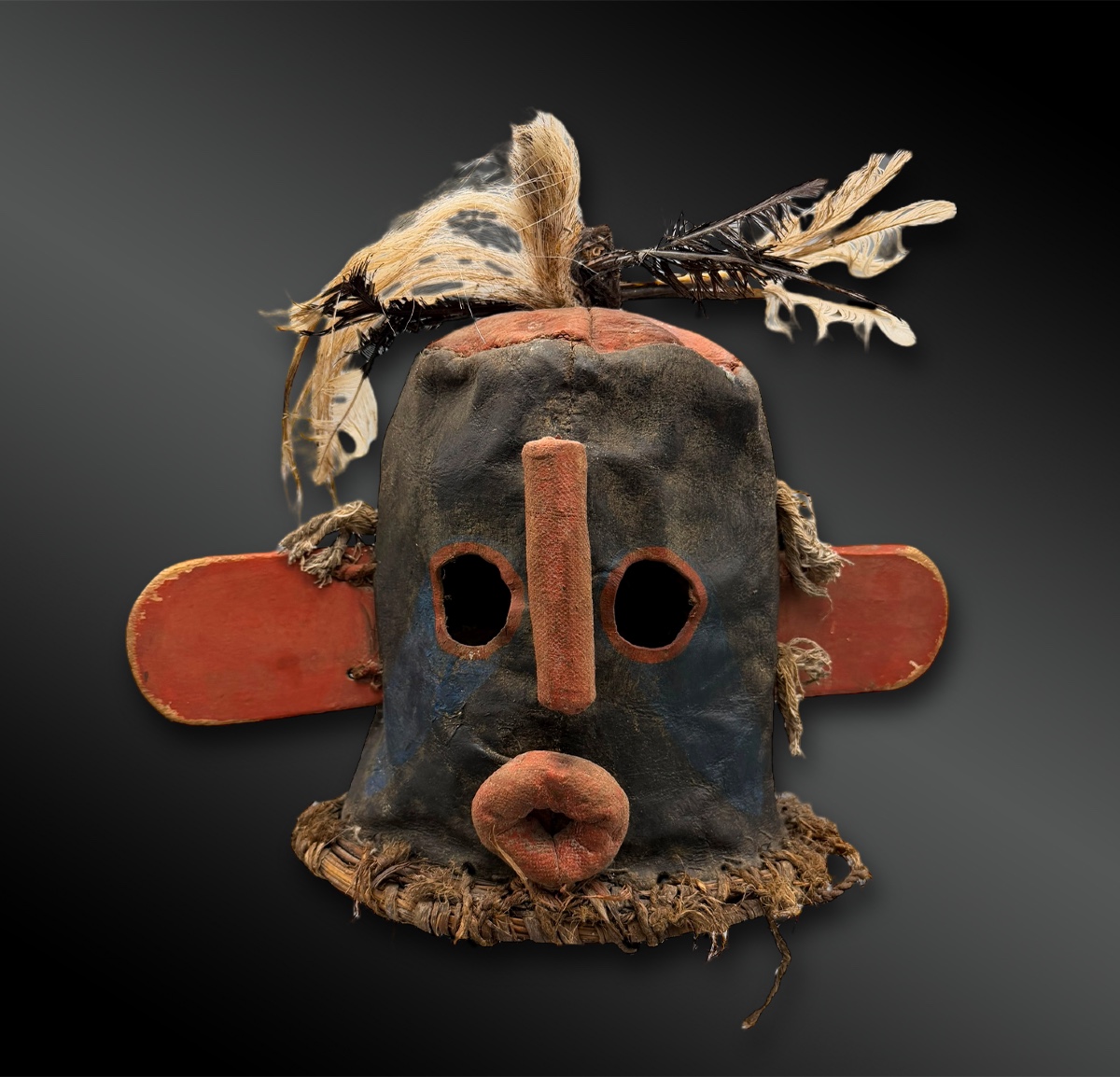





"Mask Representing Heheya - Hopi Culture, Arizona - Circa 1920-1930"
MASK representing HeheyaThe Kachina messenger of the rain gods
Hopi culture, Arizona
Circa 1920–1930
Leather, wood, horsehair, plant fibres and pigments
H: 33; W: 44 cm
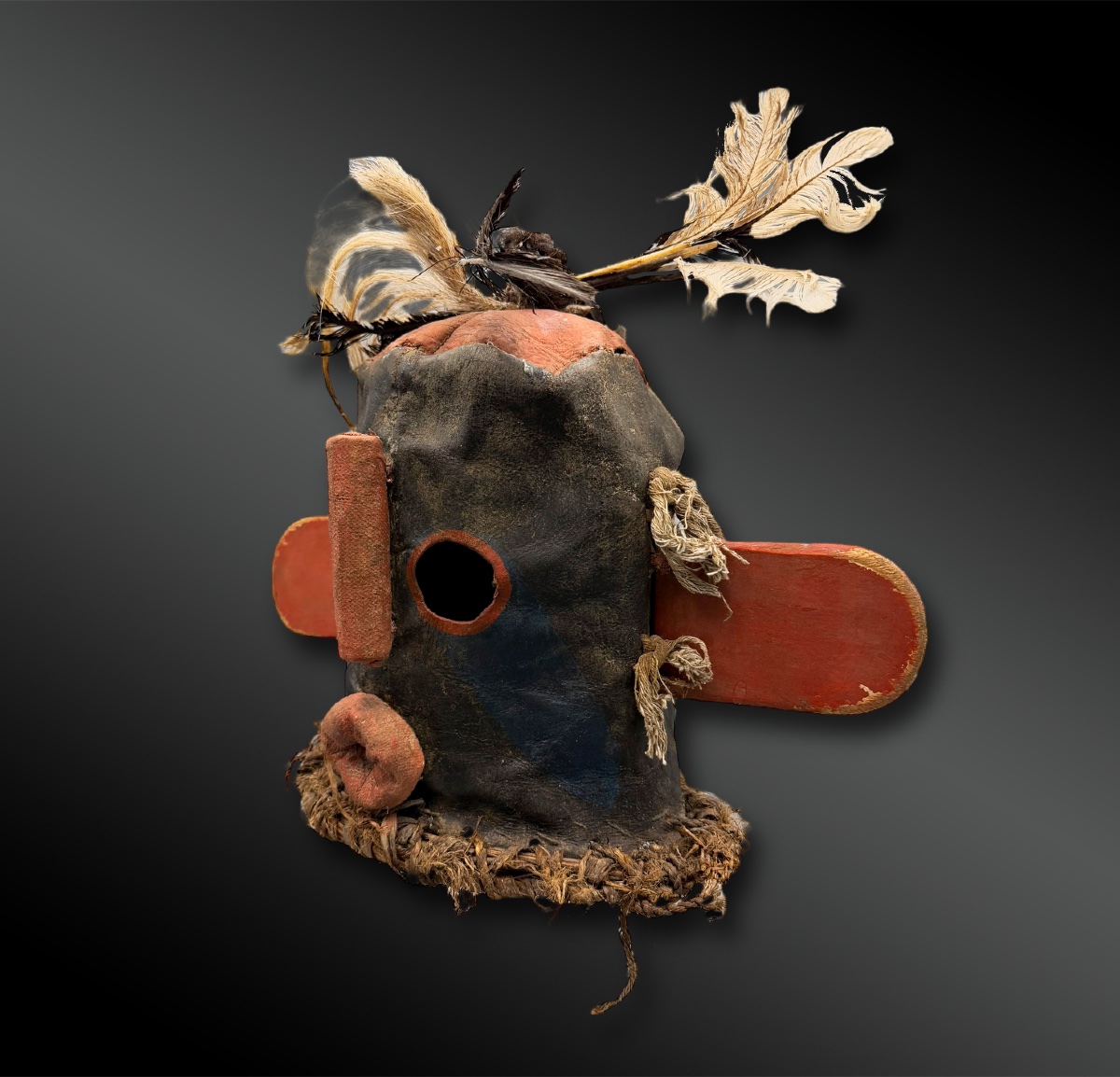
Helmet mask made of leather decorated with polychrome pigments. Heheya is recognisable by his blue-green mask, his wooden ears, his mouth made of fabric and his schematic nose – probably a corn cob covered with cotton. These elements are all pigmented red – a colour also used to outline the circular eye holes. An inverted blue triangle is painted from the top of the nose to the cheeks.
The lower edge of the mask has a rigid structure made of woven plant fibres – the remaining cords remind us of its role: to support the deity's costume.
On the reverse side, the important symbol of the sacred calendar, also known as the horizon calendar, of the mesa dances is painted in red ochre and black on a white background.
Heheya, the kachina messenger of the rain gods, appears during the third mesa.
Illustrative image: Hopi rain ceremony, village of Shungopavi, Arizona, United States, circa 1870 and 1900.
Text and photos © FCP CORIDON
Ref.: 6682












 Le Magazine de PROANTIC
 TRÉSORS Magazine
 Rivista Artiquariato