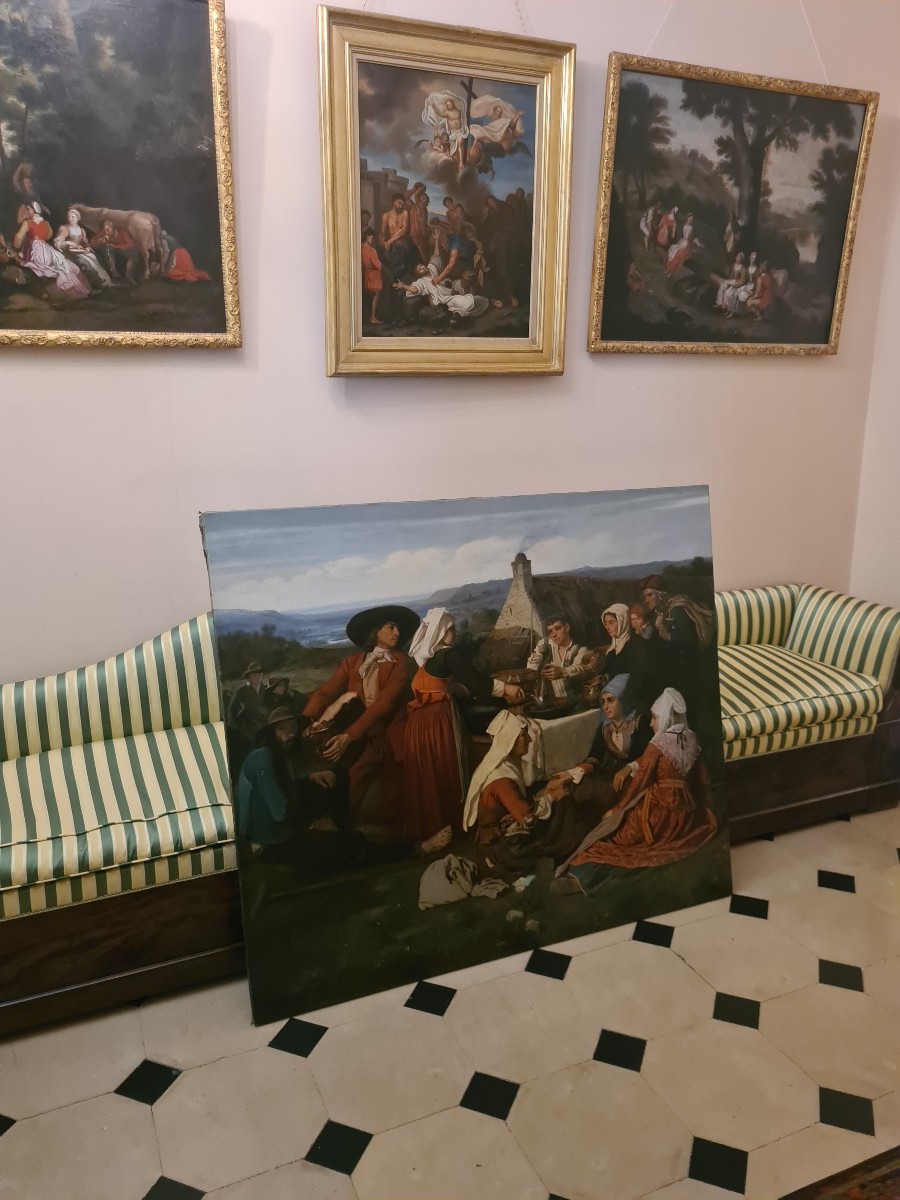


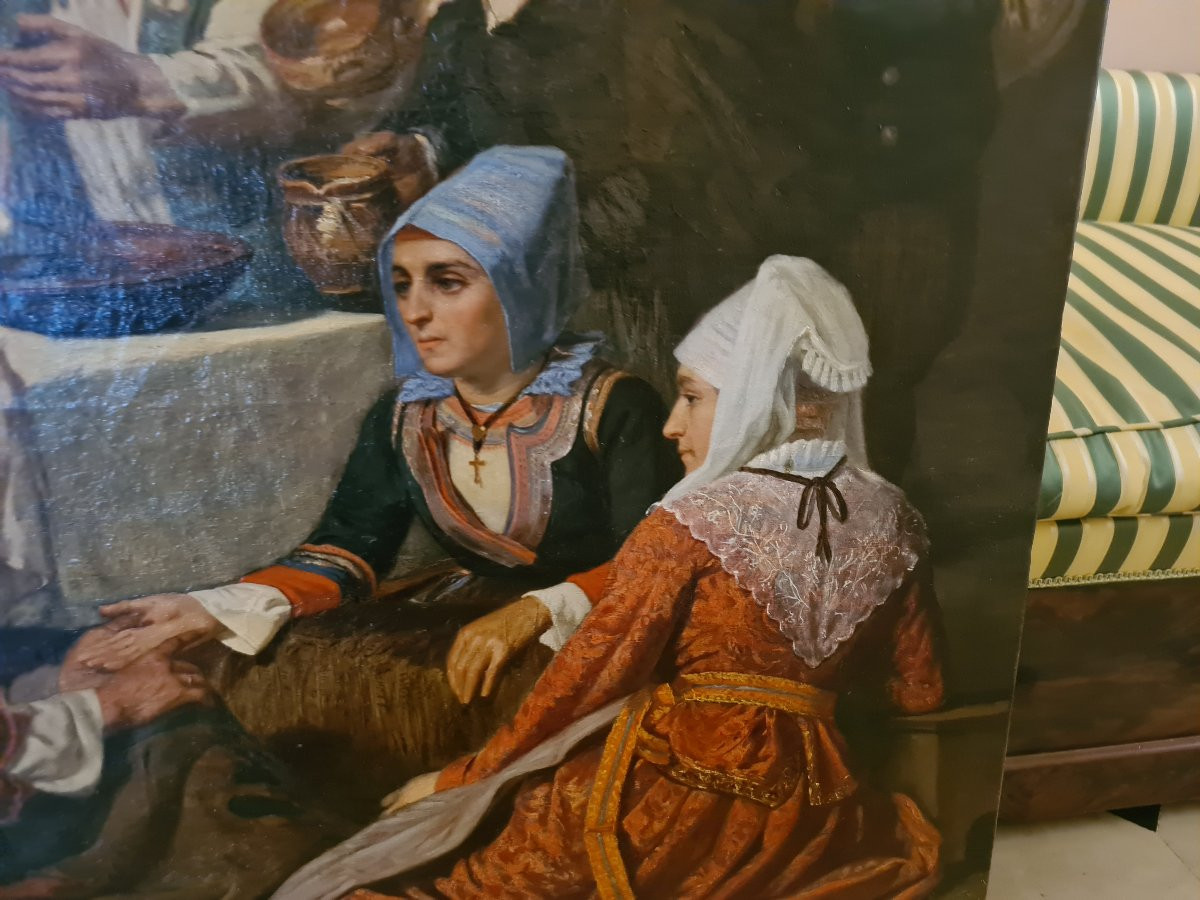
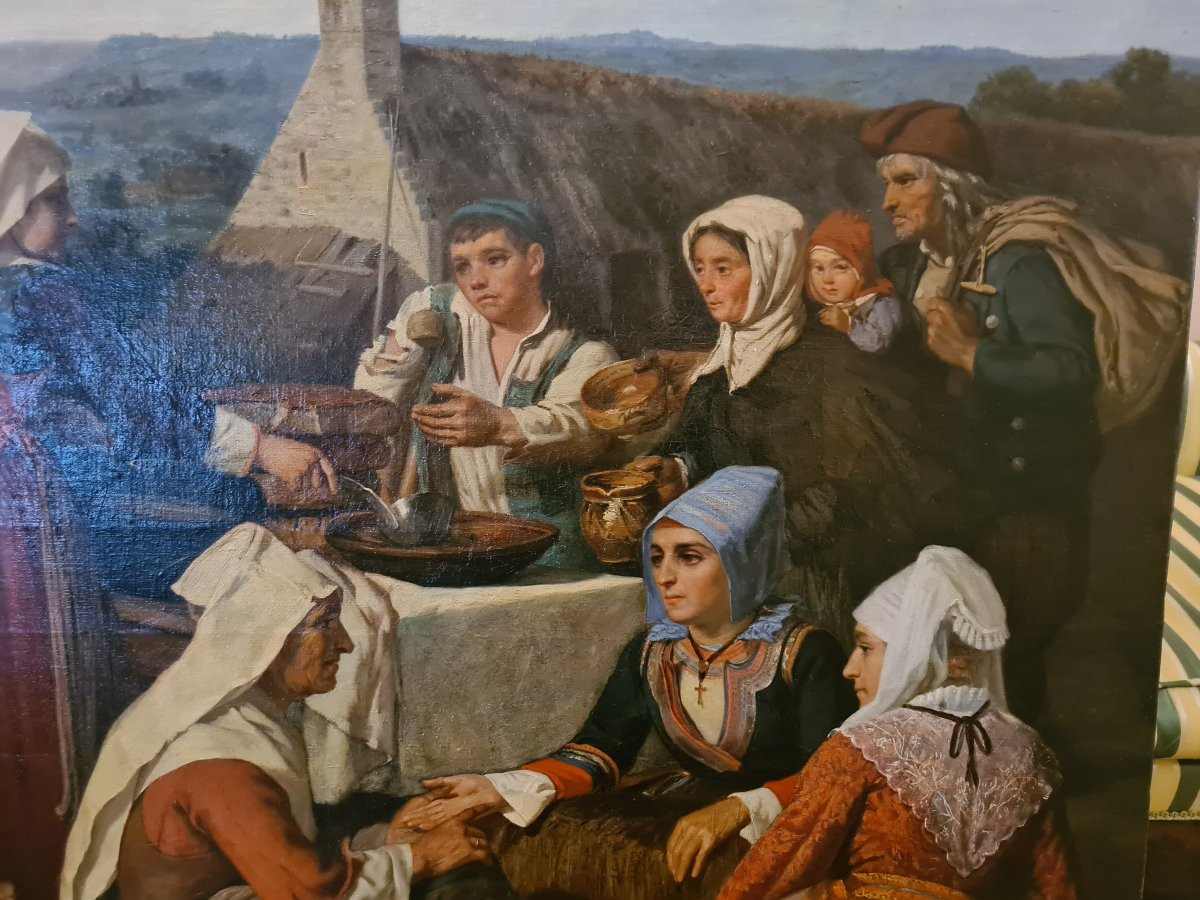
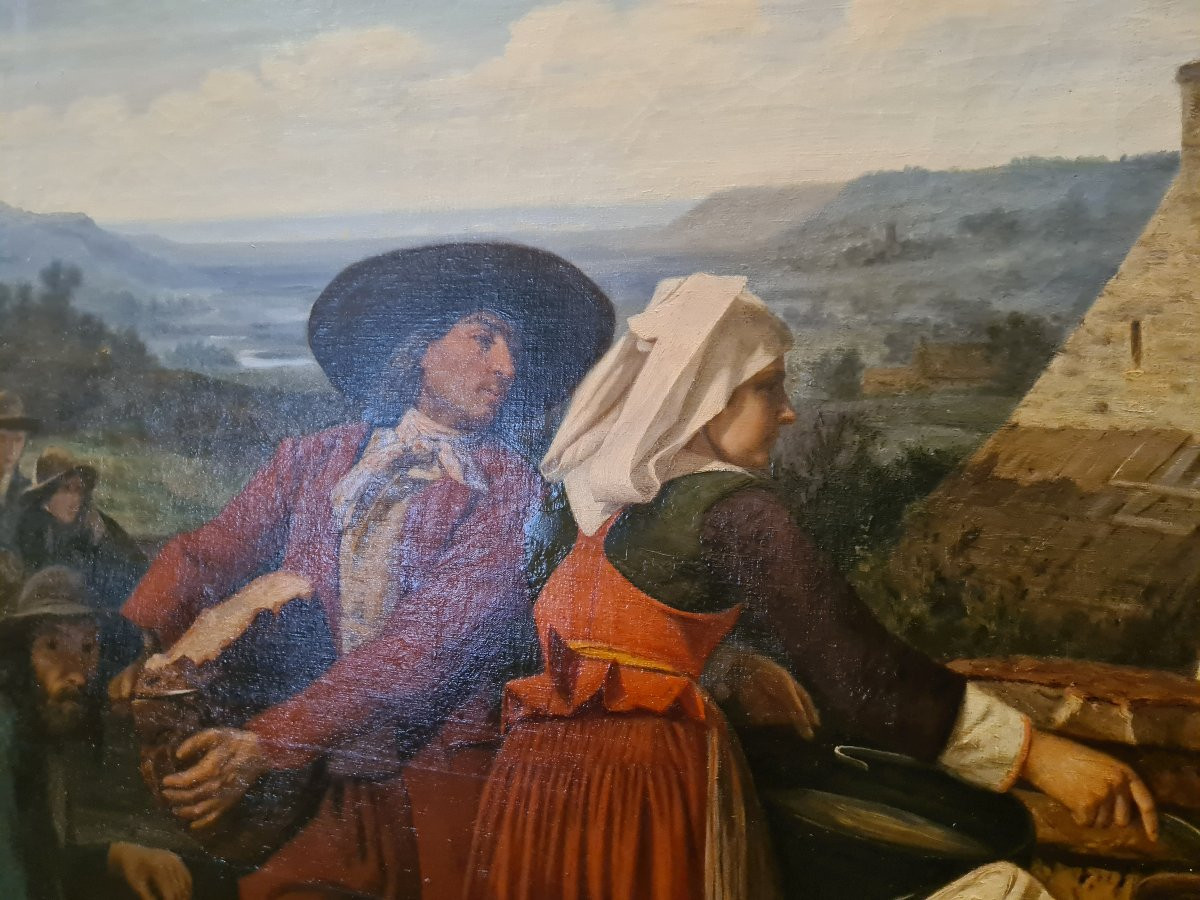


Pierre Charles Poussin (1819-1904) The Beggars' Festival - Dated And Signed 1855 - 119 X 139 Cm
Artist: Pierre Charles Poussin (1819-1904)
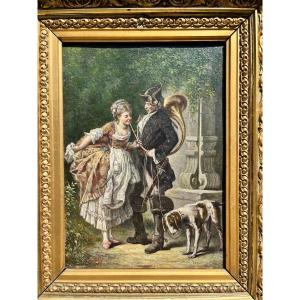
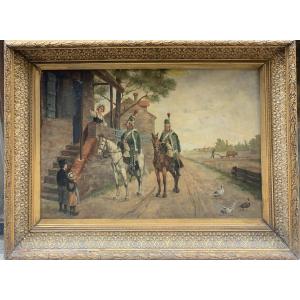
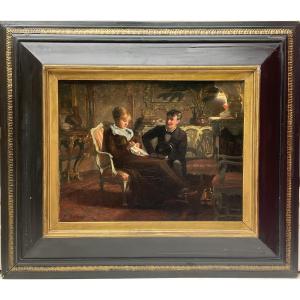
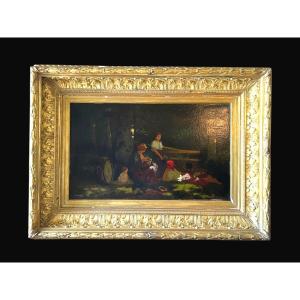
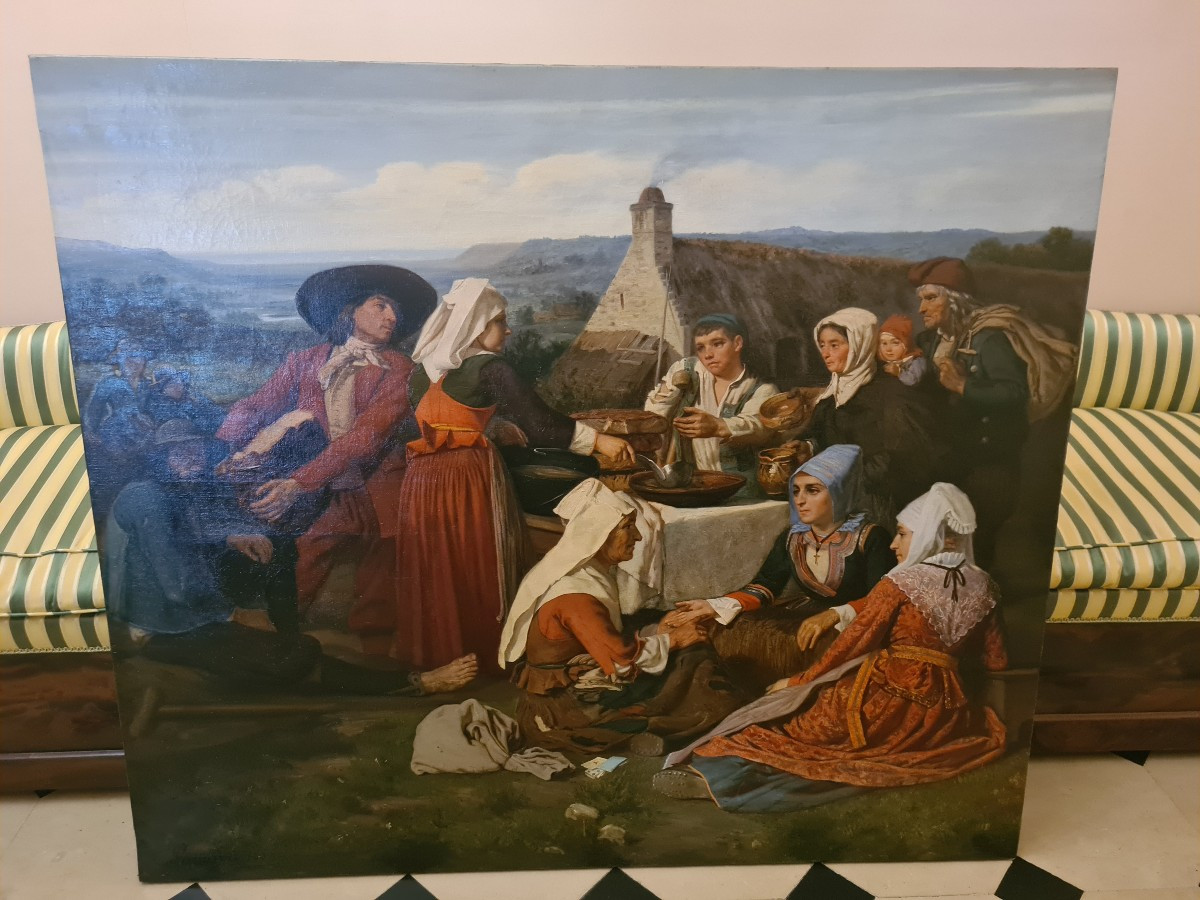
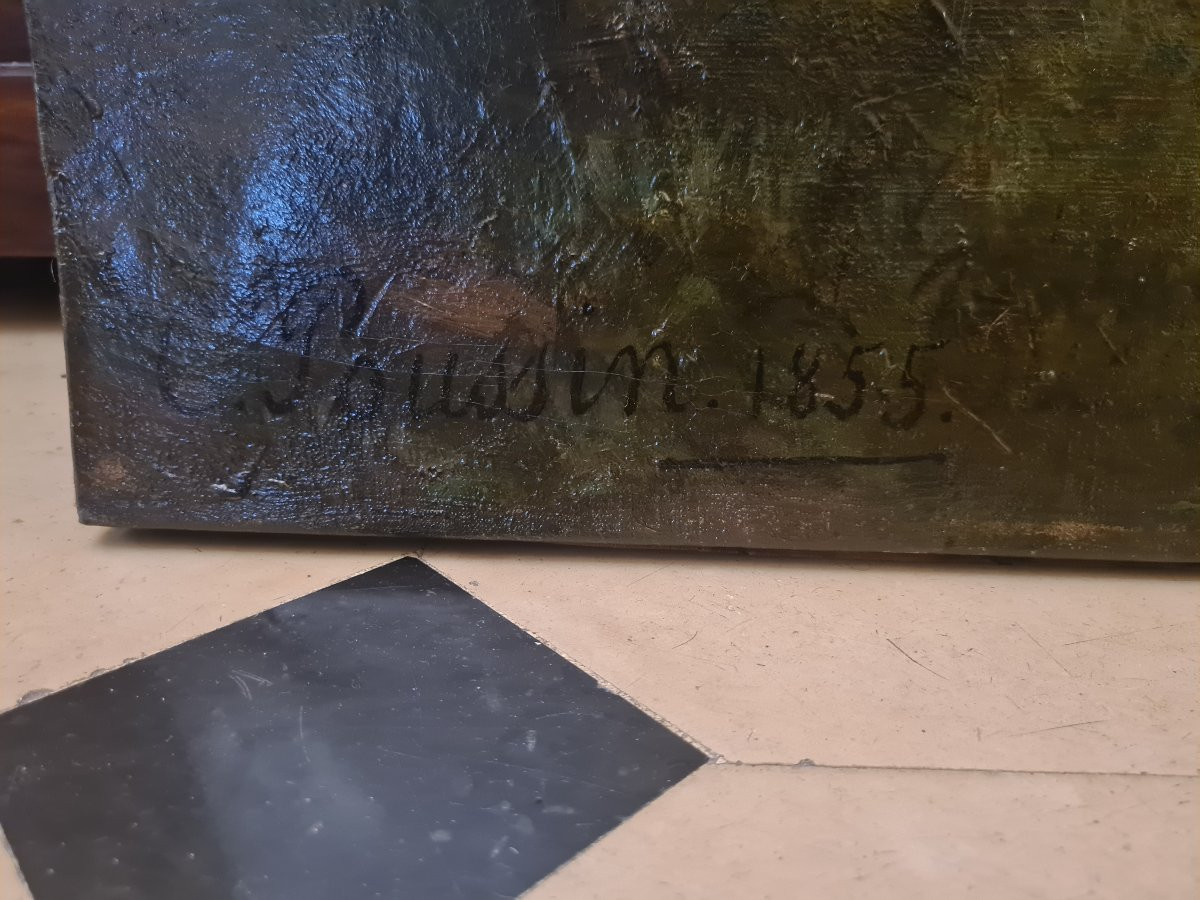
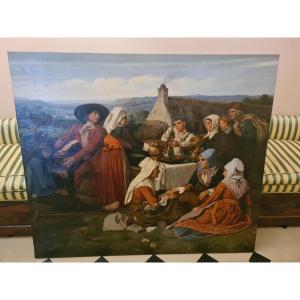
Pierre Charles Poussin (1819-1904) The Beggars' Festival, the Day After the Wedding (Finistère) On its original canvas - 119 x 139 cm Signed and dated lower left C. Poussin 1855 Exhibition: Paris, Salon of 1855, no. 3825 Perfect condition, both the frame and the painting, which has been cleaned by our restorer to revive the colors and restore its full brilliance.
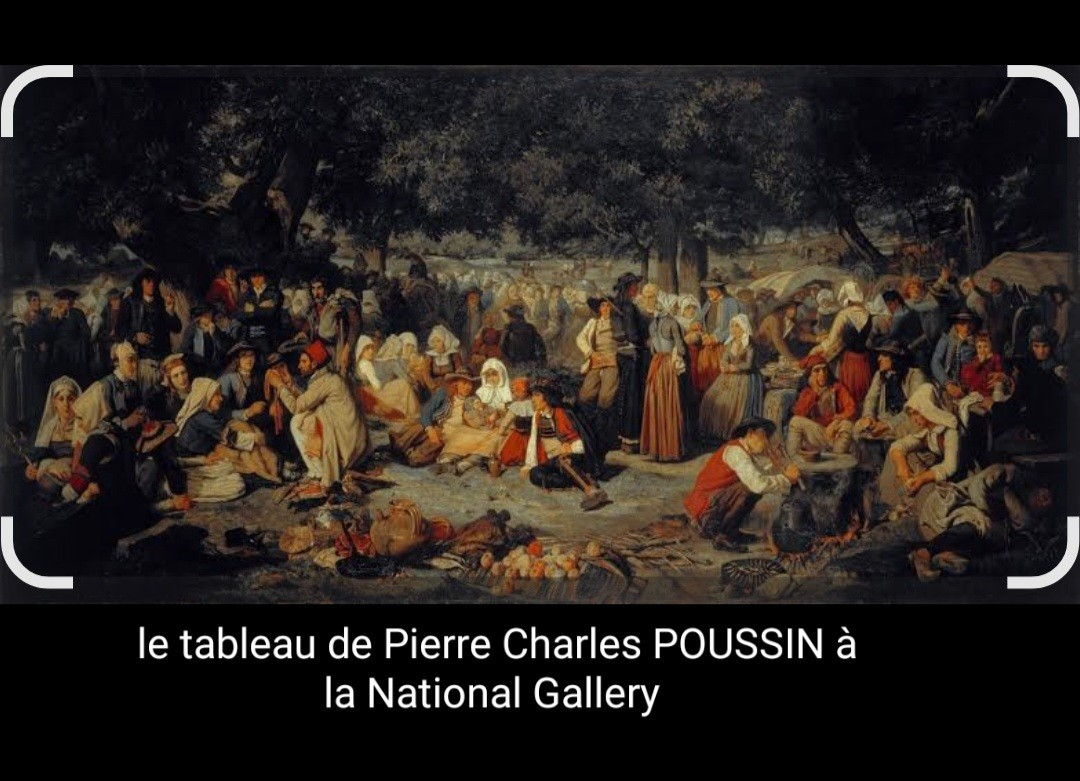
Biography of Pierre Charles Poussin (1819-1904): He was a student of the painter Léon Cogniet, an artist renowned for his classical technique and teaching. He debuted at the Paris Salon in 1842, which opened the doors to the official art world of the time. Poussin is primarily known as a genre painter, but he also painted portraits and landscapes. He exhibited regularly, and several of his works were shown at the Salon, one of the main showcases for art in 19th-century France. One of his most famous works is *Pardon Day in Brittany* (1851), a large genre scene (146 x 327 cm) depicting a traditional Breton religious festival. It is part of the collection of the National Gallery in London (see photo). It is dated 1851, four years before our painting, and corresponds to Pierre-Charles Poussin's "Breton" period. His best work.
Condition report: We purchased this painting, which had not been touched since 1855, therefore it has its original frame and canvas. Our workshop only carried out a thorough cleaning. With very little damage, just some dirt, it is now vibrant and allows one to admire all the small details of the composition.
A painting exhibited at the 1855 Salon: In 1855, under the Second Empire, the annual Salon of painting was suspended and integrated into the first Universal Exhibition held in Paris, which brought together not only industry and agriculture, but also the fine arts. The art section of this exhibition took place at the Palais des Beaux-Arts (Avenue Montaigne), a temporary building constructed specifically for the occasion. The idea was to offer a kind of international "mega-Salon" without geographical or historical boundaries, bringing together works by painters, sculptors, and architects from across Europe and the United States before a jury of sixty members. Among the major artists exhibited and the significant events: - Jean-Auguste-Dominique Ingres: a major retrospective of his work (e.g., Oedipus, Saint Symphorien). - Eugène Delacroix: a significant selection including famous paintings such as Women of Algiers. - Realistic and landscape painting (Corot, Rousseau, Millet). - A large number of works by foreign artists were also represented. The exhibition comprised several thousand works in all artistic categories and was a major event in Parisian cultural life. A very significant episode of that year was Gustave Courbet's reaction: Courbet submitted several canvases to the exhibition, but the two major works he considered essential (A Burial at Ornans and The Painter's Studio) were rejected by the jury. In response, he had a "Pavilion of Realism" erected at his own expense next to the Palais des Beaux-Arts, where he exhibited about forty of his paintings, including these two rejected works. This is considered one of the first important counter-exhibitions in art history. Twenty years before the Impressionists, Courbet was thus showing the way…
Biography of Pierre Charles Poussin (1819-1904): He was a student of the painter Léon Cogniet, an artist renowned for his classical technique and teaching. He debuted at the Paris Salon in 1842, which opened the doors to the official art world of the time. Poussin is primarily known as a genre painter, but he also painted portraits and landscapes. He exhibited regularly, and several of his works were shown at the Salon, one of the main showcases for art in 19th-century France. One of his most famous works is *Pardon Day in Brittany* (1851), a large genre scene (146 x 327 cm) depicting a traditional Breton religious festival. It is part of the collection of the National Gallery in London (see photo). It is dated 1851, four years before our painting, and corresponds to Pierre-Charles Poussin's "Breton" period. His best work.
Condition report: We purchased this painting, which had not been touched since 1855, therefore it has its original frame and canvas. Our workshop only carried out a thorough cleaning. With very little damage, just some dirt, it is now vibrant and allows one to admire all the small details of the composition.
A painting exhibited at the 1855 Salon: In 1855, under the Second Empire, the annual Salon of painting was suspended and integrated into the first Universal Exhibition held in Paris, which brought together not only industry and agriculture, but also the fine arts. The art section of this exhibition took place at the Palais des Beaux-Arts (Avenue Montaigne), a temporary building constructed specifically for the occasion. The idea was to offer a kind of international "mega-Salon" without geographical or historical boundaries, bringing together works by painters, sculptors, and architects from across Europe and the United States before a jury of sixty members. Among the major artists exhibited and the significant events: - Jean-Auguste-Dominique Ingres: a major retrospective of his work (e.g., Oedipus, Saint Symphorien). - Eugène Delacroix: a significant selection including famous paintings such as Women of Algiers. - Realistic and landscape painting (Corot, Rousseau, Millet). - A large number of works by foreign artists were also represented. The exhibition comprised several thousand works in all artistic categories and was a major event in Parisian cultural life. A very significant episode of that year was Gustave Courbet's reaction: Courbet submitted several canvases to the exhibition, but the two major works he considered essential (A Burial at Ornans and The Painter's Studio) were rejected by the jury. In response, he had a "Pavilion of Realism" erected at his own expense next to the Palais des Beaux-Arts, where he exhibited about forty of his paintings, including these two rejected works. This is considered one of the first important counter-exhibitions in art history. Twenty years before the Impressionists, Courbet was thus showing the way…
12 000 €
Period: 19th century
Style: Napoleon 3rd
Condition: Perfect condition
Material: Oil painting
Width: 119
Height: 139
Reference (ID): 1691137
Availability: In stock
Print