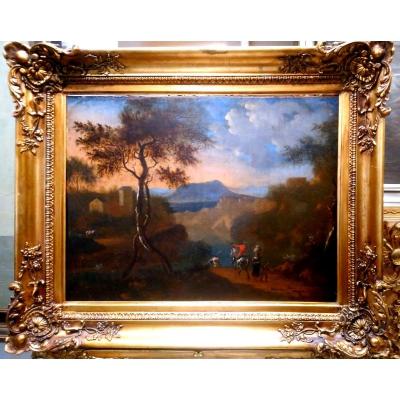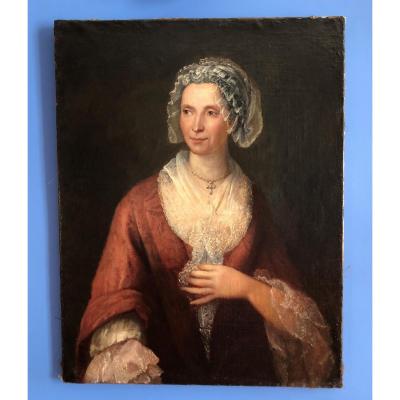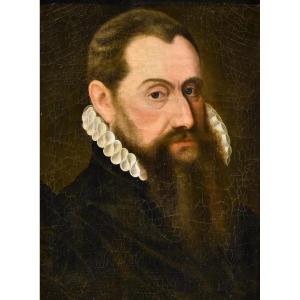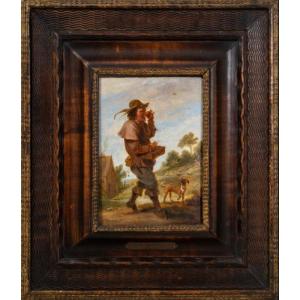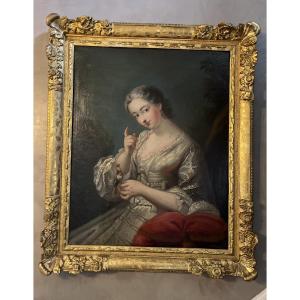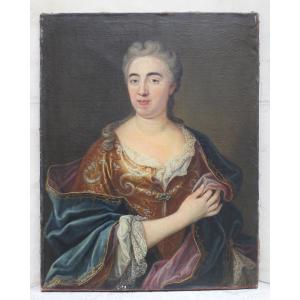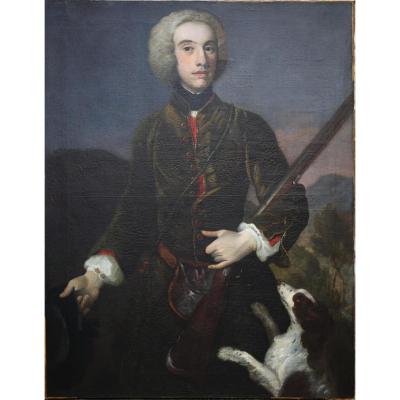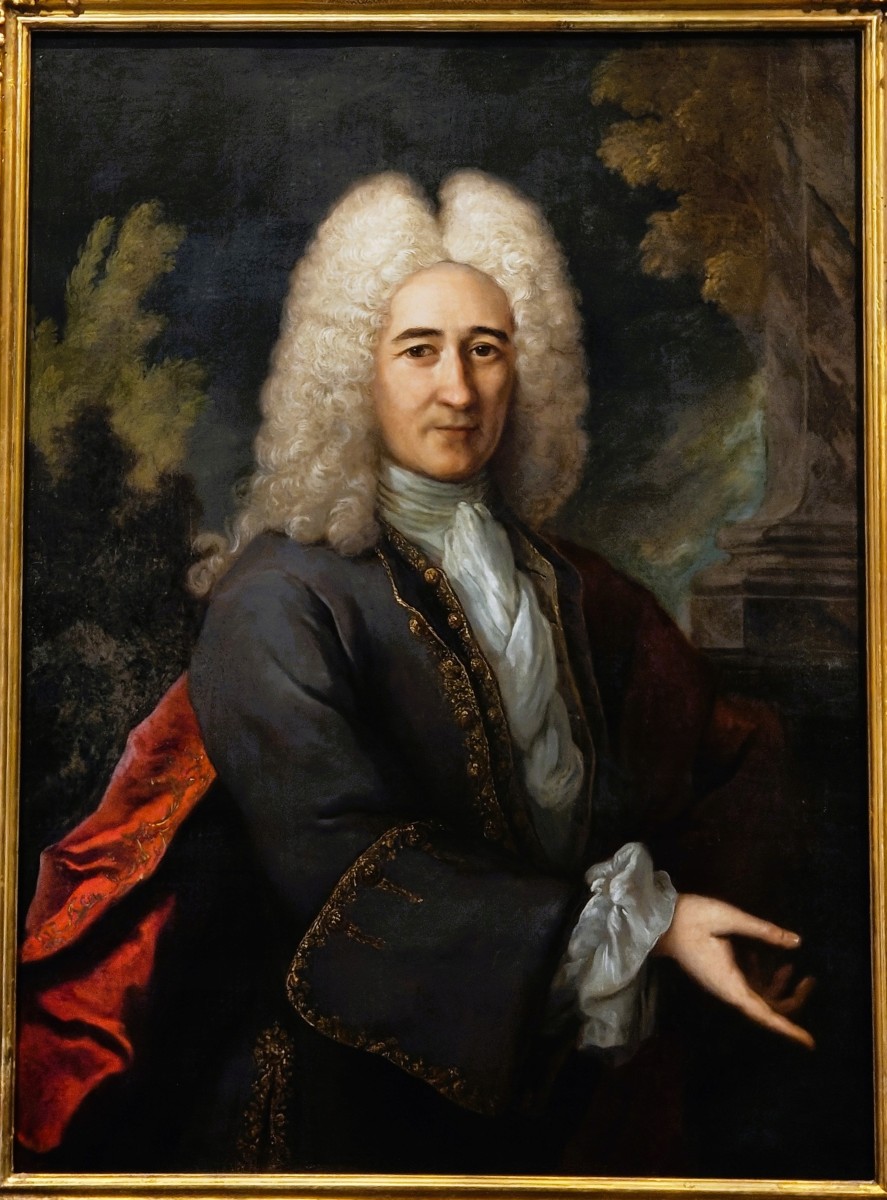
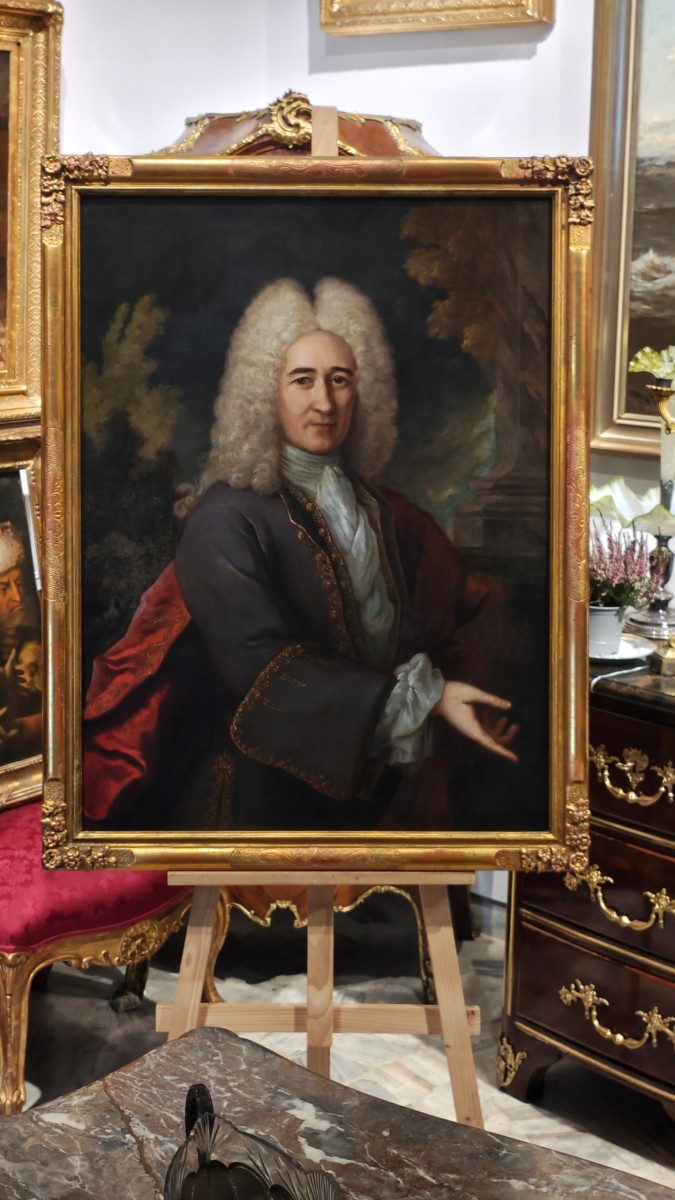
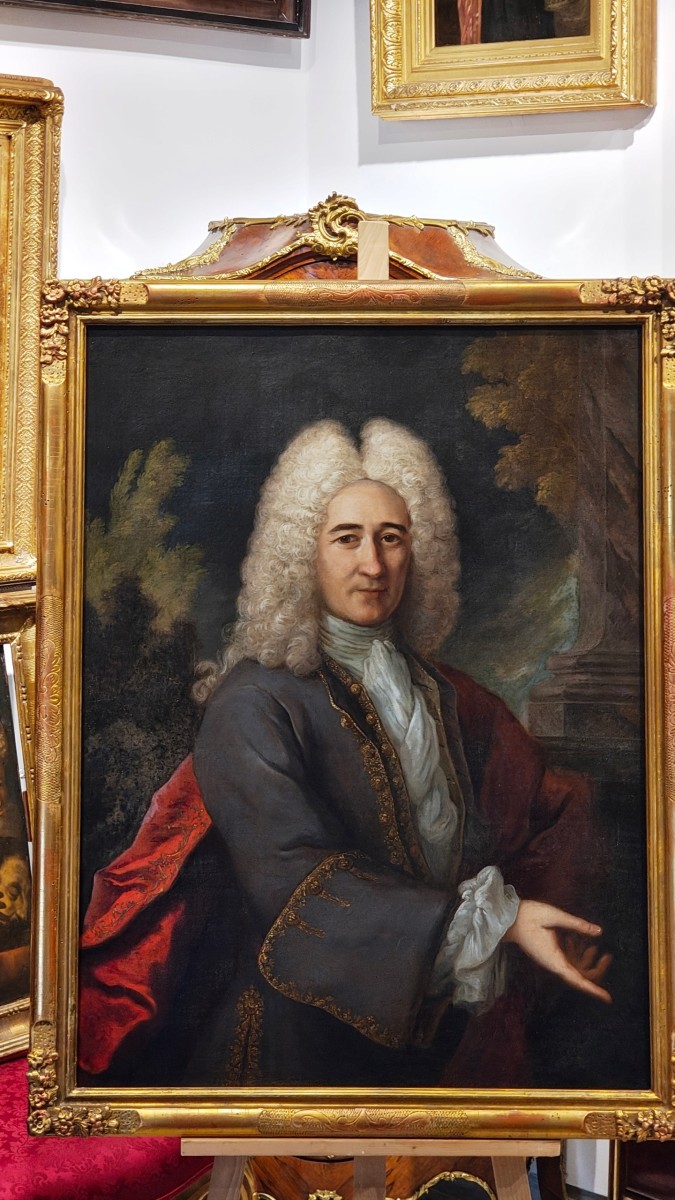
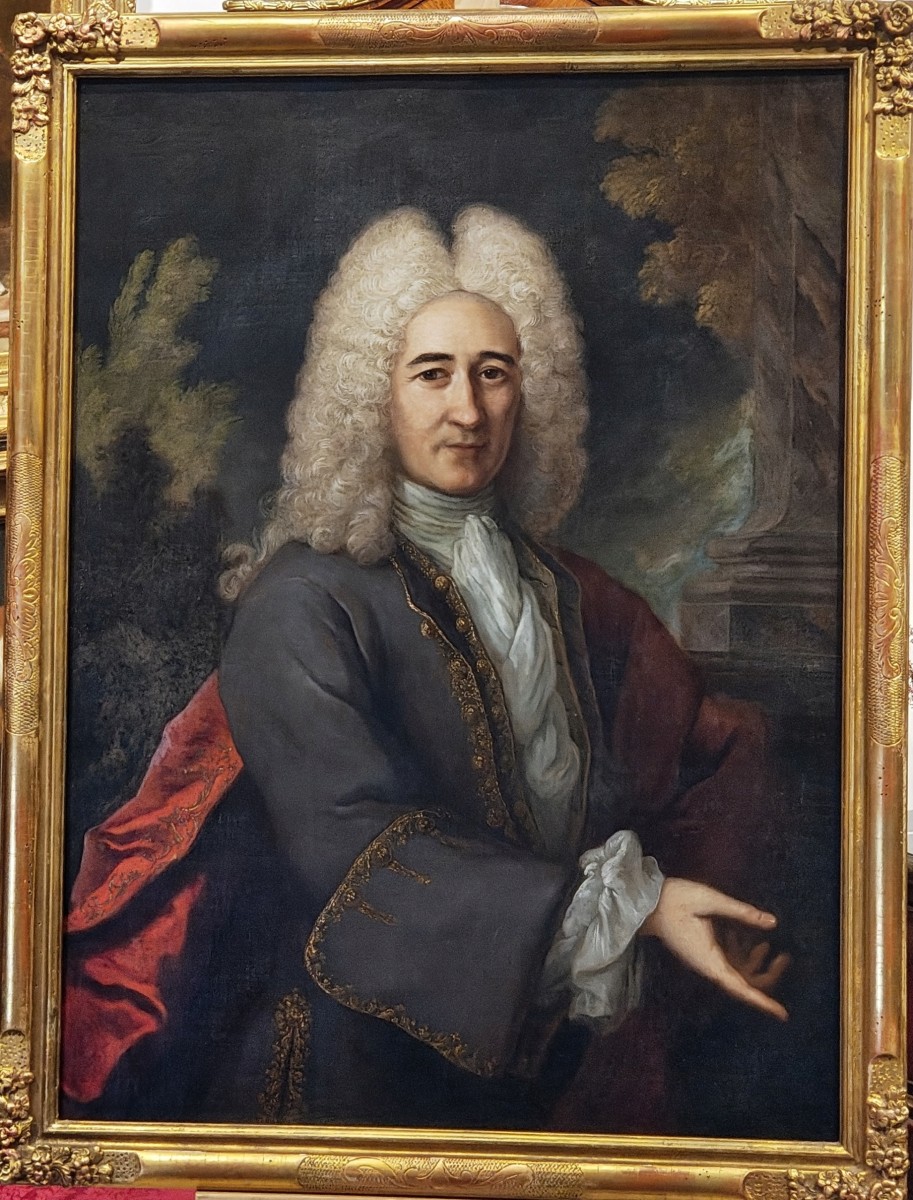


Portrait Of A Man In A Scarlet Shawl By Nicolas De Largillierre, 17th/18th Century
Artist: Nicolas De Largillierre
Portrait of a Man in a Scarlet Shawl by Nicolas de Largillierre, 17th/18th century
In the collections of, among others, the Portrait of the Assessor of the City of Paris at the Royal Łazienki Museum
Nicolas de Largillierre [a], born on October 2, 1656, in Paris, where he died on March 20, 1746, was a French painter. He is one of the most famous portrait painters of the 17th and 18th centuries.
Biography
The son of a hat merchant, Largillierre spent his childhood in Antwerp, where his family moved in 1659. In 1665, he was sent to England to learn the craft with a London merchant who had taken an interest in him. But, seeing that he was spending his time drawing, his father, a merchant in French goods, brought him back after twenty months and decided, despite great resistance, to allow him to follow his own inclinations [1].
Training
From 1668, he apprenticed in Antwerp in the studio of the painter Antoine Goubeau [1], a painter of landscapes and bamboos. Goubeau imparted to him a love of color and chiaroscuro characteristic of the Flemish school and hired him, as soon as he learned to use a brush, to paint accessories in his paintings—fruit, flowers, fish, and vegetables. Wanting to try his hand at a historical work, Largillierre secretly painted a Holy Family. When his master asked him whom he had copied, Largillierre replied that he had only consulted his own genius. Eighteen months later, Goubeau told him he had nothing more to teach him. In 1673, he was accepted as a free master of the Saint-Luc guild in Antwerp [1].
In England from 1675 to 1679
He found a successor to Van Dyck, Peter Lely, for whom Cromwell's patronage secured a prominent place among the courtiers. Overwhelmed with commissions, Lely, in need of help, added him to the ranks of his collaborators, painting draperies, accessories, and flowers for his paintings. After witnessing the restoration of paintings in Flanders, Lely recommended him to the King's Superintendent of Buildings, who commissioned him to restore several Old Masters, including canvases intended for the decoration of Windsor Castle, which required frequent alterations, enlargements, and retouching, the format of which was subsequently modified to accommodate the space they required in the royal apartments. His skill in repairing Old Master paintings and repainting certain sections brought him to the attention of King Charles II. One day, surprised to discover such great talent in such a young boy, and seeing the most damaged of these paintings – the Sleeping Cupid, whose legs the young painter had painted with the skill of a true artist – he said in French to the adults around him:
"Look at this child, you would never believe it if you hadn't seen him, because he's only a child [2]."
He became interested and asked him to show him works made entirely by his own hand. Largillierre produced three, enough to immediately secure royal favor [3].
Largillierre's fortunes seemed established at the English court, and he was considering settling in London, where he was so well received. But at the same time, religious strife in the country flared up again when Parliament began persecuting Catholics, and foreigners of that faith were ordered to leave the country [1]. Returning to Paris in 1678, after four years in England, he soon attracted attention with several beautiful portraits [3].
Returning to Paris in 1679
In London, he met Jan Frans van Bloemen, Jan Siberechts, and the painter and sculptor Pieter van der Meulen, brother of the famous Adam François van der Meulen, then painter and historiographer to Louis XIV. In Paris, he visited van der Meulen at the Gobelins, relayed news of his brother, and gained his friendship by presenting him with a magnificent portrait, in return for which van der Meulen gave him his engravings: these include engravings by Audran, Bonnart, and Boudewyns.
Upon seeing van der Meulen's portrait, Charles Le Brun, the king's first painter, promised Largillierre his protection, and he promised to return to England as soon as circumstances permitted. Similarly, when the King of England's overseer of buildings wrote to him offering him the position of custodian of the royal paintings, Le Brun replied, "Why take your talents abroad when you can shine in your own country? [3]" Largillierre declined.
Largillierre's reputation quickly grew. Settling in France, he left Paris only once: in 1685, after the accession of King James II, whom he could not refuse to paint his portrait and that of the queen. He painted a portrait of the king dressed in armor, with a huge wig and a plume of feathers on his helmet placed beside him. He also painted a portrait of the Queen, which he decorated with lace and brocade, a portrait of the Prince of Wales, Sir John Warner, his daughter, and his granddaughter. His stay in London was short, and Largillierre returned to Paris. This was not a permanent return, for, knowing that the English nobility could
When he was offered very lucrative prices for his portraits, he returned to London, where he quickly realized that English painters were very hostile towards him, which led him to return to France permanently [2].
Fashionable in France since 1689
Returning to France, from 1689 onward, he became one of the most sought-after painters and embodied the quintessence of a renowned French painter [4]. Alternating between official commissions for votive offerings and allegories, he painted portraits of the nobility and the upper middle class, thanks to which his talent allowed him to climb the ladder of the Royal Academy of Painting and Sculpture, where he was accepted on March 30, 1686, not only as a portraitist but also as a history painter, whose full-length portrait of Le Brun (Paris, Louvre) was a prized possession [3]. He was appointed assistant professor on July 4, 1699, professor on June 30, 1705, vice-rector on April 24, 1717, rector on January 10, 1722, director on July 5, 1738, and finally chancellor on May 30, 1743. He participated in the Salons of 1699 and 1704. [1]
With Marguerite-Élisabeth Forest, daughter of the landscape painter Jean Forest, a royal painter and officer of the Academy, whom he married in 1699, Largillierre had two daughters and a son: Élisabeth-Marguerite (1701); Marguerite-Élisabeth (1703); and Nicolas (1701-1742), an advisor at Châtelet, who died before him. There is an interesting portrait of his father-in-law (Palace of Fine Arts in Lille), in which he admits his debt to Rembrandt, Rubens and Van Dyck [ 4 ]. In his History of Painters, Charles Blanc writes of this painting: "Forest was an original, capricious man. His son-in-law took pleasure in painting him in the strange attire that was familiar to him, especially since he must have been tired of constantly seeing the same models: officials in folio wigs and townspeople in sausage wigs. So he depicted his father-in-law with short hair, a sort of margrave's cap with a silk base, and a fur-lined gelding. Seated in an armchair, with his hand, a wiggling eyebrow, a moist eye, the portrait breathes, is alive. Largillierre had it engraved at his own expense by Drevet's father [3] :6.
Largillierre died of paralysis in the beautiful Parisian residence he had built on the rue Geoffroy-l'Angevin, which he decorated with landscapes, flowers and fruit, several hundred portraits, and several religious paintings. He was buried in Paris in the Church of Saint-Merri." Charles Blanc describes him as "full of sincerity and joy [ 3 ]" and "loved by all [ 3 ]."
Work of Art
Detailed article: List of paintings by Nicolas de Largillierre.
Largillierre is the most complete artist of his generation [ 5 ]. This multi-talented painter was equally at home with still lifes and history paintings, landscapes, and portraits; his technical mastery allowed him to play with materials, colors, and light without making it a cold exercise. While he distinguished himself with a few history paintings, he devoted himself more particularly, without renouncing the greatness of painting, to the genre of portraiture, in which he excelled, especially in the case of women, where he was able to disentangle in their faces the qualities that constitute both beauty and character. Without leaving the model, he was able to discover unnoticed charms and enhance apparent beauties, making women all the more susceptible to the flattery of his brush, for he seemed to express only the truth, and upon viewing their portrait, one considered them similar before one considered them beautiful. The city of Paris, after hosting a meal for Louis XIV on the occasion of his convalescence in 1687, wanted to commemorate that memorable meal. Largillierre was chosen to paint it, and, as if understanding what the officers of the municipal corps truly desired, he painted their full-length portrait in the foreground, giving them a few insignificant gestures to have the opportunity to paint beautiful hands in the style of Van Dyck, Louis XIV and his court appearing only in a painting hanging on the wall [ 6 ]. His portraits, in the Flemish tradition of Rubens and van Dyck [7], always retain the vitality and sensitivity that make him one of the greatest painters of the reign of Louis XIV and the Regency. Upon his death, he left behind 4,500 portraits [3].
Forgotten at the expense of his "rival" and friend Hyacinthe Rigaud, who was supposed to be the official painter of the high nobility, Largillierre was primarily a painter of the high bourgeoisie [b]. He constitutes a link between the age of Louis XIV and the Age of Enlightenment [8] and deserves rediscovery and a rightful place in French art [c].
He influenced painters such as Petrus Johannes van Reysschoot, a Flemish painter active in London.
Gallery
Margaret Elizabeth and her son Nicholas, 1712, National Museum of Fine Arts of Argentina.
Portrait of Louis-Etienne Boullenois, 1705, oil on canvas, (oval canvas): 80 × 62 cm, private collection, Paris.
Marguerite de Largilliere, 1726, Palais des Beaux-Arts, Lille.
Portrait of Mr. Laurent
Aged 92, 1730, oil on canvas, 82 × 64.5 cm, private collection, Paris.
Studies of the Hand (circa 1714), Paris, Louvre Museum.
La Belle Strasbourgeoise, 1703, oil on canvas, Strasbourg, Museum of Fine Arts.
Portrait of La Bruyère (circa 1690), Quimper Museum of Fine Arts.
Portrait of M. de Vermont (circa 1697), Pasadena, Norton Simon Museum.
Portrait of Fontenelle, Chartres Museum of Fine Arts.
Portrait of Charles le Brun, 1686, oil on canvas, Paris, Louvre
Some works in public collections
Portrait of the Assessor of the City of Paris, Royal Łazienki Museum
Historical paintings, still lifes, and other subjects:
Still Life with a Musical Instrument, 1695-1700, 79 × 87.3 cm, Quimper, Museum of Fine Arts;
Still Life with Fruit, c. 1695-1700, oil on canvas, 77 × 97.5 cm, Amiens, Musée de Picardie
Red-legged Partridge in a Niche, c. 1680-1685, oil on canvas, 71.5 × 58.5 cm, Paris, Petit Palais
Composition with Curtains, Landscape, and Animals, detail of the artist's home decoration, 1725-1730, oil on canvas, 261 × 251 cm [10]
Portraits:
Portrait of a Woman as Diana, Algiers, National Museum of Fine Arts, Algiers;
The Stoppa family [11], circa 1685, oil on canvas, 250 × 350 cm, Château-Thierry, Hôtel-Dieu Museum [archive];
Portrait of Charles Le Brun (1619-1690), first painter of King Louis XIV (1686), reception hall of the Royal Academy of Painting and Sculpture, 1686, oil on canvas, 232 × 187 cm, Louvre [J 1]
Portrait of La Bruyère (circa 1690), Quimper Museum of Fine Arts
Marquis de Rasilly, 1690, oil on canvas, 138 × 103 cm, Jacquemart-André de Chaalis Museum
La Belle Strasbourgeoise (circa 1703), Museum of Fine Arts, Strasbourg;
Portrait of President Jean Bouhier (1704), oil on canvas, 85 × 67 cm, Dijon, Museum of Fine Arts of Dijon;
Self-Portrait (1711), Museum of the Palace of Versailles [J 2];
Monsieur de Noirmont (c. 1690-1710), Lisbon, Museu Nacional de Arte Antiga;
Jean-Baptiste Rousseau's Portrait in the Forest (1704), oil on canvas, 129 x 96 cm, Palais des Beaux-Arts, Lille [J 3]
Portrait of Jean-Baptiste Rousseau, 1710, oil on canvas, 90 x 72 cm, Uffizi Gallery, Florence [12]
Mademoiselle Duclos de Châteauneuf (1712), Chantilly, Condé Museum [J 4]
Portrait of a Judge and His Wife, circa 1714-1715, oil on canvas, 80.5 x 64.7 cm, Amiens, Musée de Picardie;
Hand Studies, circa 1715, oil on canvas, 65 × 53 cm, Louvre [13]
Princess Palatinate in Spring, Chantilly, Condé Museum [J 5];
Alleged portrait of Anne-Thérèse de Marquenat de Courcelles, Chantilly, Condé Museum [J 6];
Portrait of the Abbot of the Feuillant Order, Bordeaux Museum of Fine Arts [14], [J7];
Self-Portrait, c. 1726-1729, oil on canvas, 81 x 63.5 cm, Montpellier, Musée Fabre
Portrait of Marguerite de Sève and Portrait of Barthélemy-Jean-Claude Pupil (1729), Timken Museum of Art
Family Portrait, c. 1730, oil on canvas, 149 x 200 cm, Paris, Louvre [15]
Bust of a Woman, oil on canvas, 80 x 63 cm, Toulon Museum of Art;
Portrait of Mr. Roze-Moussard, oil on canvas, 81 x 65 cm, Tours Museum of Fine Arts [J 8];
St. John the Baptist, Museum of Art and History, Geneva;
Portrait of Jacques-Antoine Arlaud, Museum of Art and History of Geneva [16];
Self-portrait, Cantonal Museum of Fine Arts, Lausanne;
Portrait of Jacques-Antoine Arlaud, Cantonal Museum of Fine Arts, Lausanne;
Portrait of a Young Man in Armor, oil on canvas, 71 x 54 cm, depository of the Louvre Museum, Gray (Haute-Saône), Baron-Martin Museum;
Alleged portrait of Madame Barthélémy de St. Hilaire, 1709, Joseph-Déchelette Museum of Fine Arts and Archaeology, Roanne.
Portrait of Fontenelle, Chartres Museum of Fine Arts.
Drawings:
Man Bitten by a Snake, Seated in the Pose of Laocoön, black stone and chalk on brown paper, 0.530 x 0.410 m, Paris, Beaux-Arts de Paris [17], [18].
The works recently reappeared on the art market.
A version of "La Belle Strasbourgeoise," very similar to the one in Strasbourg, was acquired on September 15, 2020, for €1,570,000 [19]. It was part of the collection of industrialist Paul-Louis Weiller, part of which was sold at Christie's in Paris. Made in 1703, it was estimated at between €600,000 and one million. With a total sale price (including fees) of €1,570,000, this second version of "La Belle Strasbourgeoise" set a record for the artist at a public auction.
Students
Jean-Baptiste Oudry (1686-1755)
Homage
Rue Largillière (16th arrondissement of Paris) [20].
Highly decorative
Technique: oil on canvas
Condition: very good, after conservation
Signature: probably a barely visible work under a column, certainly by this artist, a portrait against a background
very characteristic of this artist
Dimensions: canvas 73 cm by 93 cm, with frame approximately 83 cm by 103 cm
Provenance: Europe
The Gallery issues a certificate for each item.
In the collections of, among others, the Portrait of the Assessor of the City of Paris at the Royal Łazienki Museum
Nicolas de Largillierre [a], born on October 2, 1656, in Paris, where he died on March 20, 1746, was a French painter. He is one of the most famous portrait painters of the 17th and 18th centuries.
Biography
The son of a hat merchant, Largillierre spent his childhood in Antwerp, where his family moved in 1659. In 1665, he was sent to England to learn the craft with a London merchant who had taken an interest in him. But, seeing that he was spending his time drawing, his father, a merchant in French goods, brought him back after twenty months and decided, despite great resistance, to allow him to follow his own inclinations [1].
Training
From 1668, he apprenticed in Antwerp in the studio of the painter Antoine Goubeau [1], a painter of landscapes and bamboos. Goubeau imparted to him a love of color and chiaroscuro characteristic of the Flemish school and hired him, as soon as he learned to use a brush, to paint accessories in his paintings—fruit, flowers, fish, and vegetables. Wanting to try his hand at a historical work, Largillierre secretly painted a Holy Family. When his master asked him whom he had copied, Largillierre replied that he had only consulted his own genius. Eighteen months later, Goubeau told him he had nothing more to teach him. In 1673, he was accepted as a free master of the Saint-Luc guild in Antwerp [1].
In England from 1675 to 1679
He found a successor to Van Dyck, Peter Lely, for whom Cromwell's patronage secured a prominent place among the courtiers. Overwhelmed with commissions, Lely, in need of help, added him to the ranks of his collaborators, painting draperies, accessories, and flowers for his paintings. After witnessing the restoration of paintings in Flanders, Lely recommended him to the King's Superintendent of Buildings, who commissioned him to restore several Old Masters, including canvases intended for the decoration of Windsor Castle, which required frequent alterations, enlargements, and retouching, the format of which was subsequently modified to accommodate the space they required in the royal apartments. His skill in repairing Old Master paintings and repainting certain sections brought him to the attention of King Charles II. One day, surprised to discover such great talent in such a young boy, and seeing the most damaged of these paintings – the Sleeping Cupid, whose legs the young painter had painted with the skill of a true artist – he said in French to the adults around him:
"Look at this child, you would never believe it if you hadn't seen him, because he's only a child [2]."
He became interested and asked him to show him works made entirely by his own hand. Largillierre produced three, enough to immediately secure royal favor [3].
Largillierre's fortunes seemed established at the English court, and he was considering settling in London, where he was so well received. But at the same time, religious strife in the country flared up again when Parliament began persecuting Catholics, and foreigners of that faith were ordered to leave the country [1]. Returning to Paris in 1678, after four years in England, he soon attracted attention with several beautiful portraits [3].
Returning to Paris in 1679
In London, he met Jan Frans van Bloemen, Jan Siberechts, and the painter and sculptor Pieter van der Meulen, brother of the famous Adam François van der Meulen, then painter and historiographer to Louis XIV. In Paris, he visited van der Meulen at the Gobelins, relayed news of his brother, and gained his friendship by presenting him with a magnificent portrait, in return for which van der Meulen gave him his engravings: these include engravings by Audran, Bonnart, and Boudewyns.
Upon seeing van der Meulen's portrait, Charles Le Brun, the king's first painter, promised Largillierre his protection, and he promised to return to England as soon as circumstances permitted. Similarly, when the King of England's overseer of buildings wrote to him offering him the position of custodian of the royal paintings, Le Brun replied, "Why take your talents abroad when you can shine in your own country? [3]" Largillierre declined.
Largillierre's reputation quickly grew. Settling in France, he left Paris only once: in 1685, after the accession of King James II, whom he could not refuse to paint his portrait and that of the queen. He painted a portrait of the king dressed in armor, with a huge wig and a plume of feathers on his helmet placed beside him. He also painted a portrait of the Queen, which he decorated with lace and brocade, a portrait of the Prince of Wales, Sir John Warner, his daughter, and his granddaughter. His stay in London was short, and Largillierre returned to Paris. This was not a permanent return, for, knowing that the English nobility could
When he was offered very lucrative prices for his portraits, he returned to London, where he quickly realized that English painters were very hostile towards him, which led him to return to France permanently [2].
Fashionable in France since 1689
Returning to France, from 1689 onward, he became one of the most sought-after painters and embodied the quintessence of a renowned French painter [4]. Alternating between official commissions for votive offerings and allegories, he painted portraits of the nobility and the upper middle class, thanks to which his talent allowed him to climb the ladder of the Royal Academy of Painting and Sculpture, where he was accepted on March 30, 1686, not only as a portraitist but also as a history painter, whose full-length portrait of Le Brun (Paris, Louvre) was a prized possession [3]. He was appointed assistant professor on July 4, 1699, professor on June 30, 1705, vice-rector on April 24, 1717, rector on January 10, 1722, director on July 5, 1738, and finally chancellor on May 30, 1743. He participated in the Salons of 1699 and 1704. [1]
With Marguerite-Élisabeth Forest, daughter of the landscape painter Jean Forest, a royal painter and officer of the Academy, whom he married in 1699, Largillierre had two daughters and a son: Élisabeth-Marguerite (1701); Marguerite-Élisabeth (1703); and Nicolas (1701-1742), an advisor at Châtelet, who died before him. There is an interesting portrait of his father-in-law (Palace of Fine Arts in Lille), in which he admits his debt to Rembrandt, Rubens and Van Dyck [ 4 ]. In his History of Painters, Charles Blanc writes of this painting: "Forest was an original, capricious man. His son-in-law took pleasure in painting him in the strange attire that was familiar to him, especially since he must have been tired of constantly seeing the same models: officials in folio wigs and townspeople in sausage wigs. So he depicted his father-in-law with short hair, a sort of margrave's cap with a silk base, and a fur-lined gelding. Seated in an armchair, with his hand, a wiggling eyebrow, a moist eye, the portrait breathes, is alive. Largillierre had it engraved at his own expense by Drevet's father [3] :6.
Largillierre died of paralysis in the beautiful Parisian residence he had built on the rue Geoffroy-l'Angevin, which he decorated with landscapes, flowers and fruit, several hundred portraits, and several religious paintings. He was buried in Paris in the Church of Saint-Merri." Charles Blanc describes him as "full of sincerity and joy [ 3 ]" and "loved by all [ 3 ]."
Work of Art
Detailed article: List of paintings by Nicolas de Largillierre.
Largillierre is the most complete artist of his generation [ 5 ]. This multi-talented painter was equally at home with still lifes and history paintings, landscapes, and portraits; his technical mastery allowed him to play with materials, colors, and light without making it a cold exercise. While he distinguished himself with a few history paintings, he devoted himself more particularly, without renouncing the greatness of painting, to the genre of portraiture, in which he excelled, especially in the case of women, where he was able to disentangle in their faces the qualities that constitute both beauty and character. Without leaving the model, he was able to discover unnoticed charms and enhance apparent beauties, making women all the more susceptible to the flattery of his brush, for he seemed to express only the truth, and upon viewing their portrait, one considered them similar before one considered them beautiful. The city of Paris, after hosting a meal for Louis XIV on the occasion of his convalescence in 1687, wanted to commemorate that memorable meal. Largillierre was chosen to paint it, and, as if understanding what the officers of the municipal corps truly desired, he painted their full-length portrait in the foreground, giving them a few insignificant gestures to have the opportunity to paint beautiful hands in the style of Van Dyck, Louis XIV and his court appearing only in a painting hanging on the wall [ 6 ]. His portraits, in the Flemish tradition of Rubens and van Dyck [7], always retain the vitality and sensitivity that make him one of the greatest painters of the reign of Louis XIV and the Regency. Upon his death, he left behind 4,500 portraits [3].
Forgotten at the expense of his "rival" and friend Hyacinthe Rigaud, who was supposed to be the official painter of the high nobility, Largillierre was primarily a painter of the high bourgeoisie [b]. He constitutes a link between the age of Louis XIV and the Age of Enlightenment [8] and deserves rediscovery and a rightful place in French art [c].
He influenced painters such as Petrus Johannes van Reysschoot, a Flemish painter active in London.
Gallery
Margaret Elizabeth and her son Nicholas, 1712, National Museum of Fine Arts of Argentina.
Portrait of Louis-Etienne Boullenois, 1705, oil on canvas, (oval canvas): 80 × 62 cm, private collection, Paris.
Marguerite de Largilliere, 1726, Palais des Beaux-Arts, Lille.
Portrait of Mr. Laurent
Aged 92, 1730, oil on canvas, 82 × 64.5 cm, private collection, Paris.
Studies of the Hand (circa 1714), Paris, Louvre Museum.
La Belle Strasbourgeoise, 1703, oil on canvas, Strasbourg, Museum of Fine Arts.
Portrait of La Bruyère (circa 1690), Quimper Museum of Fine Arts.
Portrait of M. de Vermont (circa 1697), Pasadena, Norton Simon Museum.
Portrait of Fontenelle, Chartres Museum of Fine Arts.
Portrait of Charles le Brun, 1686, oil on canvas, Paris, Louvre
Some works in public collections
Portrait of the Assessor of the City of Paris, Royal Łazienki Museum
Historical paintings, still lifes, and other subjects:
Still Life with a Musical Instrument, 1695-1700, 79 × 87.3 cm, Quimper, Museum of Fine Arts;
Still Life with Fruit, c. 1695-1700, oil on canvas, 77 × 97.5 cm, Amiens, Musée de Picardie
Red-legged Partridge in a Niche, c. 1680-1685, oil on canvas, 71.5 × 58.5 cm, Paris, Petit Palais
Composition with Curtains, Landscape, and Animals, detail of the artist's home decoration, 1725-1730, oil on canvas, 261 × 251 cm [10]
Portraits:
Portrait of a Woman as Diana, Algiers, National Museum of Fine Arts, Algiers;
The Stoppa family [11], circa 1685, oil on canvas, 250 × 350 cm, Château-Thierry, Hôtel-Dieu Museum [archive];
Portrait of Charles Le Brun (1619-1690), first painter of King Louis XIV (1686), reception hall of the Royal Academy of Painting and Sculpture, 1686, oil on canvas, 232 × 187 cm, Louvre [J 1]
Portrait of La Bruyère (circa 1690), Quimper Museum of Fine Arts
Marquis de Rasilly, 1690, oil on canvas, 138 × 103 cm, Jacquemart-André de Chaalis Museum
La Belle Strasbourgeoise (circa 1703), Museum of Fine Arts, Strasbourg;
Portrait of President Jean Bouhier (1704), oil on canvas, 85 × 67 cm, Dijon, Museum of Fine Arts of Dijon;
Self-Portrait (1711), Museum of the Palace of Versailles [J 2];
Monsieur de Noirmont (c. 1690-1710), Lisbon, Museu Nacional de Arte Antiga;
Jean-Baptiste Rousseau's Portrait in the Forest (1704), oil on canvas, 129 x 96 cm, Palais des Beaux-Arts, Lille [J 3]
Portrait of Jean-Baptiste Rousseau, 1710, oil on canvas, 90 x 72 cm, Uffizi Gallery, Florence [12]
Mademoiselle Duclos de Châteauneuf (1712), Chantilly, Condé Museum [J 4]
Portrait of a Judge and His Wife, circa 1714-1715, oil on canvas, 80.5 x 64.7 cm, Amiens, Musée de Picardie;
Hand Studies, circa 1715, oil on canvas, 65 × 53 cm, Louvre [13]
Princess Palatinate in Spring, Chantilly, Condé Museum [J 5];
Alleged portrait of Anne-Thérèse de Marquenat de Courcelles, Chantilly, Condé Museum [J 6];
Portrait of the Abbot of the Feuillant Order, Bordeaux Museum of Fine Arts [14], [J7];
Self-Portrait, c. 1726-1729, oil on canvas, 81 x 63.5 cm, Montpellier, Musée Fabre
Portrait of Marguerite de Sève and Portrait of Barthélemy-Jean-Claude Pupil (1729), Timken Museum of Art
Family Portrait, c. 1730, oil on canvas, 149 x 200 cm, Paris, Louvre [15]
Bust of a Woman, oil on canvas, 80 x 63 cm, Toulon Museum of Art;
Portrait of Mr. Roze-Moussard, oil on canvas, 81 x 65 cm, Tours Museum of Fine Arts [J 8];
St. John the Baptist, Museum of Art and History, Geneva;
Portrait of Jacques-Antoine Arlaud, Museum of Art and History of Geneva [16];
Self-portrait, Cantonal Museum of Fine Arts, Lausanne;
Portrait of Jacques-Antoine Arlaud, Cantonal Museum of Fine Arts, Lausanne;
Portrait of a Young Man in Armor, oil on canvas, 71 x 54 cm, depository of the Louvre Museum, Gray (Haute-Saône), Baron-Martin Museum;
Alleged portrait of Madame Barthélémy de St. Hilaire, 1709, Joseph-Déchelette Museum of Fine Arts and Archaeology, Roanne.
Portrait of Fontenelle, Chartres Museum of Fine Arts.
Drawings:
Man Bitten by a Snake, Seated in the Pose of Laocoön, black stone and chalk on brown paper, 0.530 x 0.410 m, Paris, Beaux-Arts de Paris [17], [18].
The works recently reappeared on the art market.
A version of "La Belle Strasbourgeoise," very similar to the one in Strasbourg, was acquired on September 15, 2020, for €1,570,000 [19]. It was part of the collection of industrialist Paul-Louis Weiller, part of which was sold at Christie's in Paris. Made in 1703, it was estimated at between €600,000 and one million. With a total sale price (including fees) of €1,570,000, this second version of "La Belle Strasbourgeoise" set a record for the artist at a public auction.
Students
Jean-Baptiste Oudry (1686-1755)
Homage
Rue Largillière (16th arrondissement of Paris) [20].
Highly decorative
Technique: oil on canvas
Condition: very good, after conservation
Signature: probably a barely visible work under a column, certainly by this artist, a portrait against a background
very characteristic of this artist
Dimensions: canvas 73 cm by 93 cm, with frame approximately 83 cm by 103 cm
Provenance: Europe
The Gallery issues a certificate for each item.
13 550 €
Period: 17th century
Style: Louis 15th - Transition
Condition: Excellent condition
Material: Oil painting
Length: 73
Height: 93
Reference (ID): 1686318
Availability: In stock
Print