Dutch Seascape, Oil On Panel, 17th Century, Signed W. Vitringa
Artist: Wigerus Vitringa
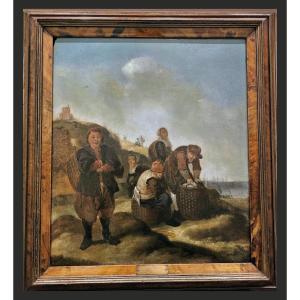
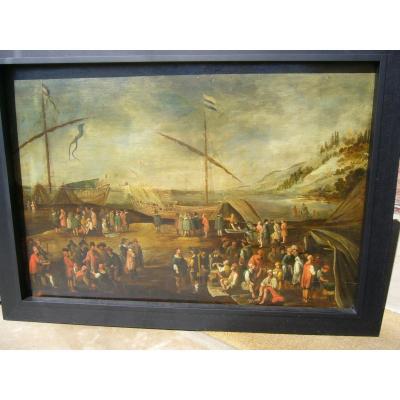
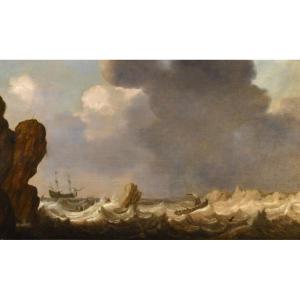
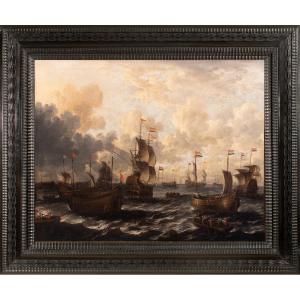
Seascape depicting several boats setting sail, signed Wigerus Vitringa.
The scene is lively and interesting, showing a wide variety of boats, from the smallest to the largest, sailing at a good speed on a choppy sea.
Oil on wood panel, in good condition.
A few very slight retouchings and a fine restoration to a crack in the panel, invisible. The only visible restoration is old, just above the ship on the right.
On the back of the panel, inventory number, remnants of inventory labels, and a collector's stamp.
In a late 19th/early 20th-century frame of imitation tortoiseshell and blackened wood.
Wigerus Vitringa, marine painter, born October 8, 1657, in Leeuwarden (Friesland, Netherlands) – died January 18, 1725, in Wirdum (Netherlands). Vitringa was a pupil of Richard Brakenburg and probably also of Ludolf Bakhuizen, one of the most celebrated Dutch marine painters of the period. Around 1680, he settled in Alkmaar, where he gained a good reputation as a marine painter. He became a member of the Guild of St. Luke (the painters' guild) in Alkmaar in 1696. In 1708, as his eyesight began to fail, he returned to Friesland (the northeast of the Netherlands) and devoted himself to teaching. Among his known pupils was Tako Hajo Jelgersma. Vitringa belongs to the Dutch tradition of marine painters of the Grand Siècle, with a clear influence from his master Bakhuizen: accurate depictions of ships, atmospheric skies, and a dynamic treatment of light and sea. His works bear witness to the maritime power of the 17th-century Netherlands. His drawings and paintings can be found in various institutions, for example, a study at the Metropolitan Museum of Art entitled "Various Ships and a Rowing Boat on an Estuary." His works are also held at the Rijksmuseum in Amsterdam, as well as in Bremen, Leningrad, and Lille. His work is compared to that of other Dutch marine painters such as Ludolf Backhuysen and Hendrik Dubbel.
Dimensions: Frame 78 cm x 57 cm; Panel 64 cm x 42 cm
The scene is lively and interesting, showing a wide variety of boats, from the smallest to the largest, sailing at a good speed on a choppy sea.
Oil on wood panel, in good condition.
A few very slight retouchings and a fine restoration to a crack in the panel, invisible. The only visible restoration is old, just above the ship on the right.
On the back of the panel, inventory number, remnants of inventory labels, and a collector's stamp.
In a late 19th/early 20th-century frame of imitation tortoiseshell and blackened wood.
Wigerus Vitringa, marine painter, born October 8, 1657, in Leeuwarden (Friesland, Netherlands) – died January 18, 1725, in Wirdum (Netherlands). Vitringa was a pupil of Richard Brakenburg and probably also of Ludolf Bakhuizen, one of the most celebrated Dutch marine painters of the period. Around 1680, he settled in Alkmaar, where he gained a good reputation as a marine painter. He became a member of the Guild of St. Luke (the painters' guild) in Alkmaar in 1696. In 1708, as his eyesight began to fail, he returned to Friesland (the northeast of the Netherlands) and devoted himself to teaching. Among his known pupils was Tako Hajo Jelgersma. Vitringa belongs to the Dutch tradition of marine painters of the Grand Siècle, with a clear influence from his master Bakhuizen: accurate depictions of ships, atmospheric skies, and a dynamic treatment of light and sea. His works bear witness to the maritime power of the 17th-century Netherlands. His drawings and paintings can be found in various institutions, for example, a study at the Metropolitan Museum of Art entitled "Various Ships and a Rowing Boat on an Estuary." His works are also held at the Rijksmuseum in Amsterdam, as well as in Bremen, Leningrad, and Lille. His work is compared to that of other Dutch marine painters such as Ludolf Backhuysen and Hendrik Dubbel.
Dimensions: Frame 78 cm x 57 cm; Panel 64 cm x 42 cm
6 500 €
Period: 17th century
Style: Renaissance, Louis 13th
Condition: Good condition
Length: 78 cm
Height: 57 cm
Reference (ID): 1685542
Availability: In stock
Print