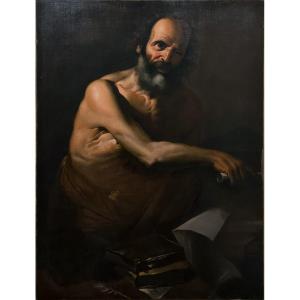

Portrait Of A Philosopher, Oil On Canvas, Neapolitan School, 17th Century
This painting is a example of Caravaggio's naturalism, probably attributable to the circle of Jusepe de Ribera (known as Lo Spagnoletto).
The painting most likely depicts an ancient philosopher (perhaps Heraclitus or Diogenes) or a hermit saint (such as Saint Jerome). In 17th-century Naples, the distinction between these two figures was often subtle: both were portrayed as elderly men, marked by time, absorbed in study, and living in poverty.
Attributes: In the lower right corner, worn books and sheets of paper (or parchment) are visible, symbols of wisdom and intellectual reflection.
Pose: The resting arm and gaze directed at the viewer create an immediate impression of physical and psychological presence. Style and technique: The work embodies the principles of tenebrism:
Use of light: A harsh, directional light strikes the man's shoulder and face, plunging the rest of the composition into deep shadow. This technique highlights anatomical volumes and skin texture.
Raw realism: The attention to detail in the representation of a "living" body—the wrinkles on the forehead, the tendons of the arm, the shaggy beard—is characteristic of the Neapolitan school, which rejected idealization in favor of an almost brutal truth. Palette: The colors are limited to a range of browns, ochres, and earthy tones, typical of the "material" painting of the Neapolitan region in the mid-17th century.
Neapolitan context: The choice of models "taken from the street" to interpret the great figures of the past is a hallmark of 17th-century Neapolitan art. This style was highly prized by collectors of the time because it combined philosophical depth with the visual power of reality. The work has been restored, relined, and repainted.
The painting most likely depicts an ancient philosopher (perhaps Heraclitus or Diogenes) or a hermit saint (such as Saint Jerome). In 17th-century Naples, the distinction between these two figures was often subtle: both were portrayed as elderly men, marked by time, absorbed in study, and living in poverty.
Attributes: In the lower right corner, worn books and sheets of paper (or parchment) are visible, symbols of wisdom and intellectual reflection.
Pose: The resting arm and gaze directed at the viewer create an immediate impression of physical and psychological presence. Style and technique: The work embodies the principles of tenebrism:
Use of light: A harsh, directional light strikes the man's shoulder and face, plunging the rest of the composition into deep shadow. This technique highlights anatomical volumes and skin texture.
Raw realism: The attention to detail in the representation of a "living" body—the wrinkles on the forehead, the tendons of the arm, the shaggy beard—is characteristic of the Neapolitan school, which rejected idealization in favor of an almost brutal truth. Palette: The colors are limited to a range of browns, ochres, and earthy tones, typical of the "material" painting of the Neapolitan region in the mid-17th century.
Neapolitan context: The choice of models "taken from the street" to interpret the great figures of the past is a hallmark of 17th-century Neapolitan art. This style was highly prized by collectors of the time because it combined philosophical depth with the visual power of reality. The work has been restored, relined, and repainted.
8 000 €
Period: 17th century
Style: Louis 14th, Regency
Condition: Fully restored
Material: Oil painting
Width: 91.5 cm
Height: 125.5 cm
Reference (ID): 1685230
Availability: In stock
Print