THIS OBJECT WAS SOLD
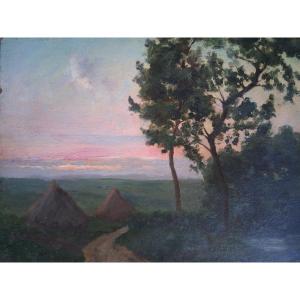
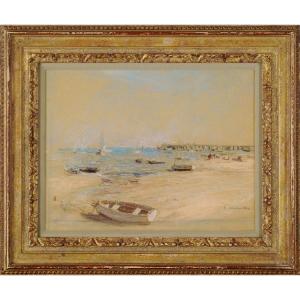
Charles Bichet (1863-1929) Trees At La Borne - Limoges Crozant


Charles BICHET
(Paris 1863 – Limoges 1929)
Trees at La Borne - Limoges
Pastel on paper
H. 36 cm; W. 45 cm
Monogrammed lower right. Located, signed, and dated on the reverse.
1908
Freed from academicism by a late but decisive Impressionist revelation, Charles Bichet embarked on a pictorial quest based on the observation of landscape and the critical assimilation of the avant-garde movements of the late 19th and early 20th centuries. Traveling throughout France, and particularly the Limousin region, he painted en plein air and constantly questioned his artistic language. From 1903 onward, in a radical break, he abandoned the somber tones of his early work, even destroying canvases that had become incompatible with his new sensibility. His painting then embraced the luminous vibrations of Impressionism, while incorporating a chromatic boldness that sometimes bordered on Fauvism, as evidenced by The Pillars of Lascaux at Châteauponsac, with its mauve and pink harmonies. As part of the summer event "La Creuse, a Valley-Studio," which highlights the central role of this region in 19th-century artistic creation, the Limoges Museum of Fine Arts is dedicating an exhibition to Charles Bichet. Having settled in Limoges in 1890, after training at the École Nationale des Arts Décoratifs in Paris, where he was born, the artist joined a constellation of painters—Allan Österlind, Eugène Alluaud, and Alfred Smith—for whom the Creuse Valley became a privileged laboratory of pictorial modernity.
This remarkable pastel, dated 1908, is one of the finest pieces in his oeuvre. Vivid, luminous, contrasting, colorful, sculpted—it has it all. These trees are tortured by the artist, who manages to capture the meanders of the bark and stumps of these cultivated trees. Within his home of Limoges, he creates masterpieces that can be included in the wave of Impressionism in Crozant.
(Paris 1863 – Limoges 1929)
Trees at La Borne - Limoges
Pastel on paper
H. 36 cm; W. 45 cm
Monogrammed lower right. Located, signed, and dated on the reverse.
1908
Freed from academicism by a late but decisive Impressionist revelation, Charles Bichet embarked on a pictorial quest based on the observation of landscape and the critical assimilation of the avant-garde movements of the late 19th and early 20th centuries. Traveling throughout France, and particularly the Limousin region, he painted en plein air and constantly questioned his artistic language. From 1903 onward, in a radical break, he abandoned the somber tones of his early work, even destroying canvases that had become incompatible with his new sensibility. His painting then embraced the luminous vibrations of Impressionism, while incorporating a chromatic boldness that sometimes bordered on Fauvism, as evidenced by The Pillars of Lascaux at Châteauponsac, with its mauve and pink harmonies. As part of the summer event "La Creuse, a Valley-Studio," which highlights the central role of this region in 19th-century artistic creation, the Limoges Museum of Fine Arts is dedicating an exhibition to Charles Bichet. Having settled in Limoges in 1890, after training at the École Nationale des Arts Décoratifs in Paris, where he was born, the artist joined a constellation of painters—Allan Österlind, Eugène Alluaud, and Alfred Smith—for whom the Creuse Valley became a privileged laboratory of pictorial modernity.
This remarkable pastel, dated 1908, is one of the finest pieces in his oeuvre. Vivid, luminous, contrasting, colorful, sculpted—it has it all. These trees are tortured by the artist, who manages to capture the meanders of the bark and stumps of these cultivated trees. Within his home of Limoges, he creates masterpieces that can be included in the wave of Impressionism in Crozant.
Explore similar pieces and discover your ideal find:
Landscapes