THIS OBJECT WAS SOLD
Oblate, San Martín De Cartes (cantabria, Spain). Gilt Bronze. Spanish School, 1680.


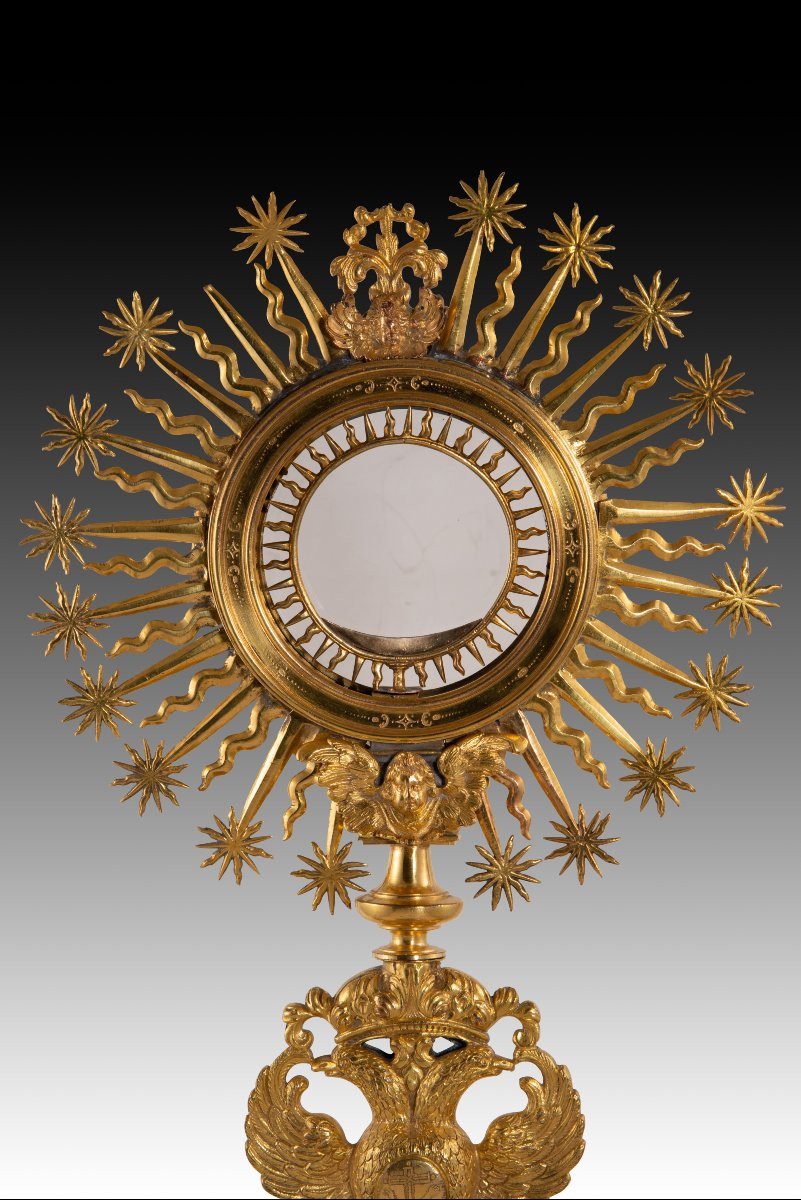


Oblate, San Martín de Cartes (Cantabria, Spain). Gilt bronze. Spanish School, 1680.
With inscription and date on the base.
Bibliography: Heredia Moreno, María del Carmen. “Origin and Diffusion of the Iconography of the Double-Headed Eagle in Spanish and Hispano-American Religious Silverware.” Archivo español de arte, LXIX, 274. April-June 1996. Pages 183, 184, 192. / Sigaut, Nelly. “Monstrances with the Double-Headed Eagle.” Revista Librosdelacorte.es. Number 15, year 9, Autumn-Winter (2017). Page 78, figure 2 (page 79).
This gilt-bronze monstrance is of the so-called "radiant sun" type, due to the shape of its upper section and the rays that compose it (alternating smooth rays ending in stars, wavy rays, and smooth rays without ends). The upper section also features a vegetal motif with a winged angel's head, and the area where the Blessed Sacrament would be placed also contains rays (alternating between smooth and wavy) and a frame with engraved elements (dots, lozenges, and C-shaped motifs). The central axis of the piece begins with a winged angel's head, a vase-shaped form, and a crowned double-headed eagle with a Franciscan shield (a Latin cross and two arms) engraved on its abdomen. It continues with several discs and moldings engraved with small geometric elements and dots. The base consists of several levels, all engraved with vegetal, geometric, and other motifs. It is simple and terminates in a cruciform base on which is engraved the inscription "RAI FELPE 1680" (note that the R at the beginning of the inscription has elements that suggest a possible combination of F and R, perhaps yielding Fray, although the cited bibliography refers to RAY). According to the publications consulted, the piece presented here is the monstrance from San Martín de Cartes (Cantabria, Spain), the most austere and oldest of a particular group of monstrances that feature a double-headed eagle on the stem and are attributed, with reservations, to the Madrid school. Compare it with the monstrance of Santa María de Orduña from 1683, the one in the church of Alquézar Castle (Barbastro, Huesca), the one of the Carmelites of Alba de Tormes, the one in Santa María de Valtierra in Navarre, or the one in the Archbishopric of Popayán (Colombia). Apparently, the origin of the double-headed eagle iconography dates back to Maximilian I's adoption of the title of Holy Roman Emperor in 1508, with the incorporation of this symbol into his coat of arms. In 1519, this emblem was introduced to the Iberian Peninsula through an engraving of Charles V as King of Spain aspiring to the Holy Roman Empire. The eagle motif appeared on religious silverware during the second half of the 17th and the beginning of the 18th centuries, the period to which the monstrances mentioned in the cited bibliography date. These sources add that the use of this emblem on religious silverware was due to very specific reasons. According to the year inscribed on this monstrance (1680), Charles II was reigning, a time marked by the intrigues of Fernando de Valenzuela, which resulted in the excommunication of the nobles and the corresponding acts of reparation to the Blessed Sacrament promoted by the monarch in response to the "violation of the Escorial monastery by the nobility." It is important to remember, however, that from this period onward, the iconography of the double-headed eagle enjoyed such popularity that it continued to be used until the 19th century.
Weight: 4550 grams. Dimensions: 34 x 26.5 x 60 cm
With inscription and date on the base.
Bibliography: Heredia Moreno, María del Carmen. “Origin and Diffusion of the Iconography of the Double-Headed Eagle in Spanish and Hispano-American Religious Silverware.” Archivo español de arte, LXIX, 274. April-June 1996. Pages 183, 184, 192. / Sigaut, Nelly. “Monstrances with the Double-Headed Eagle.” Revista Librosdelacorte.es. Number 15, year 9, Autumn-Winter (2017). Page 78, figure 2 (page 79).
This gilt-bronze monstrance is of the so-called "radiant sun" type, due to the shape of its upper section and the rays that compose it (alternating smooth rays ending in stars, wavy rays, and smooth rays without ends). The upper section also features a vegetal motif with a winged angel's head, and the area where the Blessed Sacrament would be placed also contains rays (alternating between smooth and wavy) and a frame with engraved elements (dots, lozenges, and C-shaped motifs). The central axis of the piece begins with a winged angel's head, a vase-shaped form, and a crowned double-headed eagle with a Franciscan shield (a Latin cross and two arms) engraved on its abdomen. It continues with several discs and moldings engraved with small geometric elements and dots. The base consists of several levels, all engraved with vegetal, geometric, and other motifs. It is simple and terminates in a cruciform base on which is engraved the inscription "RAI FELPE 1680" (note that the R at the beginning of the inscription has elements that suggest a possible combination of F and R, perhaps yielding Fray, although the cited bibliography refers to RAY). According to the publications consulted, the piece presented here is the monstrance from San Martín de Cartes (Cantabria, Spain), the most austere and oldest of a particular group of monstrances that feature a double-headed eagle on the stem and are attributed, with reservations, to the Madrid school. Compare it with the monstrance of Santa María de Orduña from 1683, the one in the church of Alquézar Castle (Barbastro, Huesca), the one of the Carmelites of Alba de Tormes, the one in Santa María de Valtierra in Navarre, or the one in the Archbishopric of Popayán (Colombia). Apparently, the origin of the double-headed eagle iconography dates back to Maximilian I's adoption of the title of Holy Roman Emperor in 1508, with the incorporation of this symbol into his coat of arms. In 1519, this emblem was introduced to the Iberian Peninsula through an engraving of Charles V as King of Spain aspiring to the Holy Roman Empire. The eagle motif appeared on religious silverware during the second half of the 17th and the beginning of the 18th centuries, the period to which the monstrances mentioned in the cited bibliography date. These sources add that the use of this emblem on religious silverware was due to very specific reasons. According to the year inscribed on this monstrance (1680), Charles II was reigning, a time marked by the intrigues of Fernando de Valenzuela, which resulted in the excommunication of the nobles and the corresponding acts of reparation to the Blessed Sacrament promoted by the monarch in response to the "violation of the Escorial monastery by the nobility." It is important to remember, however, that from this period onward, the iconography of the double-headed eagle enjoyed such popularity that it continued to be used until the 19th century.
Weight: 4550 grams. Dimensions: 34 x 26.5 x 60 cm
Explore similar pieces and discover your ideal find:
Christian Art