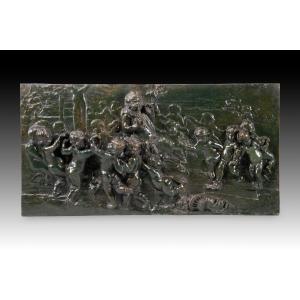


Children's Dance With The God Pan. Bronze. After Models By Lucas Faydherbe (1617-1697).
Children's Dance with the God Pan. Bronze. After models by Lucas Faydherbe (1617-1697). Probably 19th century.
A bronze plaque with a figurative relief depicts a natural landscape with trees on the left and an overturned basket of flowers in the foreground. A group of naked children are arranged to dance, their hands bound together in clusters; the figures in the foreground are prominent, while those in the background are barely sketched, creating an impression of space. In the center of the scene, a horned, goat-legged male figure, identified as Pan, son of Jupiter and the nymph Callisto, plays the flute. In classical mythology, Pan was associated with wild nature. This god, particularly venerated in Arcadia, is associated with shepherds and flocks and often appears in scenes related to Bacchus (Dionysus). This work is closely based (note the letter F in the lower left corner, which, along with an L, also appears in the original; there are differences between the two) on a carved ivory relief in the Prado Museum in Madrid (catalog number E000257). It belonged to the painter Rubens and is the work of Lucas Faydherbe (Mechelen, Belgium, 1617 – Mechelen, Belgium, 1697), who worked as an assistant or pupil in Rubens's workshop four years before the latter's death. The terracotta sketch is in the Royal Museums of Art and History in Brussels and shows slight variations from the Prado original. It is worth noting that the Royal Academy of Fine Arts of San Fernando in Madrid holds a plaster cast of the original work (Model from the molding workshop, inventory number M-903), which features a capital F in the lower left corner, as in this bronze relief.
Weight: 6350 grams. Dimensions: 54.5 x 5.5 x 28 cm
A bronze plaque with a figurative relief depicts a natural landscape with trees on the left and an overturned basket of flowers in the foreground. A group of naked children are arranged to dance, their hands bound together in clusters; the figures in the foreground are prominent, while those in the background are barely sketched, creating an impression of space. In the center of the scene, a horned, goat-legged male figure, identified as Pan, son of Jupiter and the nymph Callisto, plays the flute. In classical mythology, Pan was associated with wild nature. This god, particularly venerated in Arcadia, is associated with shepherds and flocks and often appears in scenes related to Bacchus (Dionysus). This work is closely based (note the letter F in the lower left corner, which, along with an L, also appears in the original; there are differences between the two) on a carved ivory relief in the Prado Museum in Madrid (catalog number E000257). It belonged to the painter Rubens and is the work of Lucas Faydherbe (Mechelen, Belgium, 1617 – Mechelen, Belgium, 1697), who worked as an assistant or pupil in Rubens's workshop four years before the latter's death. The terracotta sketch is in the Royal Museums of Art and History in Brussels and shows slight variations from the Prado original. It is worth noting that the Royal Academy of Fine Arts of San Fernando in Madrid holds a plaster cast of the original work (Model from the molding workshop, inventory number M-903), which features a capital F in the lower left corner, as in this bronze relief.
Weight: 6350 grams. Dimensions: 54.5 x 5.5 x 28 cm
1 500 €
Period: 19th century
Style: Other Style
Condition: En l'etat
Material: Bronze
Width: 54,5 cm
Height: 28 cm
Reference (ID): 1682722
Availability: In stock
Print