THIS OBJECT WAS SOLD
Civic Portrait Of A Gentleman In A Doublet Beside A Table With Clock, Dated 1595, Oil On Panel
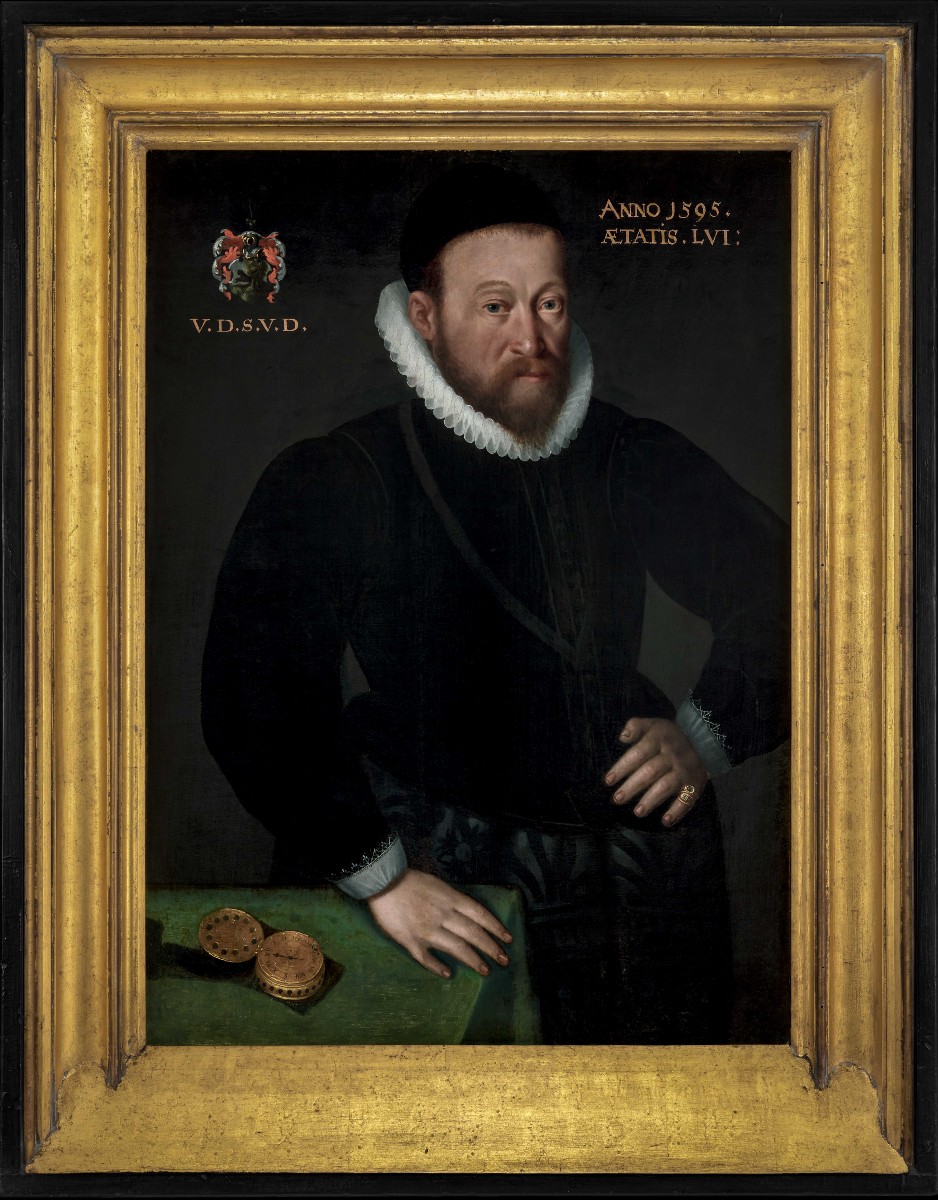
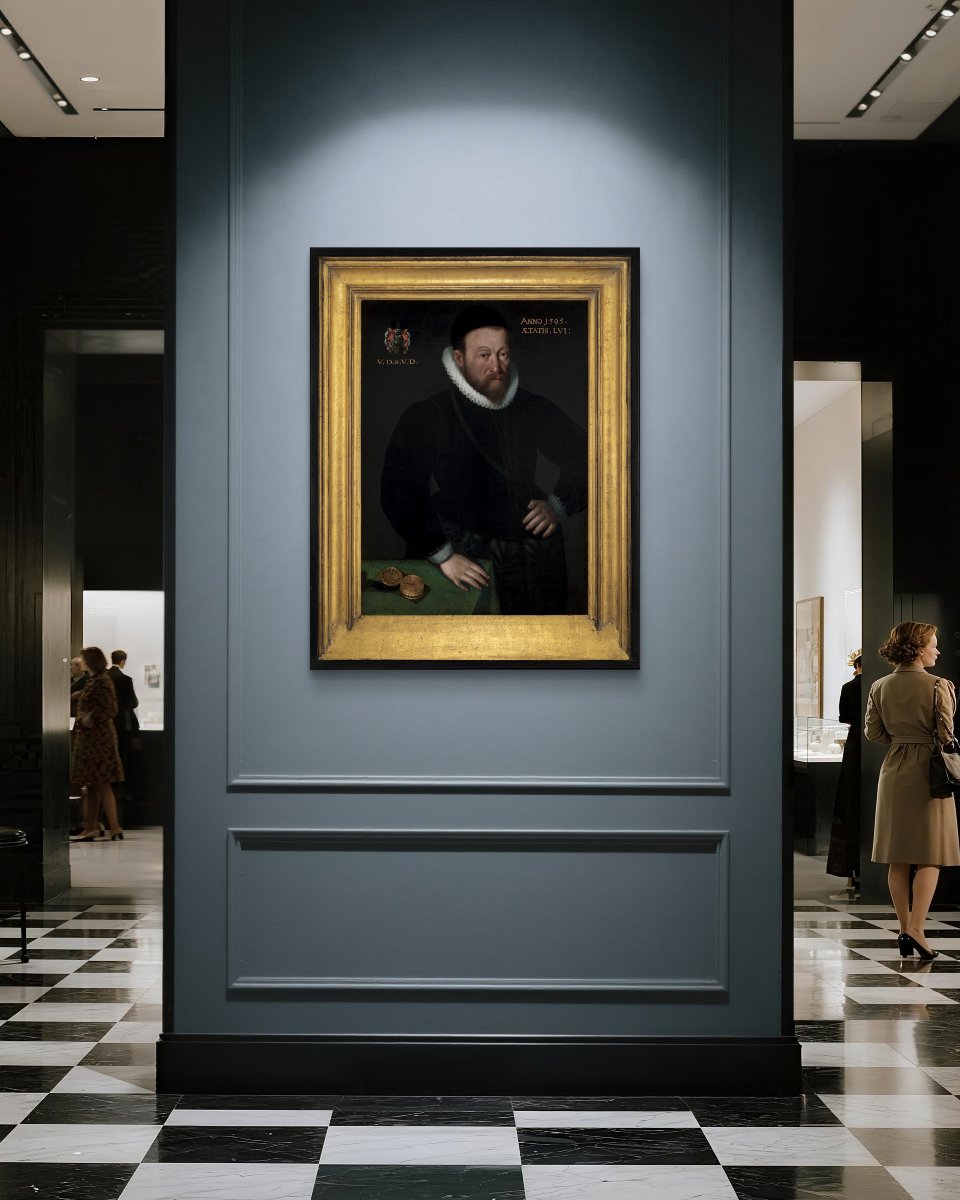



Civic Portrait of a Gentleman in a Doublet beside a Table with a Clock, dated 1595
Circle of Frans Pourbus the Elder (1545–1581)
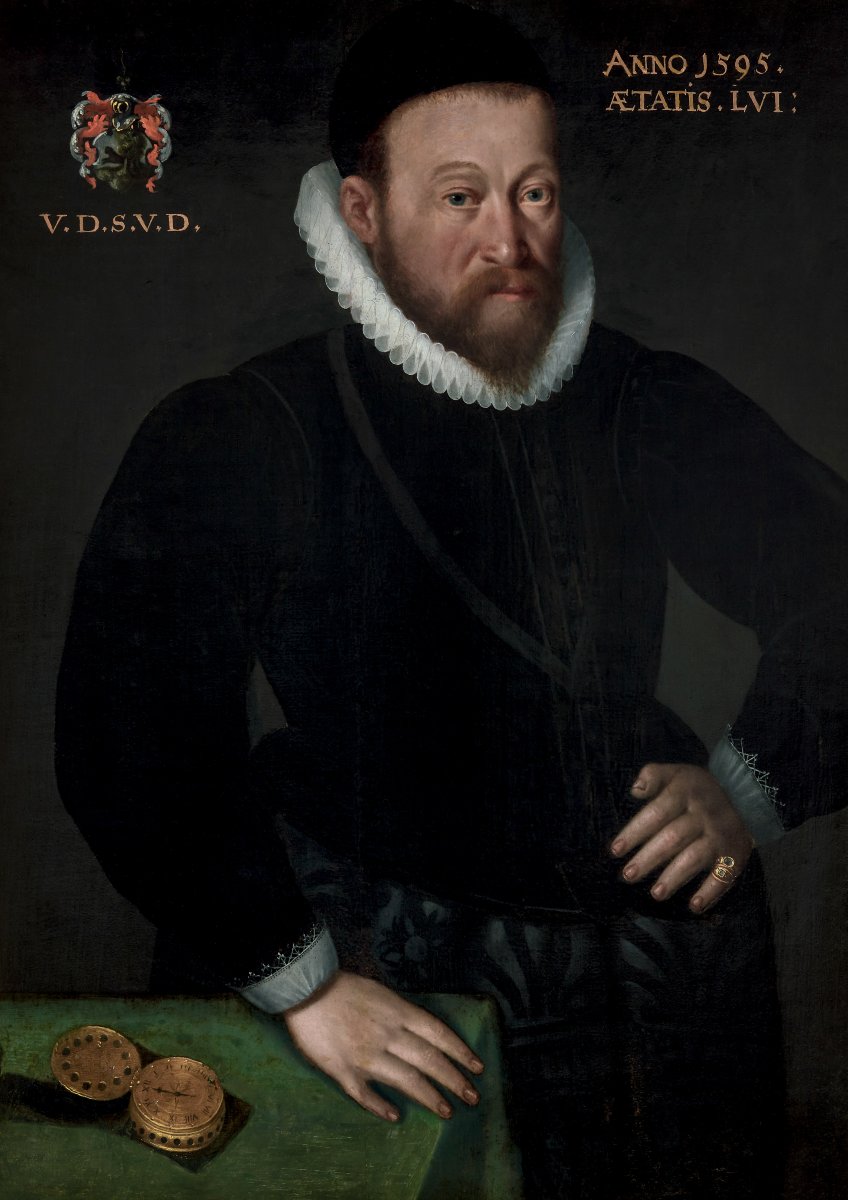
This rare and compelling late-sixteenth-century Flemish portrait ranks among the most complete and intellectually engaging examples of Antwerp civic portraiture to survive from the period. Painted on panel and dated 1595, with the sitter’s age carefully inscribed as Ætatis LVI, the work combines exceptional quality, strong condition, legible heraldry, and a psychologically nuanced likeness. Few portraits of this type retain such a coherent ensemble of inscription, armorial identity, symbolic objects, and painterly refinement, making this a work of genuine significance within the field of Northern Renaissance portraiture.
The sitter, a man of fifty-six born around 1539, is presented through the painted initials “V.D.S.V.D.” and accompanying coat of arms as a member of the armigerous urban elite, consistent with Antwerp/Brabant patrician culture. This abbreviated format reflects a common late-sixteenth-century Flemish practice, in which compound surnames—van der S… van D…—were reduced to initials for clarity and balance in portrait inscriptions. The monogram may plausibly point to a lineage connected to the Van der Straeten family or another armigerous Van der S— / Van D— branch or alliance. Heraldic analysis supports this general reading: the arms display mantling in argent and gules (silver and red), colours compatible with several Flemish and Brabant patrician armorial traditions (including Van der Straeten variants), together with a dark crest element that may reflect a quartered or allied device. Such heraldic self-assertion was typical of the merchant-magistrate class, whose members increasingly used portraiture to proclaim lineage, legitimacy, and continuity during a period of civic uncertainty.
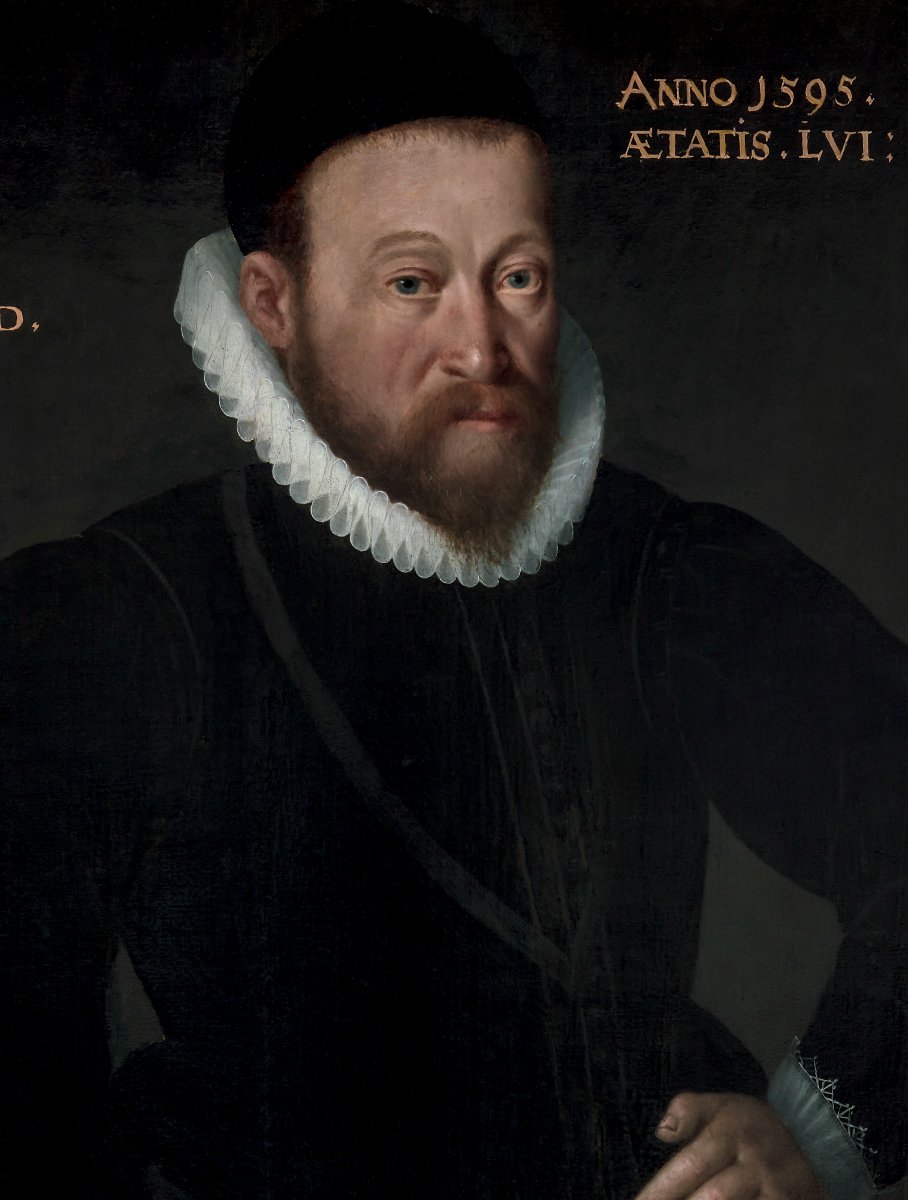
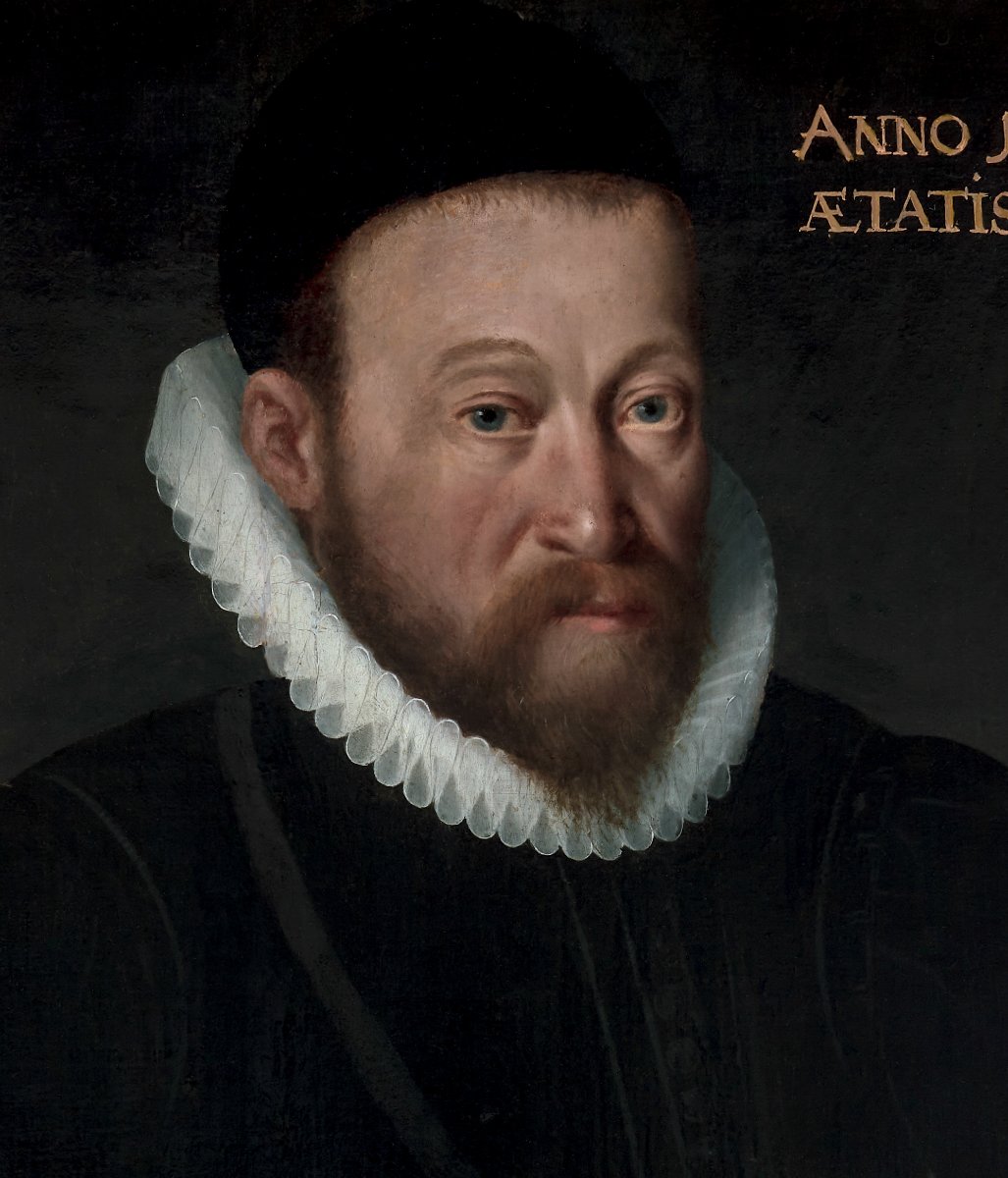
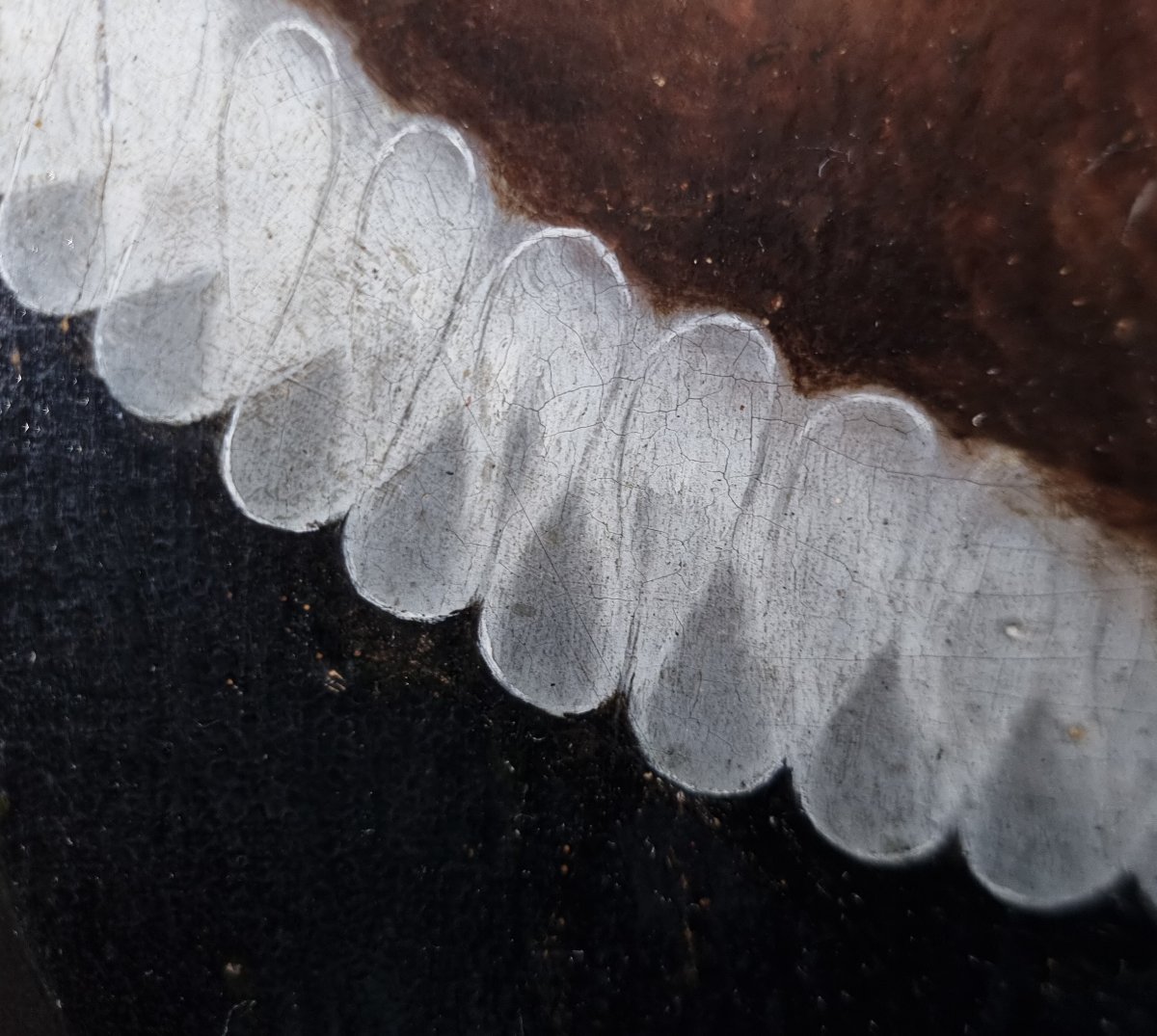
The sitter’s attire is sober yet unmistakably elite, datable precisely to the mid-1590s. He wears a black doublet of costly dye, cut without ostentation and emblematic of dignity, moral seriousness, and wealth. In late-sixteenth-century Antwerp and Brabant, black was a preferred colour of civic authority, widely adopted by magistrates, merchants, and legal officials in the wake of religious and political upheaval. His neatly pleated white ruff, carefully rendered and of moderate scale, corresponds to fashions of the 1590s before the ruff reached its most exaggerated architectural forms. Such restrained ruffs were associated with professional respectability rather than aristocratic display, reinforcing the sitter’s identity as a man of civic responsibility.
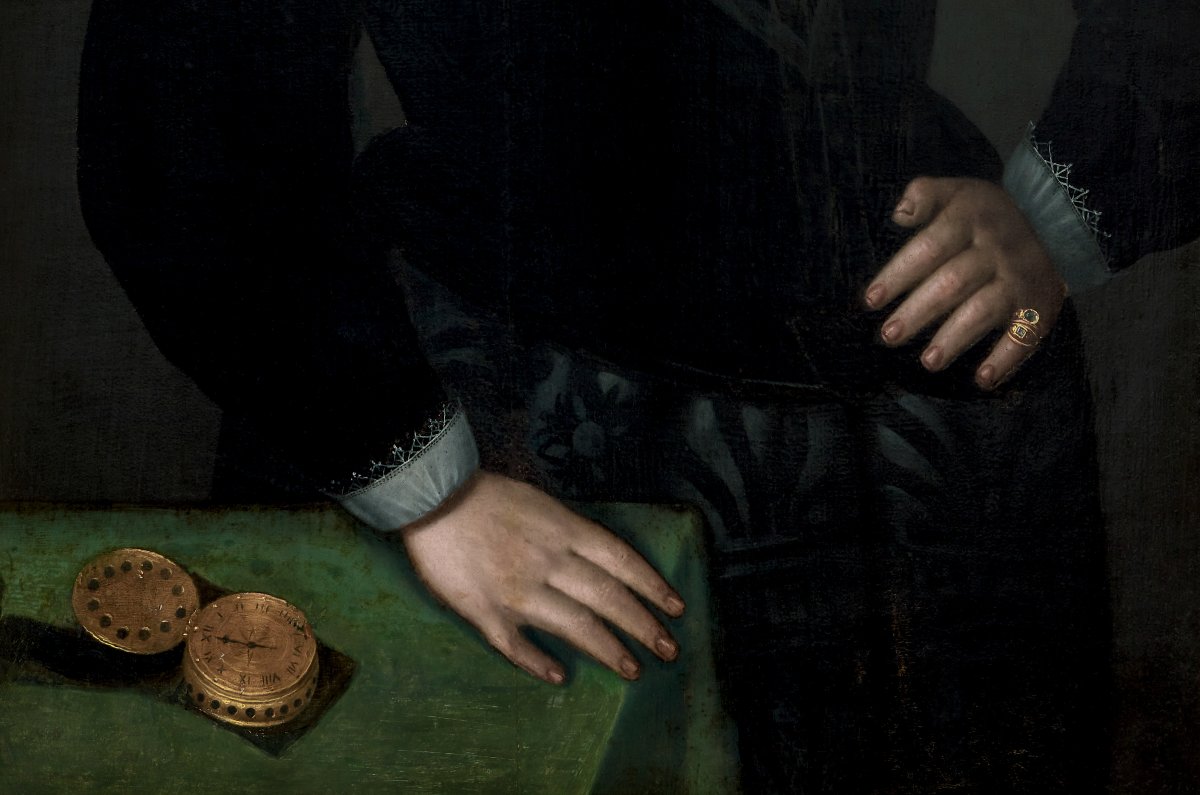
Particularly striking are the sitter’s hands, painted with breadth and authority, and the two gold rings worn on the small finger of the left hand. In contemporary Flemish portraiture, multiple rings often signified contractual power, wealth derived from commerce, or legal authority. One ring appears to function as a signet, the other as a stone-set emblem of status, together underscoring the sitter’s role as a trusted participant in the economic and civic life of his region. These are not ornamental gestures, but deliberate signs of office and responsibility.
On the green-covered table before him rests an open portable timepiece (a table watch or clockwatch), its dial clearly visible. In the 1590s, such mechanisms were luxury objects, owned by the affluent and educated, and closely associated with ideas of order, discipline, and moral accountability. The hand sits near twelve o’clock, which can be read not only as a reminder of mortality, but also as a moment of fullness and equilibrium. In the context of a man aged fifty-six, this symbol may be understood as a statement of a life at its apex—marked by vigilance, stewardship, and time well governed—rather than decline.
The inscription “ANNO 1595 · ÆTATIS LVI” is contemporary with the painting and executed in gold serifed capitals fully integrated into the pictorial surface. Its clarity provides rare chronological certainty and confirms the portrait as a deliberate act of self-representation at a mature stage of life. Together with the heraldry, it situates the sitter firmly within the culture of the late-sixteenth-century civic elite.
The historical moment in which the portrait was painted adds further resonance. Antwerp in 1595 was a city in recovery. A decade after its fall to Spanish Habsburg forces in 1585, the city was reshaping its identity amid confessional realignment, economic contraction, and the departure of many Protestant merchants to the northern Netherlands. Those who remained formed a resilient governing class—Catholic-aligned merchants, magistrates, and guild leaders—tasked with stabilising civic institutions and redefining Antwerp’s role within the Spanish Netherlands. Portraiture during this period served as a powerful tool of continuity, asserting lineage, authority, and moral steadiness in uncertain times. The sitter of this portrait belongs unmistakably to that world.
Stylistically, the painting belongs to the Antwerp school of the 1590s, closely aligned with the portrait tradition shaped by Frans Pourbus the Elder, yet clearly executed after his death in 1581. The soft modelling of the eyes, with gently dissolved eyelids and internalised highlights, the restrained atmospheric handling of flesh, and the massed, tonal treatment of the beard distinguish the work from the sharper linearity of Ambrosius Francken I and from the more animated brushwork of Martin de Vos. The ruff lacks the rigid architectural precision typical of Frans Pourbus himself, while retaining the sobriety of his idiom. The hands are broad and untheatrical, conveying authority without flourish, and the overall psychological tone is quiet, introspective, and civic rather than courtly.
What ultimately sets this portrait apart is the coherence of its message. Costume, gesture, heraldry, inscription, and symbolic objects operate in concert to construct an image of authority, lineage, and measured responsibility. It is both a finely painted likeness and a sophisticated statement of identity at a pivotal moment in the history of the Southern Netherlands. As such, the painting offers not only aesthetic appeal, but a vivid human document of late-sixteenth-century civic life. Its quality, condition, secure dating, and intellectual richness make it a standout example of Antwerp portraiture and a work of considerable interest to collectors and institutions alike.
Inscribed: “ANNO 1595 · ÆTATIS · LVI” and with heraldic device and initials: “V.D.S.V.D.”
Measurements: Height 89cm, Width 70cm, Depth 7cm framed (Height 35”, Width 27.5”, Depth 2.75” framed)
Circle of Frans Pourbus the Elder (1545–1581)
This rare and compelling late-sixteenth-century Flemish portrait ranks among the most complete and intellectually engaging examples of Antwerp civic portraiture to survive from the period. Painted on panel and dated 1595, with the sitter’s age carefully inscribed as Ætatis LVI, the work combines exceptional quality, strong condition, legible heraldry, and a psychologically nuanced likeness. Few portraits of this type retain such a coherent ensemble of inscription, armorial identity, symbolic objects, and painterly refinement, making this a work of genuine significance within the field of Northern Renaissance portraiture.
The sitter, a man of fifty-six born around 1539, is presented through the painted initials “V.D.S.V.D.” and accompanying coat of arms as a member of the armigerous urban elite, consistent with Antwerp/Brabant patrician culture. This abbreviated format reflects a common late-sixteenth-century Flemish practice, in which compound surnames—van der S… van D…—were reduced to initials for clarity and balance in portrait inscriptions. The monogram may plausibly point to a lineage connected to the Van der Straeten family or another armigerous Van der S— / Van D— branch or alliance. Heraldic analysis supports this general reading: the arms display mantling in argent and gules (silver and red), colours compatible with several Flemish and Brabant patrician armorial traditions (including Van der Straeten variants), together with a dark crest element that may reflect a quartered or allied device. Such heraldic self-assertion was typical of the merchant-magistrate class, whose members increasingly used portraiture to proclaim lineage, legitimacy, and continuity during a period of civic uncertainty.
The sitter’s attire is sober yet unmistakably elite, datable precisely to the mid-1590s. He wears a black doublet of costly dye, cut without ostentation and emblematic of dignity, moral seriousness, and wealth. In late-sixteenth-century Antwerp and Brabant, black was a preferred colour of civic authority, widely adopted by magistrates, merchants, and legal officials in the wake of religious and political upheaval. His neatly pleated white ruff, carefully rendered and of moderate scale, corresponds to fashions of the 1590s before the ruff reached its most exaggerated architectural forms. Such restrained ruffs were associated with professional respectability rather than aristocratic display, reinforcing the sitter’s identity as a man of civic responsibility.
Particularly striking are the sitter’s hands, painted with breadth and authority, and the two gold rings worn on the small finger of the left hand. In contemporary Flemish portraiture, multiple rings often signified contractual power, wealth derived from commerce, or legal authority. One ring appears to function as a signet, the other as a stone-set emblem of status, together underscoring the sitter’s role as a trusted participant in the economic and civic life of his region. These are not ornamental gestures, but deliberate signs of office and responsibility.
On the green-covered table before him rests an open portable timepiece (a table watch or clockwatch), its dial clearly visible. In the 1590s, such mechanisms were luxury objects, owned by the affluent and educated, and closely associated with ideas of order, discipline, and moral accountability. The hand sits near twelve o’clock, which can be read not only as a reminder of mortality, but also as a moment of fullness and equilibrium. In the context of a man aged fifty-six, this symbol may be understood as a statement of a life at its apex—marked by vigilance, stewardship, and time well governed—rather than decline.
The inscription “ANNO 1595 · ÆTATIS LVI” is contemporary with the painting and executed in gold serifed capitals fully integrated into the pictorial surface. Its clarity provides rare chronological certainty and confirms the portrait as a deliberate act of self-representation at a mature stage of life. Together with the heraldry, it situates the sitter firmly within the culture of the late-sixteenth-century civic elite.
The historical moment in which the portrait was painted adds further resonance. Antwerp in 1595 was a city in recovery. A decade after its fall to Spanish Habsburg forces in 1585, the city was reshaping its identity amid confessional realignment, economic contraction, and the departure of many Protestant merchants to the northern Netherlands. Those who remained formed a resilient governing class—Catholic-aligned merchants, magistrates, and guild leaders—tasked with stabilising civic institutions and redefining Antwerp’s role within the Spanish Netherlands. Portraiture during this period served as a powerful tool of continuity, asserting lineage, authority, and moral steadiness in uncertain times. The sitter of this portrait belongs unmistakably to that world.
Stylistically, the painting belongs to the Antwerp school of the 1590s, closely aligned with the portrait tradition shaped by Frans Pourbus the Elder, yet clearly executed after his death in 1581. The soft modelling of the eyes, with gently dissolved eyelids and internalised highlights, the restrained atmospheric handling of flesh, and the massed, tonal treatment of the beard distinguish the work from the sharper linearity of Ambrosius Francken I and from the more animated brushwork of Martin de Vos. The ruff lacks the rigid architectural precision typical of Frans Pourbus himself, while retaining the sobriety of his idiom. The hands are broad and untheatrical, conveying authority without flourish, and the overall psychological tone is quiet, introspective, and civic rather than courtly.
What ultimately sets this portrait apart is the coherence of its message. Costume, gesture, heraldry, inscription, and symbolic objects operate in concert to construct an image of authority, lineage, and measured responsibility. It is both a finely painted likeness and a sophisticated statement of identity at a pivotal moment in the history of the Southern Netherlands. As such, the painting offers not only aesthetic appeal, but a vivid human document of late-sixteenth-century civic life. Its quality, condition, secure dating, and intellectual richness make it a standout example of Antwerp portraiture and a work of considerable interest to collectors and institutions alike.
Inscribed: “ANNO 1595 · ÆTATIS · LVI” and with heraldic device and initials: “V.D.S.V.D.”
Measurements: Height 89cm, Width 70cm, Depth 7cm framed (Height 35”, Width 27.5”, Depth 2.75” framed)
Explore similar pieces and discover your ideal find:
Portraits