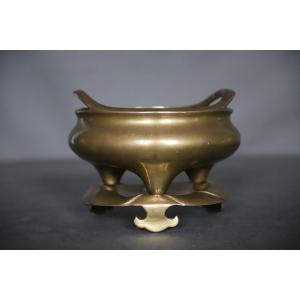
China Qing Dynasty Reign Of Guangxu Decor Yún Wén Tripod Vase Frosted Enamel XIXth Chinese
Artist: Chine
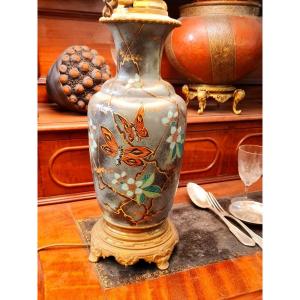
Globular tripod vase in frosted cloisonné enamel. China, Qing Dynasty, Guangxu reign (1875–1908). This small globular cloisonné enamel vase is a prime example of one of the most subtle and intellectually fertile periods in Chinese art: the end of the Qing Dynasty, a time of transition where millennia-old imperial tradition engages with a nascent modernity. Crafted on a finely hammered copper body, the object takes on a spherical form resting on three small feet, a configuration that is both aesthetic and symbolic, evoking stability, balance, and continuity. The deliberately understated circular rim highlights the rich decoration of the body. The entire surface is enlivened by a deep black background traversed by a continuous motif of stylized clouds (yún wén), rendered in spiraling volutes. This decoration, of great antiquity in Chinese iconography, symbolizes the circulation of vital energy, protection, and cosmic harmony. It serves here as a dynamic field upon which a floral design of great visual intensity unfolds. The stylized flowers, arranged in a circular rhythm, are rendered in a palette of cobalt blues, turquoise, and luminous greens, enhanced by geometric floral centers. The glazes exhibit a crystallized frosted effect, intentionally achieved during firing, giving the surface a vibrant, almost mineral texture that captures and diffracts light depending on the viewing angle. This effect, sought after at the end of the 19th century, testifies to advanced technical mastery and a refined aesthetic sensibility, far removed from later industrial productions. Under the reign of the Guangxu Emperor, China underwent a period of profound political, intellectual, and artistic transformation. While the Empire faced external pressures and internal reforms, workshops perpetuated ancestral know-how while exploring new decorative sensibilities. Cloisonné then experienced a resurgence of interest, particularly for cabinet objects intended for scholars, cultivated interiors, and a clientele sensitive to symbolism as much as to the material itself. This vase belongs to this category of objects where craftsmanship becomes an act of cultural resistance: preserving tradition while inscribing it within a changing world. Each slightly undulating partition reveals the human hand, the slowness of the gesture, and the intelligence of fire. In Chinese tradition, spiraling clouds are messengers between heaven and earth. They accompany the immortals, protect places, and promote the harmonious flow of energy. Blue flowers, associated with longevity and wisdom, evoke the permanence of beauty beyond the upheavals of the world. It is known that objects decorated with clouds retain good fortune in the home, preventing beneficial Qi from escaping. Harmony of space and circulation of breath: Through its perfectly rounded shape, this vase establishes a dynamic of continuity and visual gentleness. In Chinese thought, the sphere represents unity: it soothes the tensions of a space and fosters a fluid perception of it. The gaze doesn't linger on it, but rather moves freely. Resting on three points creates a stable and balanced anchor. The tripod evokes permanence and discreet solidity, allowing for a steady flow of energy without rigidity or disruption. The object appears poised, not imposed. The deep, nuanced blue and green enamels activate a subtle dialogue between the elements of Water and Wood. Water supports intelligence, reflection, and memory, while Wood accompanies growth, creativity, and renewal. Their coexistence creates an atmosphere conducive to spaces for thought, reading, or creation. The continuous motif of stylized clouds (yún wén) plays a central role: it sets energy in motion, prevents stagnation, and facilitates the harmonious circulation of Qi within the room. The swirling lines, without beginning or end, act like a visual breath, regulating the energy intensity of the space. Finally, the frosted effect of the glazes, far from being merely decorative, softens the reflection of light. It diffuses, filters, and calms. This texture transforms the object into a mediator: it captures the surrounding activity and returns it in a serene and balanced form. This vase naturally finds its place in a library, an office, a cozy living room, or a space dedicated to contemplation. It accompanies places where we think, where we decide, where we create—without ever dominating them.
150 €
Period: 19th century
Style: Asian art
Condition: Condition of use
Material: Bronze
Reference (ID): 1679212
Availability: In stock
Print