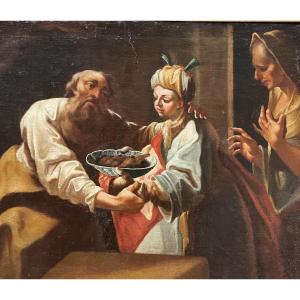


Isaac Blesses Jacob, Genesis 27
Oil on canvas, second half of the 17th century
Dimensions: 119 x 93 cm with frame
without frame 109x83 cm
The scene brings together three figures: Isaac, aged and bedridden; Rebecca, Isaac’s wife, identifiable on the right; and Jacob, standing beside the bed, with his arms covered in animal skins and wearing an unusual headdress.
Between the figures stands a large blue-and-white dish. It may recall a Delft plate or, more broadly, a European 17th-century production inspired by Chinese porcelain; it is plausibly the work of a continental manufactory, Italian or French. In the dish we see game, a central element of the scene.
The subject is drawn from the Book of Genesis and revolves entirely around the themes of birthright and blessing, on which the principal line of the Hebrew people depends. In Genesis 25:29–34, Esau relinquishes his right of primogeniture to Jacob. In Genesis 27, Isaac, now blind, asks his elder son:
“Go out to the field and hunt some game for me. Prepare a savory dish such as I love.”
Rebecca prepares the game and sends Jacob in place of his brother. The goatskins on Jacob’s arms imitate Esau’s hairy body, allowing Isaac to recognize him through touch.
The blessing is not a symbolic gesture, but the act that confirms the transmission of the promise and the line of descent.
It is striking how Jacob’s attire — animal skins, a sort of mantle or caftan, and a turban-like headdress — creates an overall orientalizing effect, consistent with a 17th-century pictorial convention rather than a precise historical reference.
The scene is dark and somber, in keeping with seventeenth-century taste, with careful attention to effects of light spreading through darkness.
Rebecca’s hands and the faces emerge from shadow through a concentrated illumination, revealing an awareness of the Caravaggesque lesson, as if the scene were lit by the flicker of a candle.











 Le Magazine de PROANTIC
 TRÉSORS Magazine
 Rivista Artiquariato