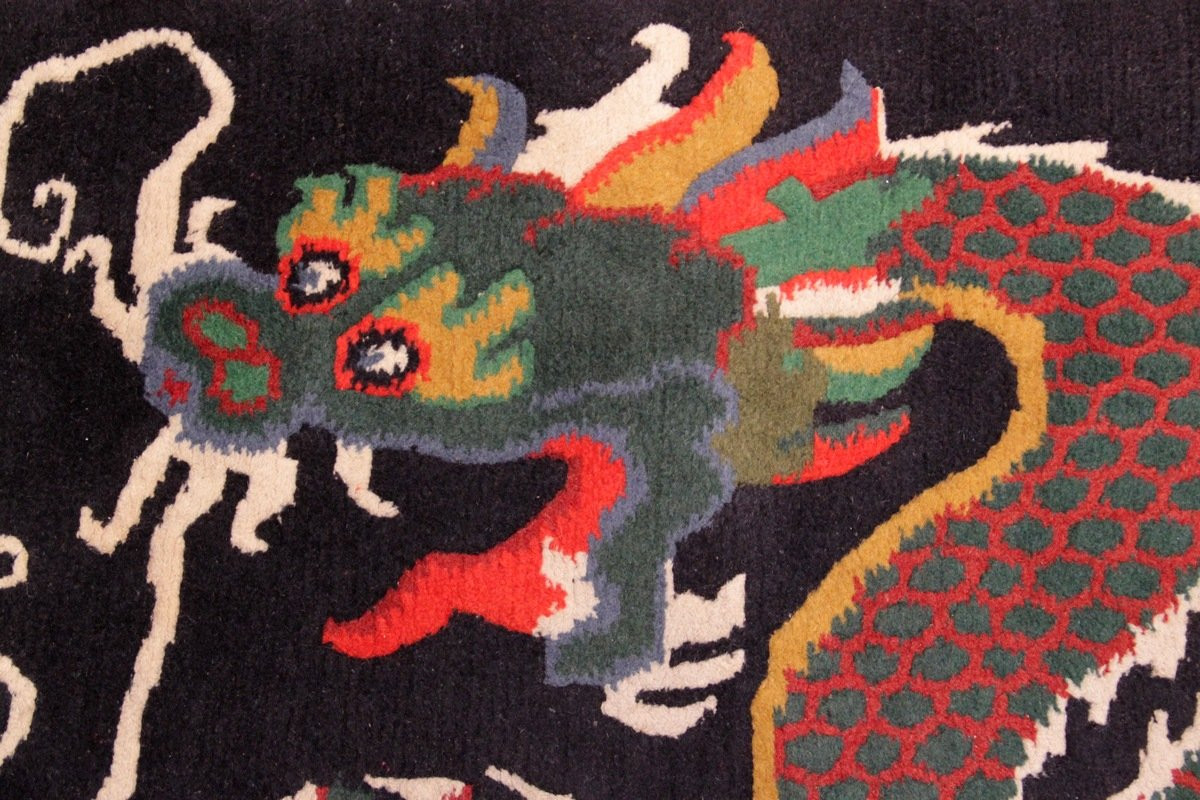


Tibetan Rug 175 X 93 Cm
Tibetan wool rug, cotton warp and weft, circa 1980. Very good condition.
This rug is typical of creations made in Darjeeling (India) or Nepal by Tibetan refugees.
Tibet (Xizang in Chinese) was, for a long time, difficult for foreigners to access. The first Tibetans were called the Qiang and were already in conflict with the Chinese from the 1st century BC to the 9th century AD. By the 16th century, the name Dalai Lama referred to the leader of the country. There is not much information available on Tibetan rugs. In the 1960s, Tibetans settled in Nepal and India, bringing their traditions and techniques to create rugs rich in symbolism.
The wool used in Tibetan rugs is of excellent quality and very thick. Note that the Tibetan knot differs from knots used in the East.
The rug features a dragon motif on a navy blue and black background. The dragon is a mythical creature depicted with four legs, sometimes wings, and a serpent's tail. In Chinese folklore, the dragon is the transformed form of a fish. It symbolizes fertility and, when paired with a pearl, represents thunder or the sun. In Tibetan culture, the dragon is a protective symbol. The dragon depicted here is a four-clawed dragon, reserved for the imperial nobility. The five-clawed dragon was reserved for the Emperor and Empress.
Free Chronopost delivery within France and Europe. Please feel free to contact us by phone or email. (We ship our rugs and kilims via Chronopost or Colissimo at our expense (up to 30 kg) within mainland France and Europe).
This rug is typical of creations made in Darjeeling (India) or Nepal by Tibetan refugees.
Tibet (Xizang in Chinese) was, for a long time, difficult for foreigners to access. The first Tibetans were called the Qiang and were already in conflict with the Chinese from the 1st century BC to the 9th century AD. By the 16th century, the name Dalai Lama referred to the leader of the country. There is not much information available on Tibetan rugs. In the 1960s, Tibetans settled in Nepal and India, bringing their traditions and techniques to create rugs rich in symbolism.
The wool used in Tibetan rugs is of excellent quality and very thick. Note that the Tibetan knot differs from knots used in the East.
The rug features a dragon motif on a navy blue and black background. The dragon is a mythical creature depicted with four legs, sometimes wings, and a serpent's tail. In Chinese folklore, the dragon is the transformed form of a fish. It symbolizes fertility and, when paired with a pearl, represents thunder or the sun. In Tibetan culture, the dragon is a protective symbol. The dragon depicted here is a four-clawed dragon, reserved for the imperial nobility. The five-clawed dragon was reserved for the Emperor and Empress.
Free Chronopost delivery within France and Europe. Please feel free to contact us by phone or email. (We ship our rugs and kilims via Chronopost or Colissimo at our expense (up to 30 kg) within mainland France and Europe).
875 €
Period: 20th century
Style: Other Style
Condition: Excellent condition
Material: Wool
Length: 175 cm
Width: 93 cm
Reference (ID): 1674686
Availability: In stock
Print