THIS OBJECT WAS SOLD
Portrait Of A Young Woman With A “giraffe” Hairstyle, 1834


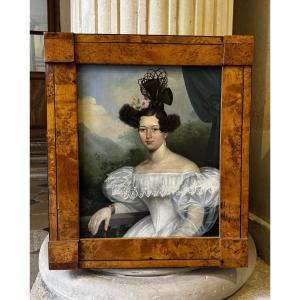


Portrait of a Young Woman with a “Giraffe” Hairstyle
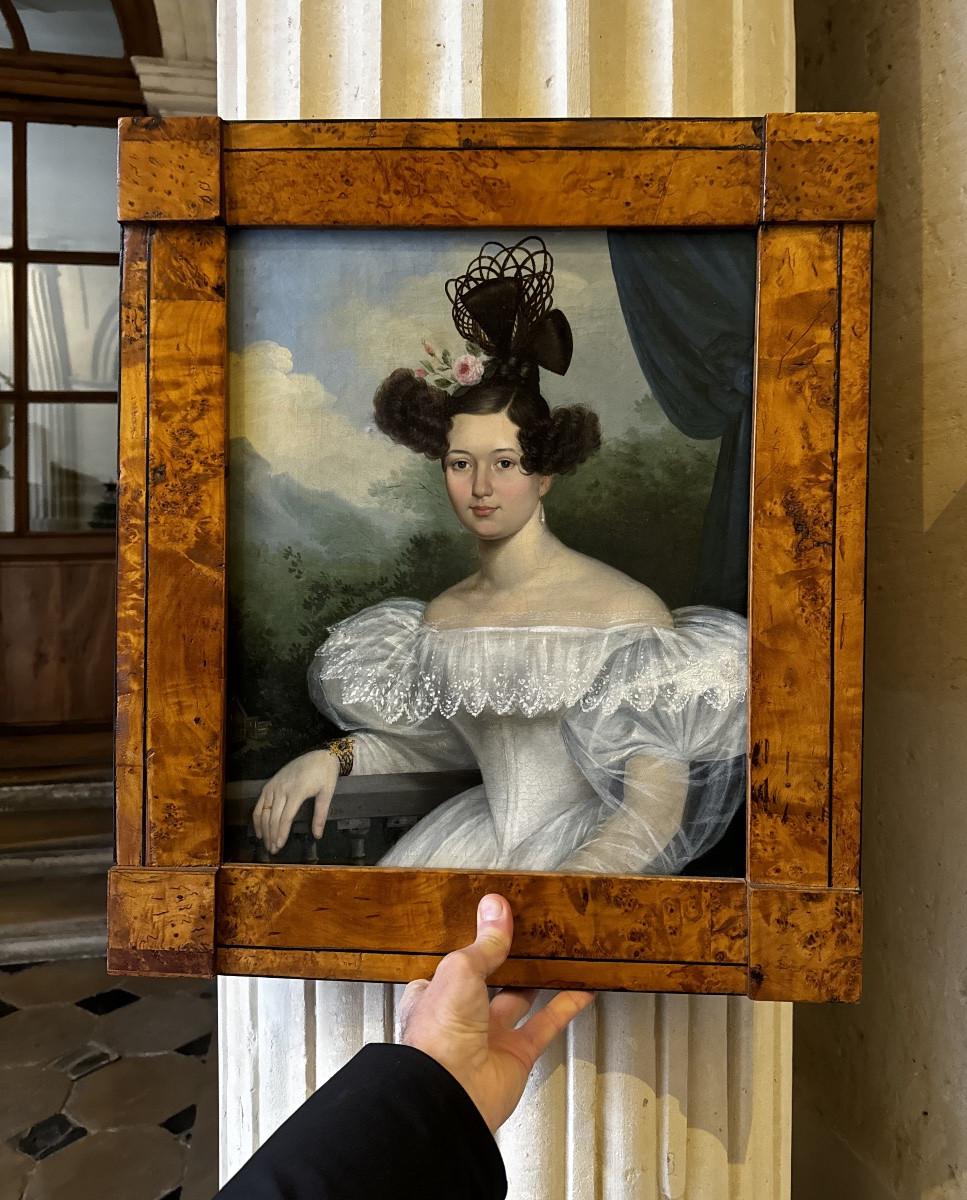
Oil on canvas, signed and dated 1834
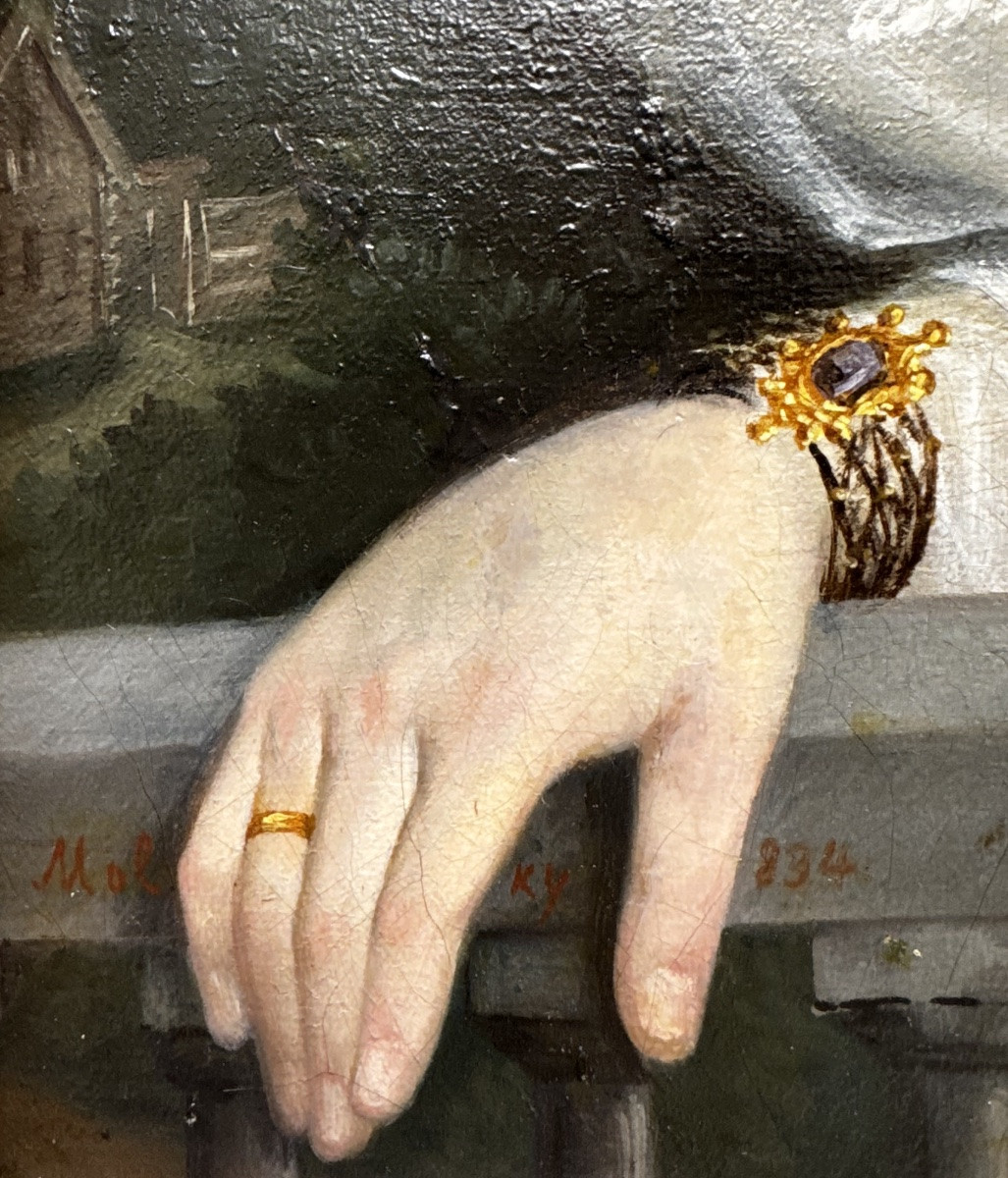
Signed Mol…ky (signature partially concealed by the sitter’s hand)
Original burl-wood frame
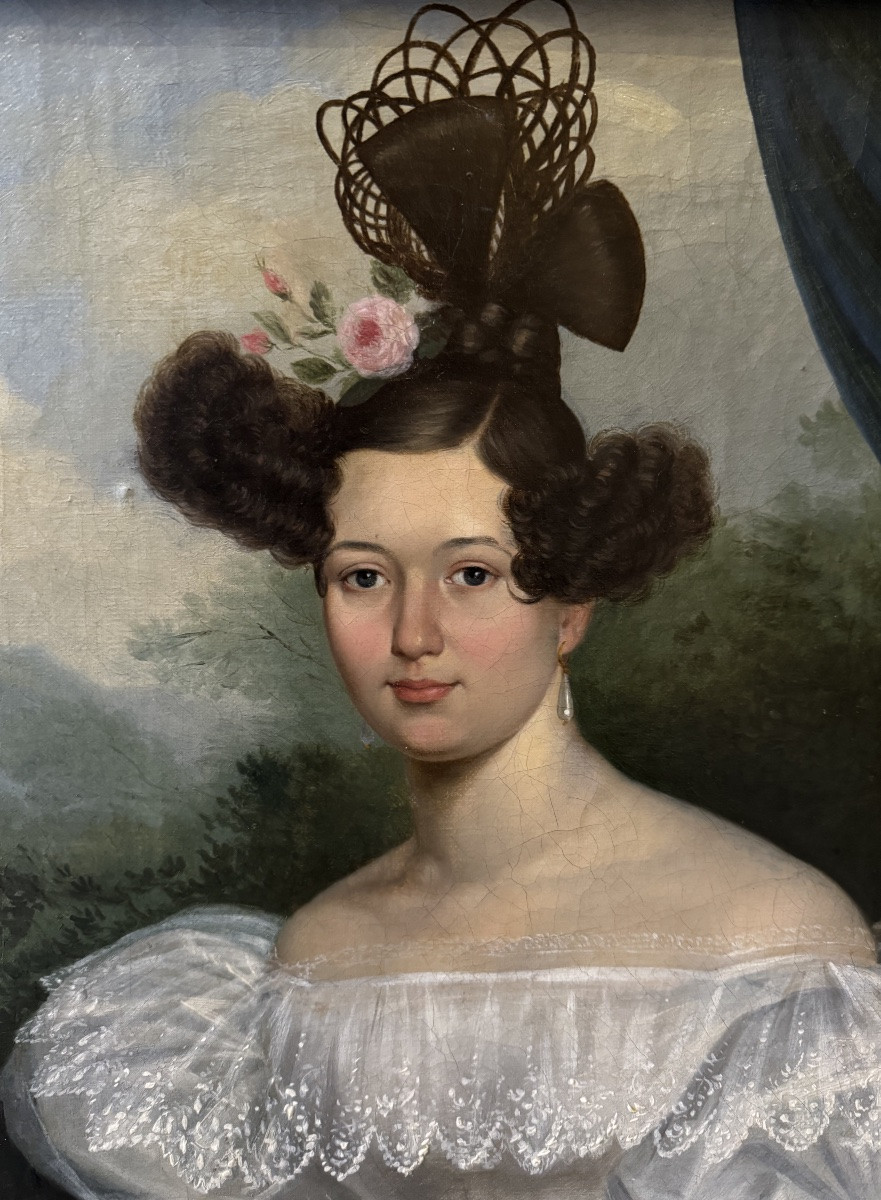
This refined portrait depicts an elegant young woman wearing a white dress with puffed sleeves in finely embroidered muslin. Her delicate, almost youthful face stands out against a charming landscape background in which a wooden country house can be discerned. The pearly tones of the flesh, the calm and direct gaze, and the smooth, carefully finished surface of the painting evoke an intimate portrait, intended for the sitter herself and her family circle.
The high hairstyle, structured with pronounced lateral volumes and adorned with a black hair net and a flower, corresponds to the so-called “giraffe” hairstyle, a fashion directly inspired by the extraordinary enthusiasm aroused by the arrival in France of the famous giraffe presented to King Charles X by Mehmet Ali, Viceroy of Egypt.
Captured in East Africa, the young giraffe was transported down the Nile to Alexandria, then shipped to Marseille. Upon her arrival in France in the autumn of 1826, she undertook an extraordinary journey of nearly 900 kilometres on foot in the spring of 1827, accompanied in particular by the naturalist Étienne Geoffroy Saint-Hilaire and her Oriental keepers. Her passage through towns and villages aroused immense curiosity everywhere. Presented to the king at Saint-Cloud, she was eventually installed at the Jardin des Plantes in Paris, where she became a true public phenomenon.
This event sparked a genuine “giraffemania”: decorative objects, textiles, prints, and above all women’s fashion embraced the elongated silhouette of the animal. Hairstyles rose higher, extending the line of the neck and head, giving rise to the “giraffe” hairstyle, which was especially fashionable between 1829 and 1835, not only in France but throughout Europe. Similar enthusiasms followed the arrival of giraffes offered to London and Vienna.
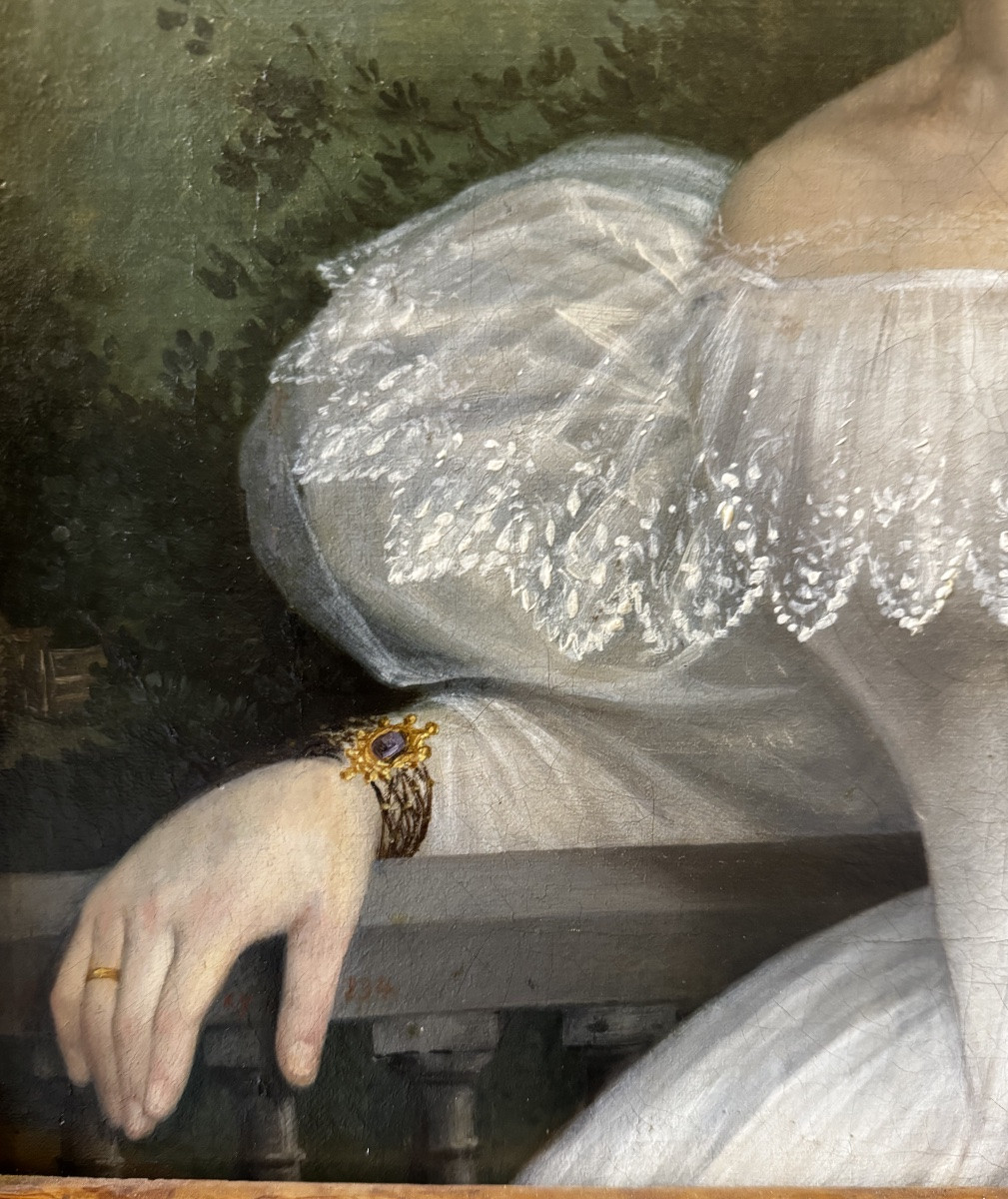
Another particularly telling detail draws attention: the young woman wears a hair bracelet at her wrist, braided from human hair and fitted with a clasp. Such jewellery, very popular in the early nineteenth century, belongs to the realm of sentiment and memory. Hair bracelets and jewels could serve as tokens of romantic or marital attachment, family keepsakes, or symbols of fidelity, sometimes associated with marriage.
This discreet yet meaningful detail reinforces the hypothesis that the sitter is a recently married young woman, especially as she also wears a ring on her ring finger. It situates the work firmly within the culture of sentiment characteristic of the post-Romantic period and the bourgeois world of the 1830s.
Through the precision of the drawing, the softness of the modelling, the restrained expression, and the absence of theatrical effect, this portrait clearly belongs to the Biedermeier aesthetic, dominant in bourgeois circles in Central Europe and the German-speaking regions during this period.
The painting is signed at the lower edge; the signature, partially legible as “Mol…ky”, is partly obscured by the sitter’s hand, inviting a cautious attribution to an artist active around 1830–1840, likely in Austria or its surrounding regions.
The canvas is in very good condition and is presented in its original burl-wood frame, highly characteristic of the period.
Dimensions (including frame): 51 × 57 cm
Explore similar pieces and discover your ideal find:
Portraits