THIS OBJECT WAS SOLD
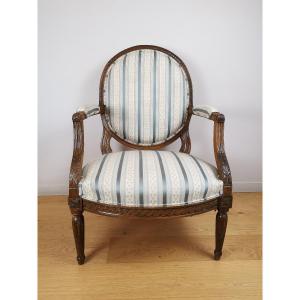
Empire Armchair, Jacob Desmalter, For The Imperial Palace Of The Tuileries.


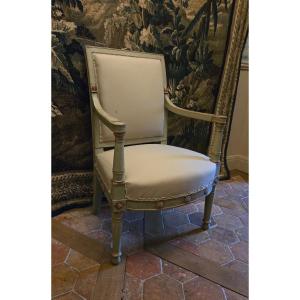


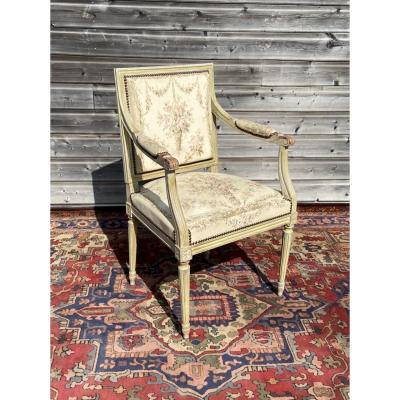
Paris, circa 1800–1810. Carved and painted wood. Provenance: Tuileries Palace. A rare Empire period armchair by Jacob Desmalter, bearing the stamp "Jacob D. rue Meslée," used by François-Honoré Jacob, known as Jacob Desmalter, after his partnership with his father and when he became the official cabinetmaker to the imperial court. This armchair is part of the fundamental historical context of the refurnishing of the Tuileries Palace beginning in 1800, the year Napoleon Bonaparte, First Consul, officially took up residence there on February 19, 1800. On this occasion, the former royal apartments were redesigned under the direction of the architect Charles Percier and later Fontaine, and a vast campaign of new furniture commissions was undertaken to adapt the residence to the new image of power. Jacob Desmalter played a central role in these commissions, supplying chairs, furniture, and complete suites for the official apartments and state rooms. Description: The armchair is crafted from carved and painted wood, retaining its original polychromy in a pale green, delicately highlighted with mahogany red. The seat's shape is typical of the Empire style: a straight, molded back, rectilinear armrests resting on turned uprights in the form of Roman columns, tapered legs with rings, and connecting blocks hollowed with a lozenge and a rosette. The seat rail is accented with carved discs. The rear legs are saber-shaped. The piece is distinguished by the monumental restraint of its design, emphasizing the chair's structure rather than excessive decoration, in accordance with the aesthetic principles of the Empire, inherited from Antiquity. Upholstery and Condition: The upholstery is later additions but in perfect condition, meticulously executed. The armchair is presented without decorative fabric, allowing the structure and proportions of the seat to be clearly visible. The frame is in very good condition, sound and stable, without major alterations, attesting to high-quality craftsmanship from a leading workshop. Inventory Marks and Provenance: The armchair retains a remarkable and consistent set of inventory marks, allowing its administrative history to be precisely traced: A printed label reading "Palais impérial des Tuileries – TH n° 8" attests that the armchair was in use at the Tuileries Palace during the First Empire. This designation very likely confirms an order for refurnishing the palace after Napoleon's installation in 1800. A brand mark of three fleurs-de-lis under a crown, accompanied by the initials "TH," corresponds to an official inventory during the Restoration, when the Imperial Furniture was integrated into the Royal Furniture, the Tuileries remaining a state residence. A printed label reading "Château des Tuileries," datable to 1829, attests that the armchair was still present at the palace at that time. The combined presence of these imperial and royal marks constitutes a rare documentary record, tracing the chair's history without interruption from its commission to its inclusion in public collections. Dimensions: Total height: 90 cm; Seat height: 41 cm; Width: 59 cm; Depth: 53 cm. Conclusion: With its Jacob Desmalter stamp, rue Meslée, its original polychromy, and above all, the wealth of its imperial and royal inventory marks, this armchair is a major example of the official furnishings of the Tuileries Palace, directly linked to Napoleon Bonaparte's move to the palace in 1800 and the major refurnishing campaigns that followed. It exemplifies Jacob Desmalter's crucial role in creating furniture for the ruling class and boasts a continuous institutional provenance, from the First Empire to the Restoration—a particularly rare occurrence for a chair now held outside of public collections.
Explore similar pieces and discover your ideal find:
Armchairs