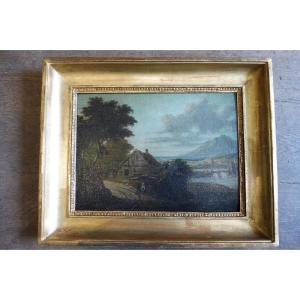
"Adalbert Waagen - Landscape On The Shores Of Lake Tegern In Southern Bavaria"
Adalbert Waagen, Munich, 1834 – Bertesgaden, 1898. On the shores of Lake Tegern in Southern Bavaria. Oil on panel. Signed and dated lower left "A. Waagen. 1857". Located on the reverse "Gegend am Tegern See". 25 x 40 cm (39 x 53 cm with frame). Very good condition. Beautiful 19th-century carved and gilded wood frame. Viewable at the gallery. Adalbert Waagen was a German landscape painter. He devoted himself primarily to landscapes, and more specifically to mountain landscapes. His style was influenced by his teacher, Zimmermann, via Joseph Anton Koch. Leopold, Prince Regent of Bavaria, awarded him the honorary title of Royal Professor in 1891. His works are held in the Martin von Wagner Museum, the Julius Maximilian University of Würzburg, and the Munich City Museum. Waagen first studied with Albert Zimmermann in Munich between 1855 and 1858. Our painting, dated "1857," dates from this period. After completing his studies in 1860, Waagen established his studio in Munich, in the home of his friend Karl Millner. He regularly undertook study trips with Hermann Krüger and other students to the mountains of Old Bavaria and Tyrol. Our painting, in fact, is set in southern Bavaria "near Lake Tergen." Waagen's style became broader and more realistic at this time, both in its atmosphere and its use of color. At this time, Waagen became a central figure in the vibrant artistic circle of "Young Munich," alongside Otto Stöger, Theodor Pixis, Georg Kremplsetzer, August Spieß, Friedrich and Heinrich Lossow, and Christian Jank. After the death of his uncle, the metronome Schechner, Waagen inherited his magnificent villa in Berchtesgaden and settled permanently with his young wife in 1869 in the studio built into the mountainside, facing the Watzmann: a place of exceptional beauty. Numerous commissions then poured in from England, America, and Russia. Waagen became very famous and notably worked on the design of a cycle of "Landscapes of the Nibelungs" for King Ludwig II, drawing inspiration from Preller's Odyssey paintings. These landscapes were to be painted as frescoes at Schwanstein Castle. (Source: Allgemeine Deutsche Biographie. Vol. 54. Leipzig: Duncker & Humblot. pp. 778–780) 










 Le Magazine de PROANTIC
 TRÉSORS Magazine
 Rivista Artiquariato