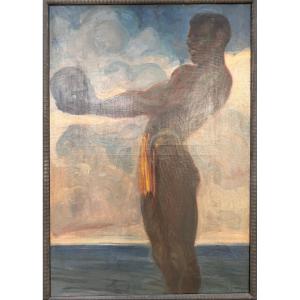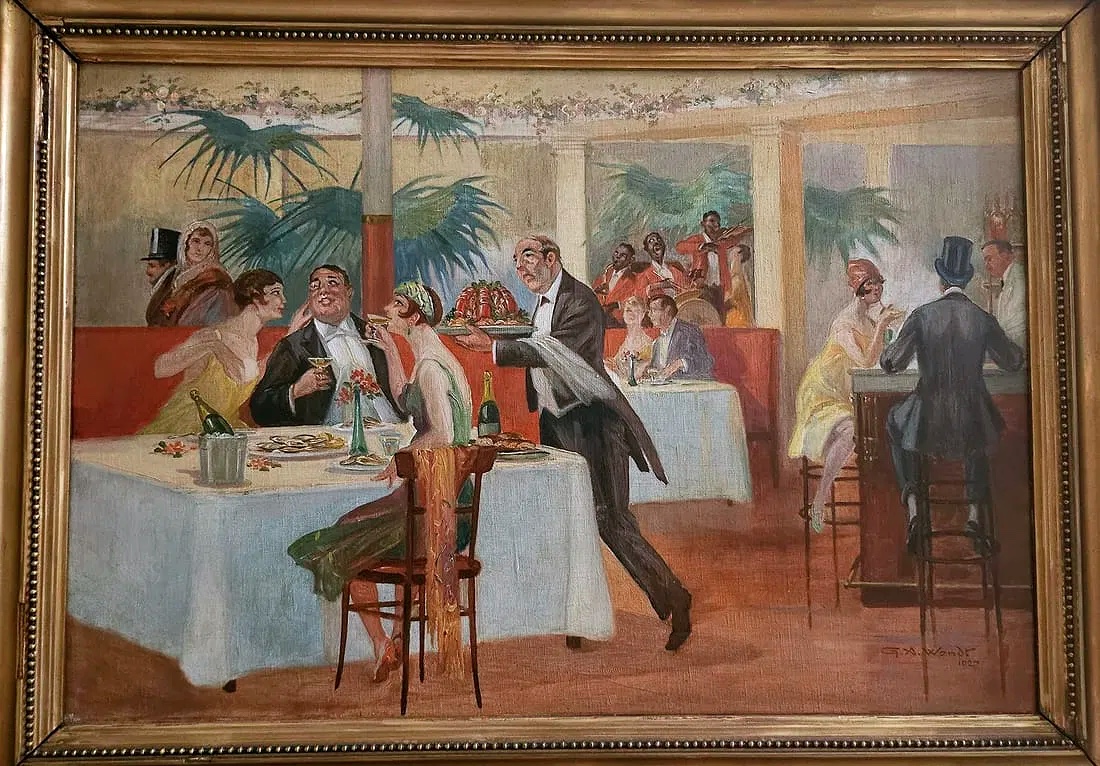


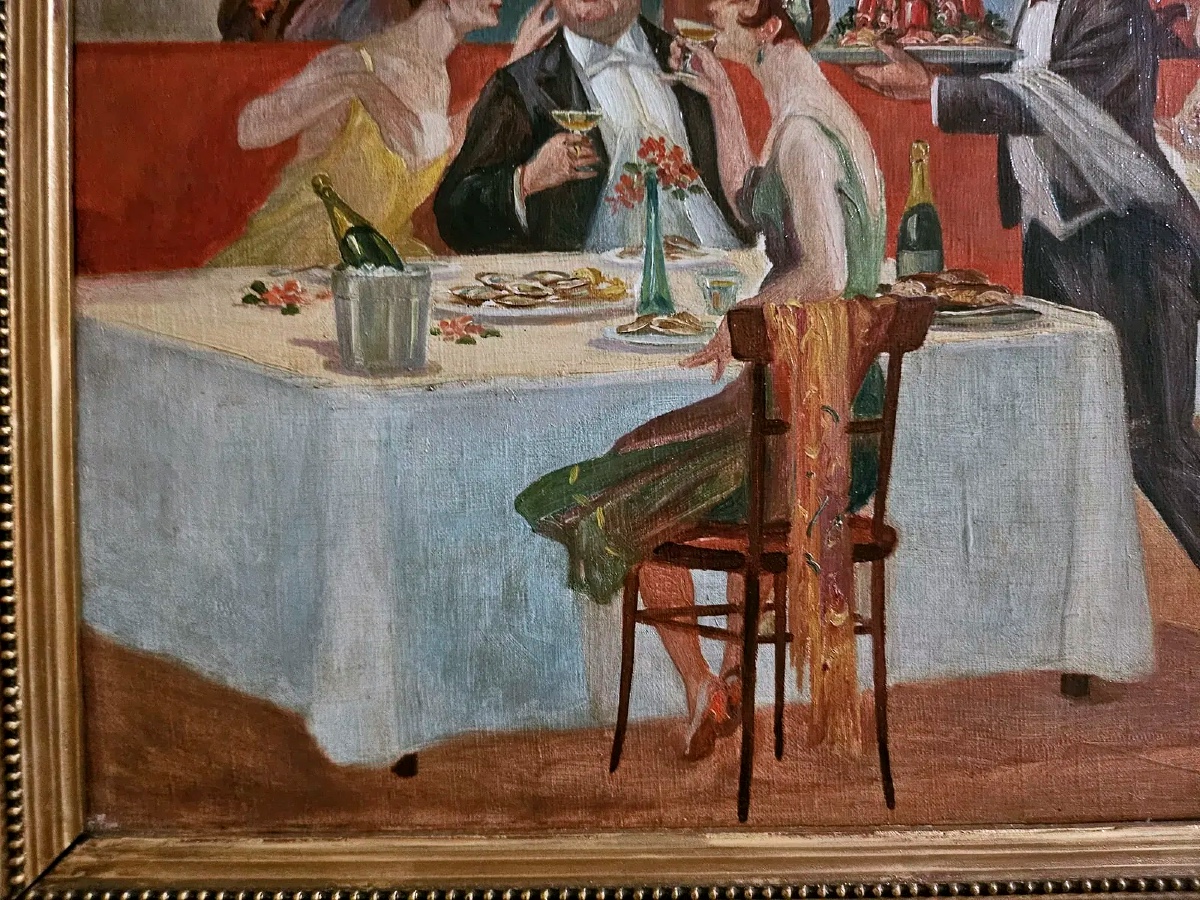


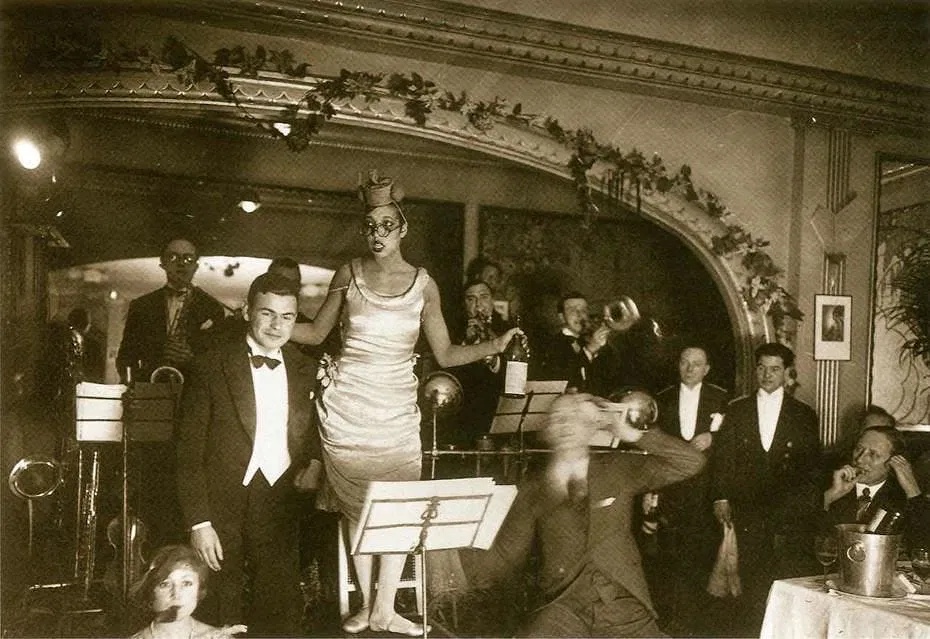


Art Nouveau Oil On Canvass Painting Depicting Famous Montparnasse Restaurant " La Coupole "
A restaurant hall with guests and set tables, with a black jazz band in the background.Signed and dated in the lower right corner:G.X.Wendt 1927Condition:GoodMeasures: 65/48 cmJosephine Baker, born Freda Josephine McDonald on June 3, 1906 in St. Louis, Missouri, embodies an exceptional destiny, between dance, song, resistance and commitment to justice. Naturalized French in 1937, she forged deep ties with France, where she became an emblematic figure. Josephine Baker is not only an artistic icon, but also a World War II resistance fighter, decorated for her heroism. Her love for France was palpable, and she chose to rest there eternally, at the Château des Milandes. This captivating portrait reveals a flamboyant, committed and generous woman who left an indelible mark on Franco-American history.Josephine Baker first found a role in Philadelphia with the Dixie Steppers touring troupe. In 1922, she moved to Harlem, New York, where she landed successive roles in Daly’s 63rd Street Theater for the musical Shuffle along, with the Chocolate Dandies, and at the Plantation Club.Josephine Baker is spotted by an impresario from the Théâtre des Champs-Elysées, looking for a new type of show, who convinces her to come to France.Josephine Baker conquered Parisian audiences in 1925 at the Théâtre des Champs-Élysées with her show "La Revue Nègre". Her dazzling success propelled her into a career as a singer, notably with the unforgettable song "J’ai deux amours". Within a few years, she became the first black international star and one of the highest-paid artists in Europe.Josephine Baker, nicknamed "the Black Venus", realized that France offered a freedom she didn’t have in the United States. In 1937, she became a French citizen and, during the Second World War, her loyalty to her adopted country led her to become actively involved in the French Resistance. Travelling throughout North Africa, she used her celebrity to gather intelligence for the Free French. For her services to France, she received several decorations including the Légion d’honneur, the Croix de guerre avec palme and the Médaille de la Résistance avec rosette.After the war, she threw herself heart and soul into the fight against racism. At the same time, her return to the French stage as an artist consolidated her iconic status. In 1963, alongside Martin Luther King Jr at the March on Washington, she gave a memorable speech on the freedom that she gained in France, contrasting it with the oppression she had experienced in the United States. Dressed in her French army uniform, proudly wearing her decorations, she declared: "In France, I was never afraid".She continued her fight against injustice, campaigning alongside the International League against Racism and Anti-Semitism (Licra) in France. Her château in Les Milandes became a haven of peace for a "rainbow tribe" of twelve adopted children, illustrating her inclusive and generous vision.But this dream of harmony between peoples came up against reality. Too generous and spendthrift, the artist sunk her fortune into a lavish lifestyle. In the end, she found support from her friend Princess Grace of Monaco.In her sixties, the music-hall diva continues to perform on stage. In 1975, to celebrate her 50-year career and love affair with the French, a show was staged at Bobino. In front of the whole of Paris, Josephine Baker was a triumph. On April 10, after a few performances, she was found unconscious in her apartment, victim of a cerebral hemorrhage.On November 30, 2021, forty-six years after her death, Josephine Baker was admitted to the Panthéon by decision of French President Emmanuel Macron. It’s a fitting tribute to an extraordinary woman who devoted her life to the quest for freedom and justice. Today, her legacy continues to shine, reminding everyone of the importance of fighting discrimination and celebrating diversity.Of Josephine Baker, Ernest Hemingway said, "the most sensational woman anyone ever saw."La Coupole is a famous brasserie in Montparnasse in Paris. It was opened on December 20, 1927 by Ernest Fraux and René Lafon during the Roaring Twenties when Montparnasse housed a large artistic and literary community – expatriates and members of the Lost Generation. They decorated the place in the contemporary art deco style.Artists of the School of Paris and intellectuals frequented the brasserie in the interwar period.The La Coupole Dance Hall, in the basement, opened on December 24, 1928 and is where musicians performed. Filiberto Rico's Rico's Créole Band (1910-1976) was the main orchestra of La Coupole, playing rumba, bolero, guaracha, samba and other baião until the 1960s.Among the first artists and intellectuals to adopt La Coupole as their regular haunt were Jean Cocteau, Alberto Giacometti, Joséphine Baker, Man Ray, Georges Braque and Brassaï. Louis Aragon and Elsa Triolet met there in 1928. In the 1930s, aficionados of La Coupole were PPablo Picasso, Simone de Beauvoir and JeanPaul Sartre, Sonia Delaunay, André Malraux, Jacques Prévert, Marc Chagall, Édith Piaf among many others. In the 1940s and 1950s La Coupole was frequented by Ernest Hemingway, Henry Miller, Marlene Dietrich, and Ava Gardner.
Condition Good condition
Dimensions 48 x 65 cm
Condition Good condition
Dimensions 48 x 65 cm
7 500 €
Period: 20th century
Style: Art Deco
Condition: Good condition
Material: Oil painting
Reference (ID): 1670319
Availability: In stock
Print