




Depiction Of The Black Madonna As Sancta Maria De Pace
Sancta Maria de Pace
Oil on canvas, marouflaged on panel
Probably Germany, 18th century
Dimensions: approx. 46 × 35 cm (exclusief. frame)
Provenance: Private collection, South Germany
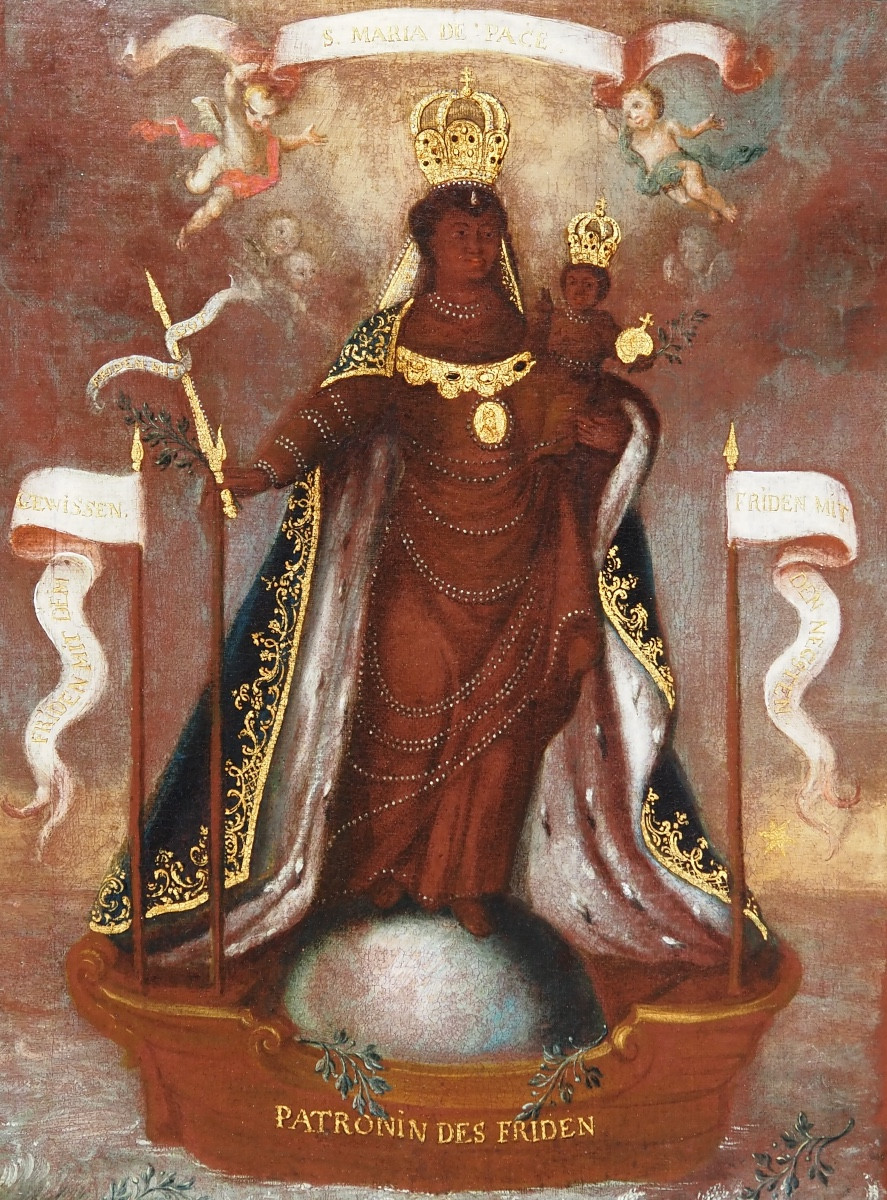
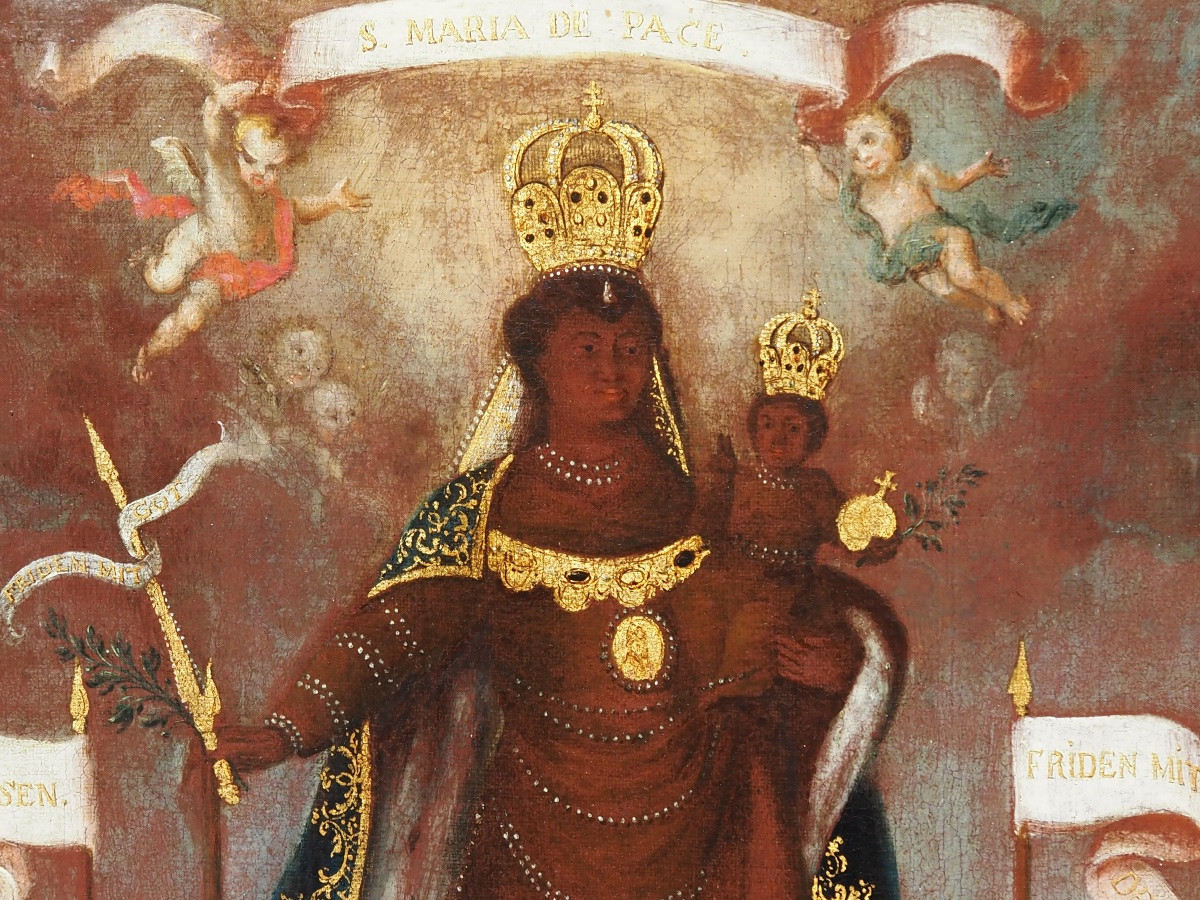
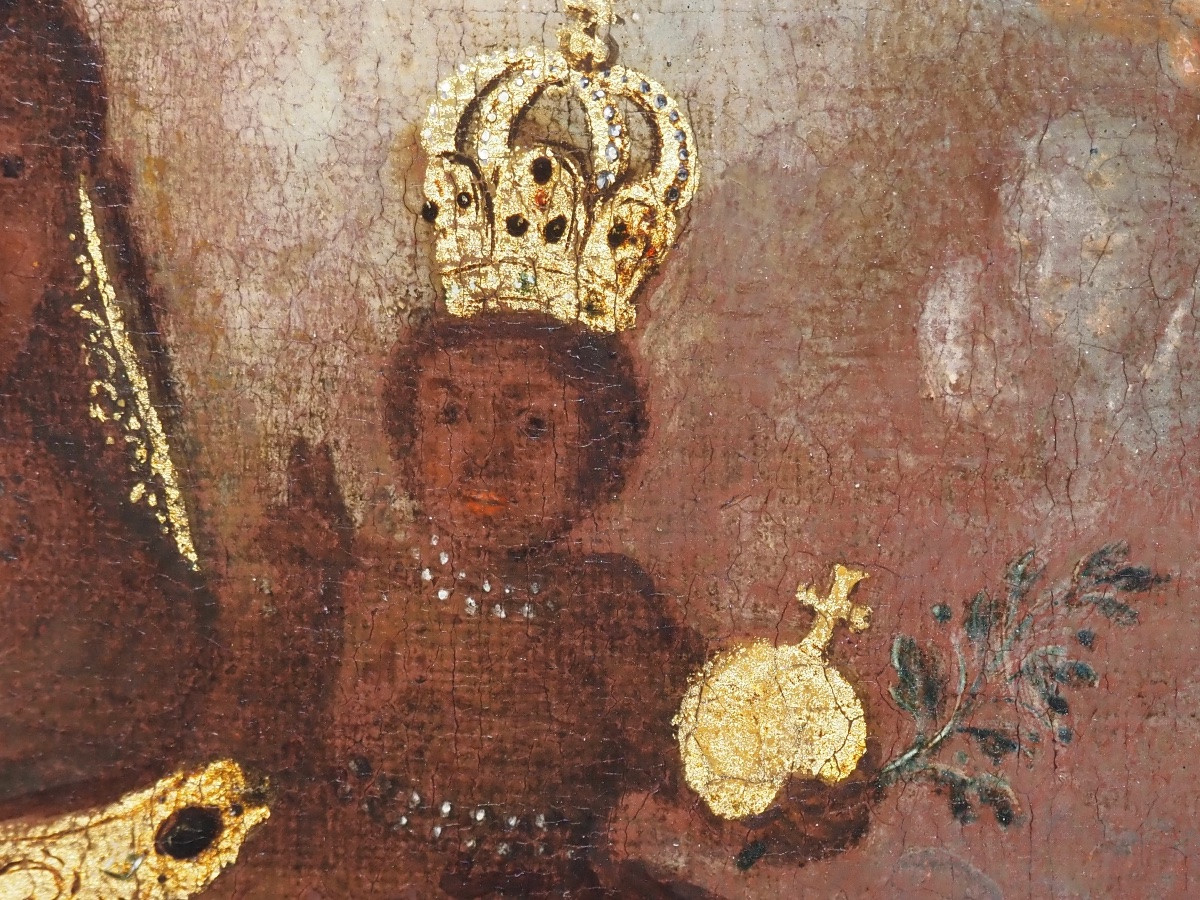
This painting shows a depiction of the Black Madonna as Sancta Maria de Pace, Mary, Queen of Peace. Both the Madonna and the Christ Child have dark skin and tightly curled hair. Mary wears a long brown underdress and a blue-and-gold decorated ermine mantle, white-lined with black tail tips. In her right hand she holds both a sceptre and a branch, portraying her as Regina Pacis, Queen of Peace. A golden oval medallion bearing the image of a papal figure hangs on her chest. She stands on a globe placed within a boat-shaped basin floating on still water, possibly a lake or sea.
The Christ Child, seated on Mary’s left arm, also wears a brown garment and holds in his left hand a golden globus cruciger and a branch, possibly an olive branch. This peace-branch appears throughout the image: similar tendrils wind along both sides of the composition and also spring from the basin in which Mary stands upon the globe. Both figures wear multiple strings of pearls as symbols of purity and spiritual authority, and both are crowned.
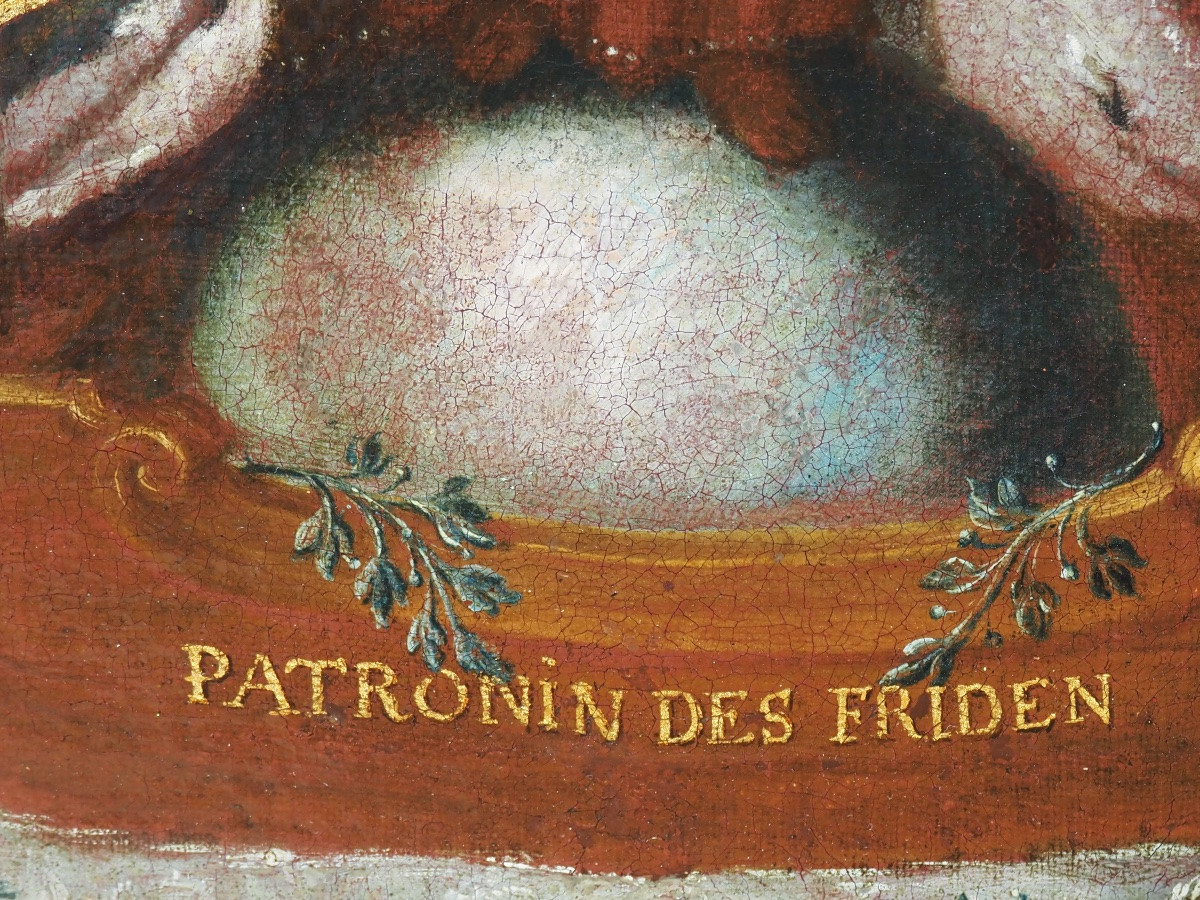
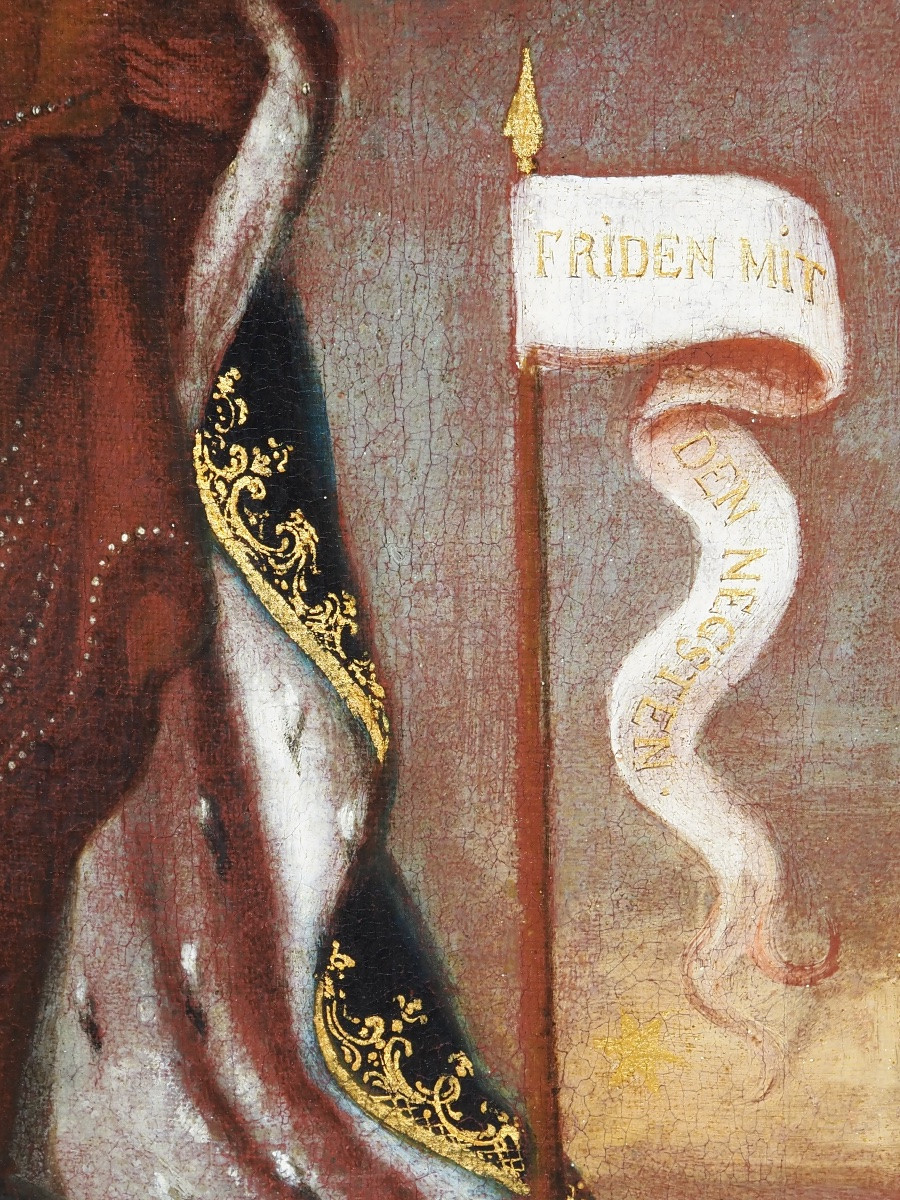
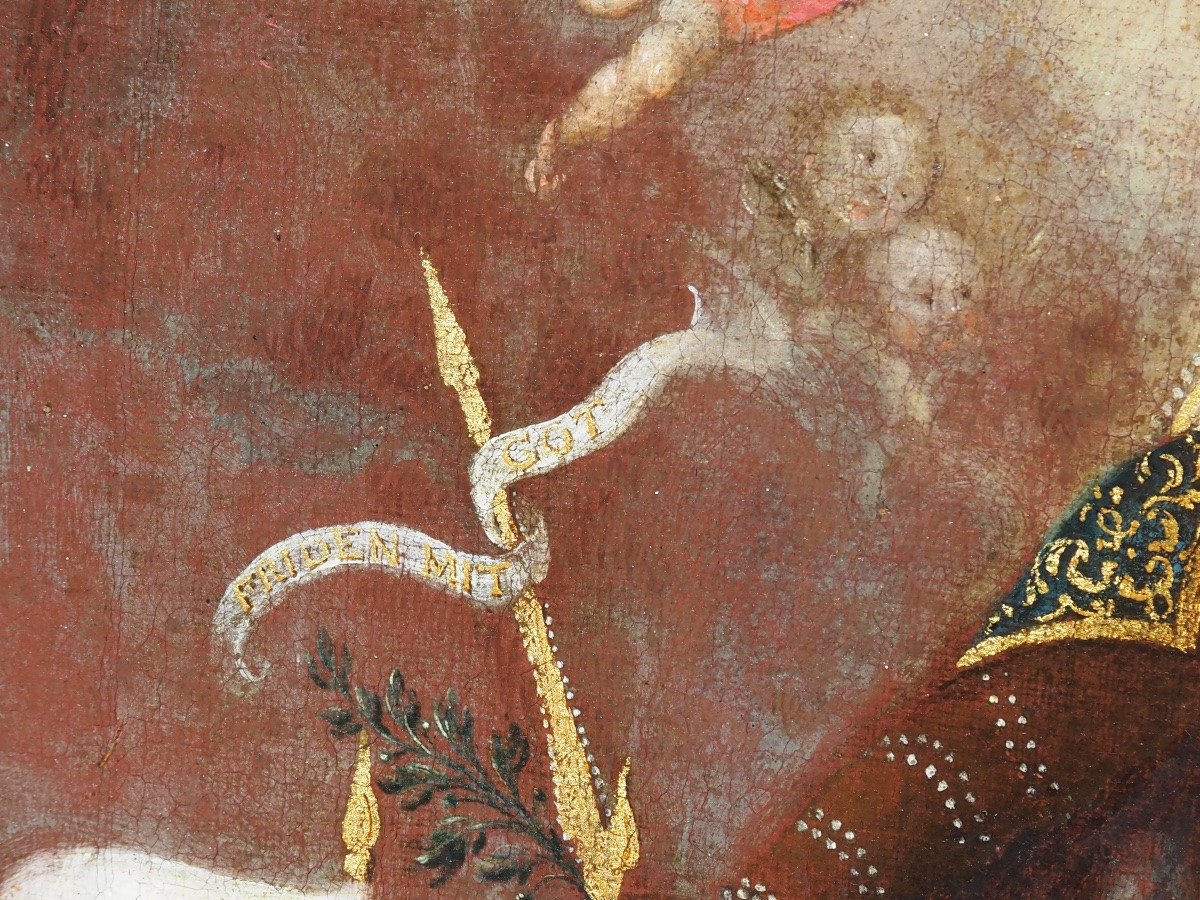
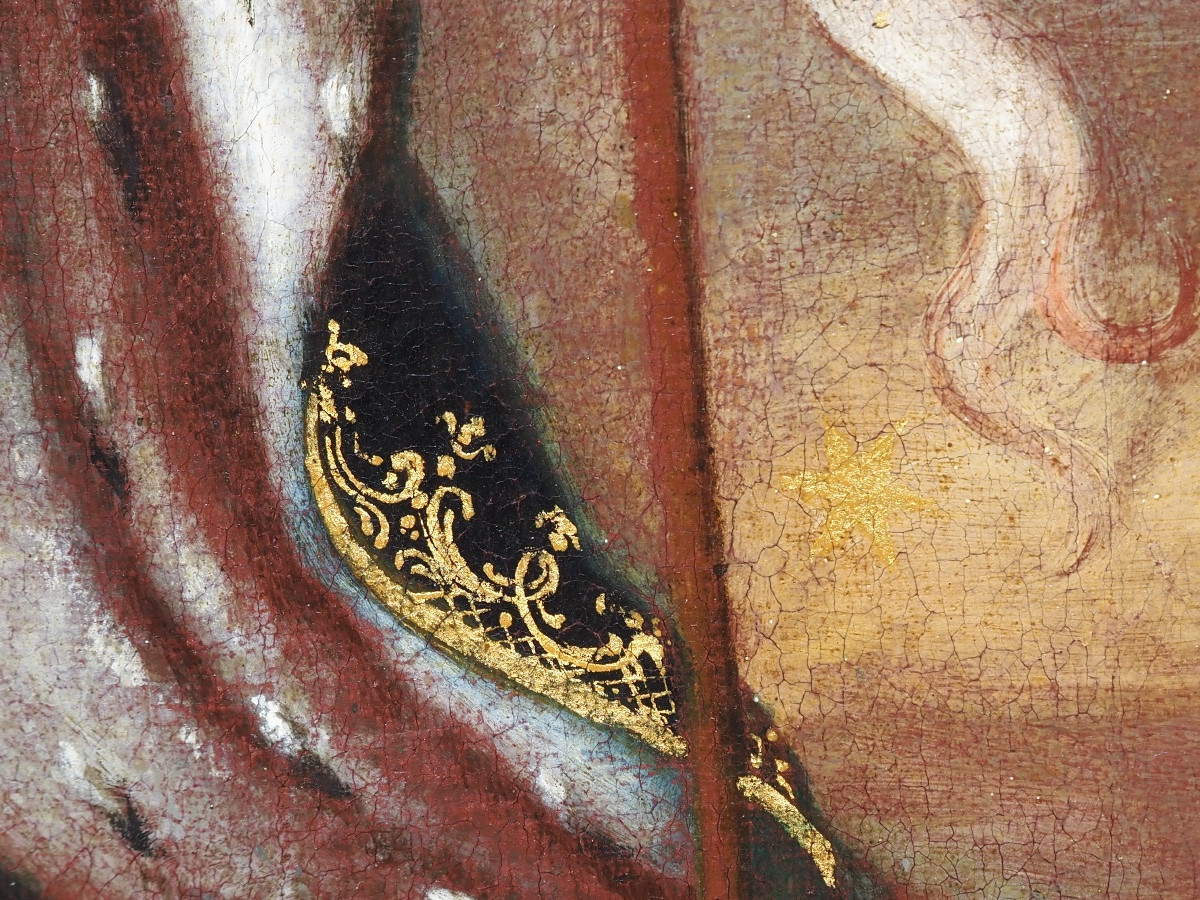
On the rim of the basin the inscription “PATRONIN DES FRIDEN” appears in golden letters. Attached to the sceptre in Mary’s right hand is a banner reading “FRIDEN MIT GOT.” (Peace with God) On either side of the basin are two flagpoles with banners reading “FRIDEN MIT DEM GEWISSEN” (left, Peace with the conscience) and “FRIDEN MIT DEN NECSTEN” (right, Peace with one’s neighbour(s)). Below the right banner, a five-pointed star appears, referring to Mary as Stella Maris (Star of the Sea). Above Mary’s head, a banner with the inscription “S. MARIA DE PACE” is held by two putti.
The composition follows the Baroque visual language of the Regina Pacis devotion, in which Mary is presented as an intermediary for peace: with God, with oneself (the conscience), and with one’s neighbour, a triad also found in the theological discourse surrounding peace sermons and Masses of the 17th and 18th centuries.
The image is closely related to a series of 17th- and 18th-century engravings from the Carmelite convent in Cologne (Karmel Maria vom Frieden), where a devotion to Maria de Pace developed around a Marian statue donated by Maria de’ Medici. This statue, later lost, was considered miraculous and was invoked as a bringer of peace especially during the Thirty Years’ War. Several engravings from this context depict Mary with the Child on a globe, with olive branches and banners or inscriptions emphasizing her peace-bearing title.
In contrast to these prints, on which Mary is usually shown with European facial features, this painting, like another example in the former Augustinian Canons’ monastery of Pfaffen-Schwabenheim, presents a Black Madonna. There is no evidence that the original statue in Cologne was black, which makes these paintings all the more remarkable. The combination of devotional iconography and dark skin tone appears to make this an extremely rare representation within early modern Marian devotion.
Of particular interest within the context of the Maria de Pace veneration is the presence of Edith Stein (Sr. Teresia Benedicta of the Cross) at the Karmel Maria vom Frieden in Cologne. She entered this Carmelite community in 1933 and remained there until her departure on 31 December 1938, when she left for the Carmel in Echt (the Netherlands) for reasons of safety. According to sources from the Edith Stein Archive, on her last day in Germany she made a brief prayer visit to the Maria vom Frieden church, by then already serving as a parish church, to pray before the “Queen of Peace.”
* Engraving in the last image included with the purchase.
Oil on canvas, marouflaged on panel
Probably Germany, 18th century
Dimensions: approx. 46 × 35 cm (exclusief. frame)
Provenance: Private collection, South Germany
This painting shows a depiction of the Black Madonna as Sancta Maria de Pace, Mary, Queen of Peace. Both the Madonna and the Christ Child have dark skin and tightly curled hair. Mary wears a long brown underdress and a blue-and-gold decorated ermine mantle, white-lined with black tail tips. In her right hand she holds both a sceptre and a branch, portraying her as Regina Pacis, Queen of Peace. A golden oval medallion bearing the image of a papal figure hangs on her chest. She stands on a globe placed within a boat-shaped basin floating on still water, possibly a lake or sea.
The Christ Child, seated on Mary’s left arm, also wears a brown garment and holds in his left hand a golden globus cruciger and a branch, possibly an olive branch. This peace-branch appears throughout the image: similar tendrils wind along both sides of the composition and also spring from the basin in which Mary stands upon the globe. Both figures wear multiple strings of pearls as symbols of purity and spiritual authority, and both are crowned.
On the rim of the basin the inscription “PATRONIN DES FRIDEN” appears in golden letters. Attached to the sceptre in Mary’s right hand is a banner reading “FRIDEN MIT GOT.” (Peace with God) On either side of the basin are two flagpoles with banners reading “FRIDEN MIT DEM GEWISSEN” (left, Peace with the conscience) and “FRIDEN MIT DEN NECSTEN” (right, Peace with one’s neighbour(s)). Below the right banner, a five-pointed star appears, referring to Mary as Stella Maris (Star of the Sea). Above Mary’s head, a banner with the inscription “S. MARIA DE PACE” is held by two putti.
The composition follows the Baroque visual language of the Regina Pacis devotion, in which Mary is presented as an intermediary for peace: with God, with oneself (the conscience), and with one’s neighbour, a triad also found in the theological discourse surrounding peace sermons and Masses of the 17th and 18th centuries.
The image is closely related to a series of 17th- and 18th-century engravings from the Carmelite convent in Cologne (Karmel Maria vom Frieden), where a devotion to Maria de Pace developed around a Marian statue donated by Maria de’ Medici. This statue, later lost, was considered miraculous and was invoked as a bringer of peace especially during the Thirty Years’ War. Several engravings from this context depict Mary with the Child on a globe, with olive branches and banners or inscriptions emphasizing her peace-bearing title.
In contrast to these prints, on which Mary is usually shown with European facial features, this painting, like another example in the former Augustinian Canons’ monastery of Pfaffen-Schwabenheim, presents a Black Madonna. There is no evidence that the original statue in Cologne was black, which makes these paintings all the more remarkable. The combination of devotional iconography and dark skin tone appears to make this an extremely rare representation within early modern Marian devotion.
Of particular interest within the context of the Maria de Pace veneration is the presence of Edith Stein (Sr. Teresia Benedicta of the Cross) at the Karmel Maria vom Frieden in Cologne. She entered this Carmelite community in 1933 and remained there until her departure on 31 December 1938, when she left for the Carmel in Echt (the Netherlands) for reasons of safety. According to sources from the Edith Stein Archive, on her last day in Germany she made a brief prayer visit to the Maria vom Frieden church, by then already serving as a parish church, to pray before the “Queen of Peace.”
* Engraving in the last image included with the purchase.
15 000 €
Period: 18th century
Style: Other Style
Condition: Good condition
Material: Oil painting
Width: 35 cm.
Height: 46 cm.
Reference (ID): 1670074
Availability: In stock
Print