Louis XVI Style Clock With A Globe In Homage To The Navigator Marion Dufresne
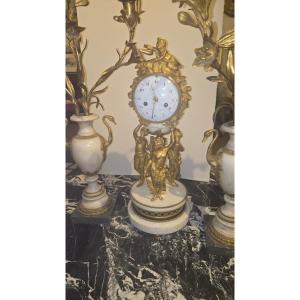
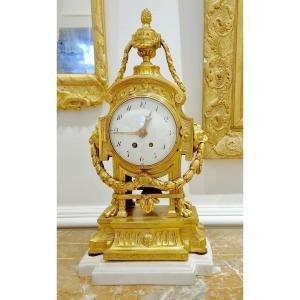
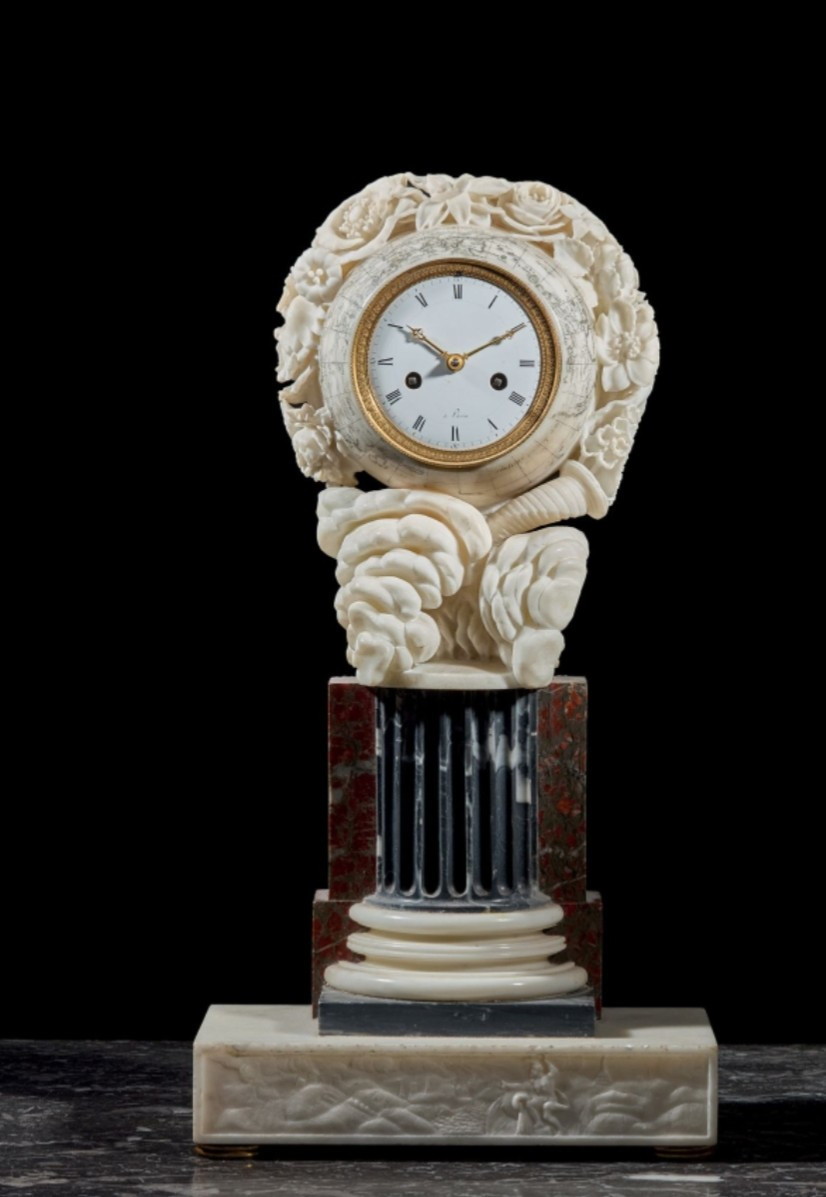
A clock, known as the “Homage to Captain MARION-DUFRESNE” clock, in white, black, and red veined marble, Paris, circa 1790. The enamel dial is mounted on a black Doric column, with sculpted white marble decoration depicting wisps of mist terminating in flowering cornucopias. The rounded rim of the dial features a map engraved in black, with the inscription: “Kerguelen, I. seen by Marion in 1772”. The dial, with black Roman numerals, is marked “Paris”. The rectangular white marble base is adorned with a frieze of classical figures. This “Homage Clock” is dedicated to the navigator and explorer Marc Joseph Marion du Fresne, known as MARION-DUFRESNE (1724-1772). 52 x 28 cm Marc Joseph Marion du Fresne, known as MARION-DUFRESNE (1724-1772), who notably discovered Marion Island, Prince Edward Island, and the Crozet Islands in 1772. At the age of 11, his father arranged for him to embark for the first time in 1735 on a ship of the French East India Company, bound for Pondicherry, as an ensign ad honores (unpaid). It was during his numerous voyages to America, Africa, Île de France (now Mauritius), and India that he became friends with Captain d'Après de Mannevillette, a learned officer and renowned hydrographer. Under his tutelage, Marion made his first surveys and created his first nautical charts. From 1750 to 1769, he pursued a career with the French East India Company. When the Seven Years' War broke out in May 1756, he was appointed captain of the Compagnie des In 1761. Marion received command of the ship Le Comte d'Argenson, tasked with transporting a scientific mission to Rodrigues Island, then French, located in the Indian Ocean 500 km north of Mauritius. He took the astronomer Alexandre Guy Pingré there to observe the transit of Venus. During his last exploration, on January 13, 1772, at 46° south latitude, he sighted land too shrouded in mist to determine if it was inhabited. He named it Terre de l'Espérance (Land of Hope) and Île de la Caverne (Cave Island). (This archipelago, composed of two islands, was rediscovered by Cook in 1776, who named them the Prince Edward Islands.) The flowered horn emerging from the mist on the clock is certainly a reference to this episode. The captain died on June 12, 1772, in the Bay of Islands, New Zealand, under obscure and tragic circumstances—some even alleging cannibalism—about which much has been written. Marion-Dufresne's journal was never found. According to the latest version, attested to by a historian and based on the testimony of a descendant* of a sailor from the expedition, Marion-Dufresne ventured into forbidden waters to fish and was massacred along with his escort by the Maori.
35 000 €
Period: 18th century
Style: Louis 16th, Directory
Condition: Excellent condition
Material: Marble
Reference (ID): 1666887
Availability: In stock
Print