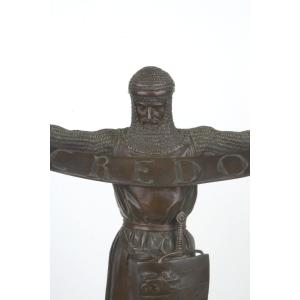


"Creed - Emmanuel Fremiet - 1824-1910"
The first Credo was created in 1885. Made of plaster, it is exhibited in Antwerp. Emmanuel FREMIET then cast a bronze one whose success is immediate: he sells 112 editions in just two years and three months!The composition of the statue is affirmed, the vertical vision being broken the horizontal form composed by the two arms and the banner. The rest of the statue is sober, even if the detail is precisely chiseled. The eye should only be captivated by the general appearance of the Crusader, and by the banner that expresses his Faith.
Emmanuel FREMIET liked to tell this little anecdote that his grandson, Philippe FAURÉ-FREMIET, relates in his work 'FREMIET', about the inspiration that had guided him in his
creation of the Credo: "one evening while he is in his workshop, he learns by reading a friend’s letter that one of his most fervent prayers has been answered. A surge of gratitude lifts him, head bent and arms crossed, reciting his Credo. In memory of this moment of grace, he sculpted this Credo on which we find the features of the sculptors in those of the Crusader.
Emmanuel FREMIET :
If until 1874, his name was well known to his peers, it is the inauguration of his monumental equestrian statue of Joan of Arc, place des Pyramides in Paris, which reveals him to the general public. The animal sculptor of genius that he was, considered as the equal of the one who marked so much this genre, the great master Antoine-Louis BARYE (1795-1875) enters by the big door in the cenacle of the monumental sculptors. The Second Empire but especially the Third Republic send him many orders.
Master imagier, to take up the expression of his biographer Jacques de BIEZ, Emmanuel FREMIET sculpts with as much happiness and humor, whatever the theme. The skillful fingers give birth to a whole world of graceful, elegant statuettes that each tell a little about the history of France with a lot of picturesque but above all a remarkable realism and sense of historical detail. Moreover, Emmanuel FREMIET does not work in a vacuum.
Before seizing his draft, he constitutes his sources and diligently attends the
libraries. Nothing is left to chance...












 Le Magazine de PROANTIC
 TRÉSORS Magazine
 Rivista Artiquariato