






Maurice Millière (1871-1946) An Artist In His Studio, Oil On Canvas, Signed
Artist: Maurice Millière (1871-1946)
Maurice Milliere (1871-1946)
An artist in his studio,
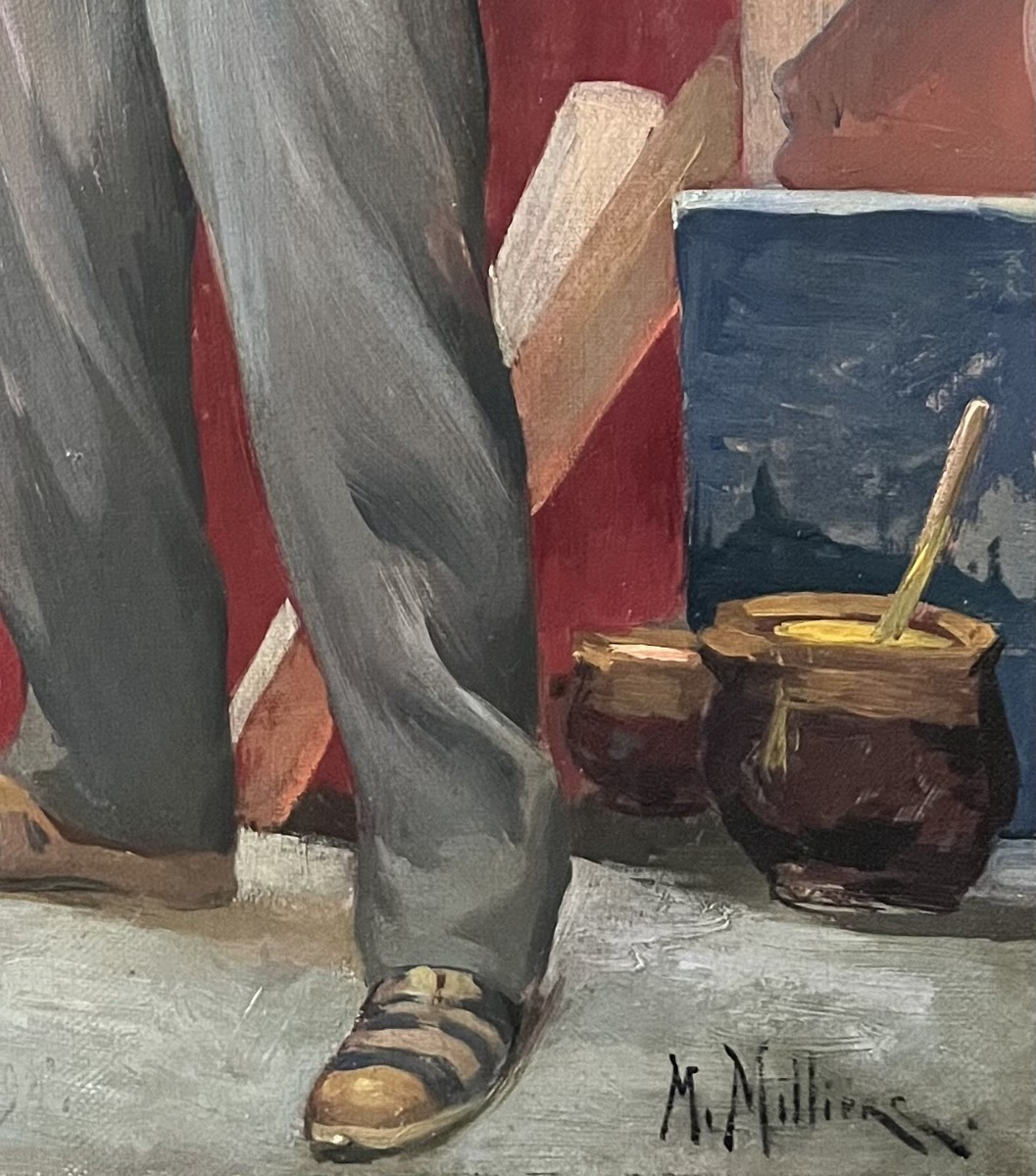
signed lower right
oil on canvas
46 x 27 cm
framed : 52 x 33 cm
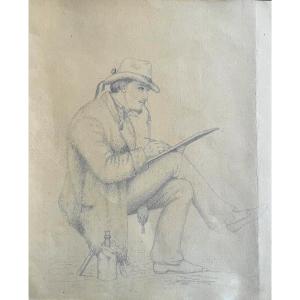
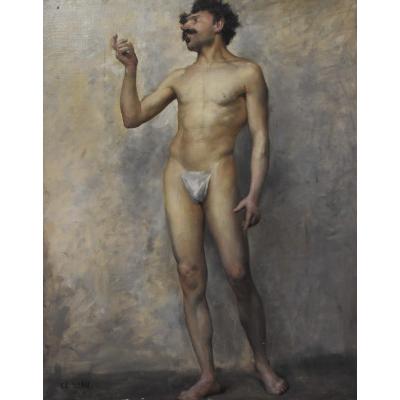
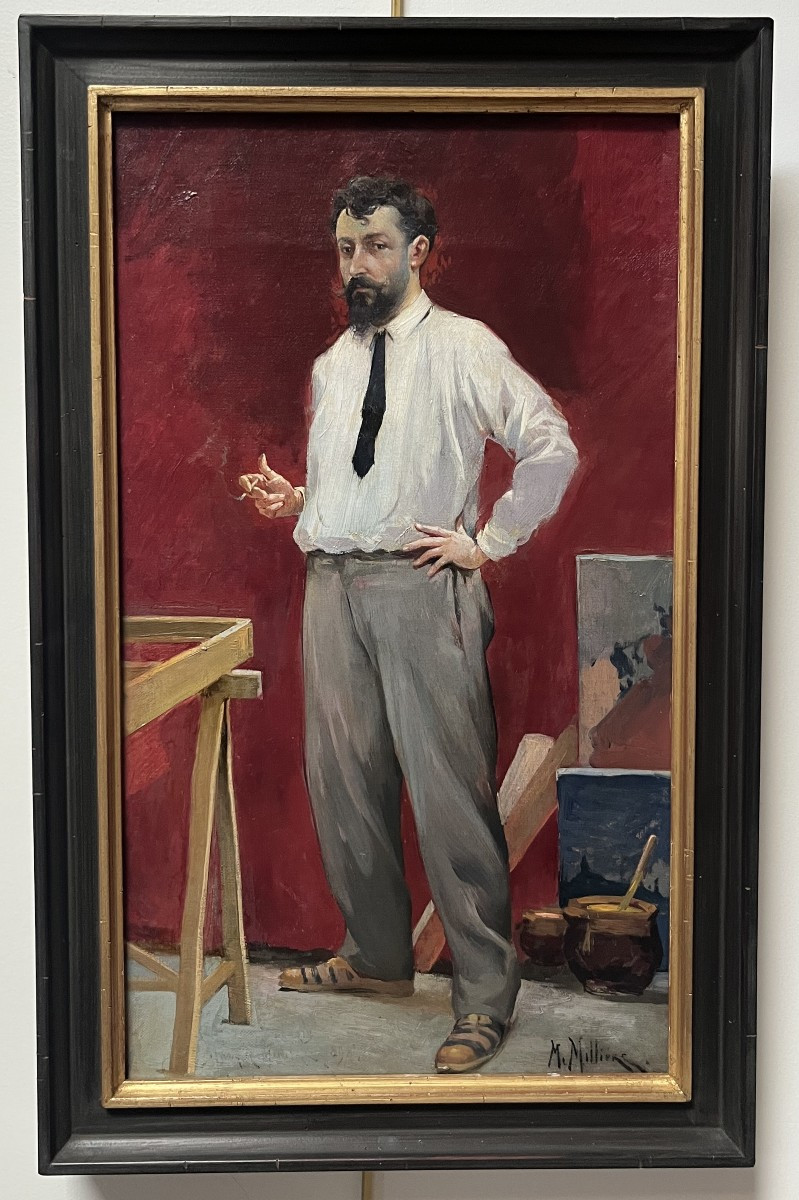
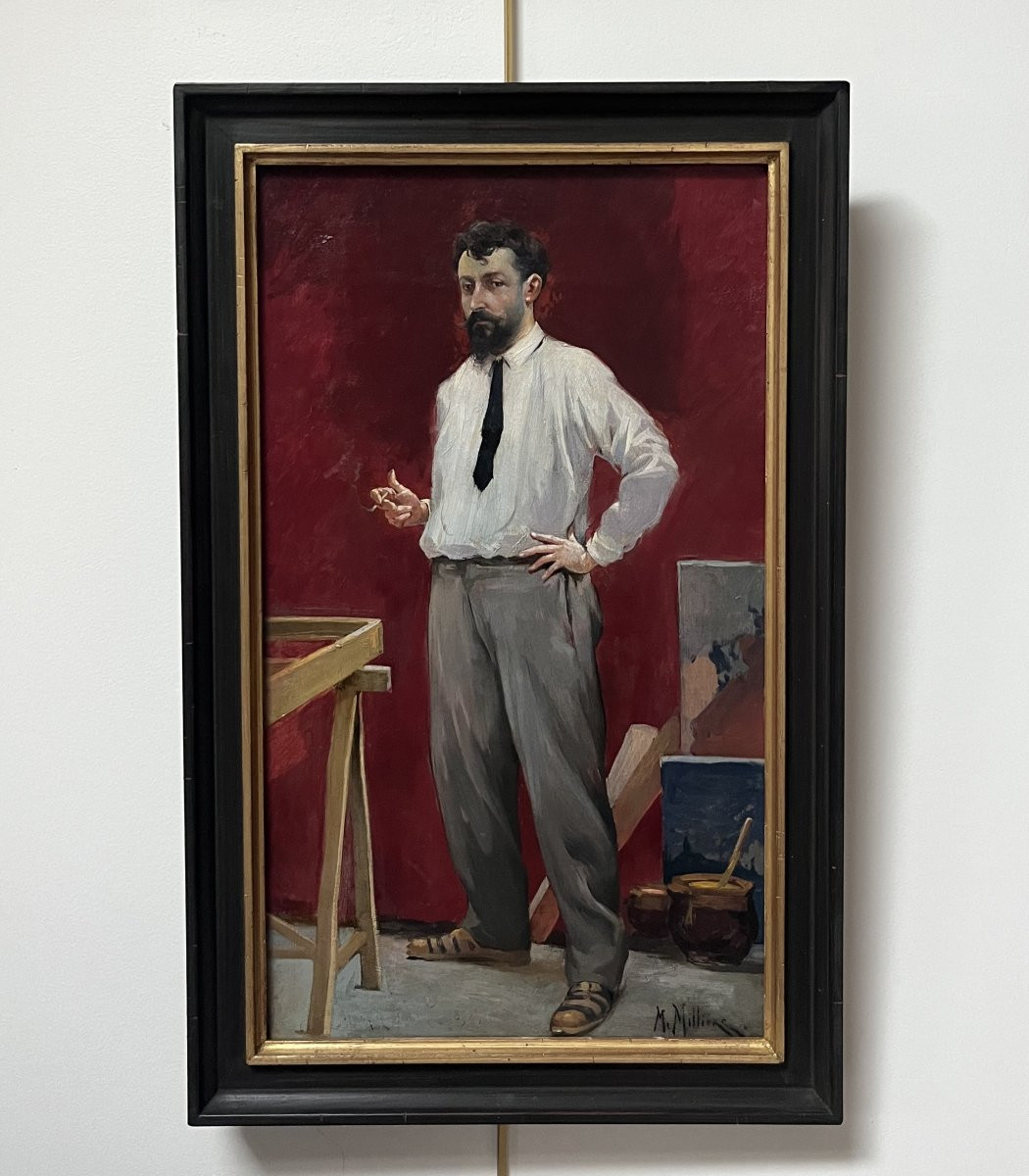
It is particularly interesting to find Maurice Millière working in a genre very different from that for which he is best known: depictions of young Parisian women. This unique portrait shows Millière in a more original and intriguing light. It captures a painter in his studio, creating a scene with various details: canvases on the floor to the right, a stretcher frame on trestles and even shoes that must have been quite striking at the time. The painter appears to be taking a break to smoke and pose for Millière.
There is a real sense of complicity between the two artists. At the same time, however, everything in this painting is carefully chosen and composed, such as the admirable red background against which the model stands out.
Combining elements of both a portrait and a studio scene, the painter's intention was to create a unique piece that pays homage to the bond between the two artists.
Maurice Georges Louis Millière was born in Le Havre in 187. He came from a working-class family in Le Havre; his father was a salesman for a merchant.
Millière began by studying painting at the École des Beaux-Arts in Le Havre. He moved to Paris in 1889 and enrolled at the École des Arts Décoratifs, also attending certain workshops at the École des Beaux-Arts.
His first notable graphic works were posters and sheet music for companies such as Le Boulch and Le Divan Japonais (1899).
From 1917 onwards, he published large numbers of depictions of scantily clad women: first in Fantasio (1917), then in Bagatelles, La Vie parisienne, Le Frou-frou, Le Sourire, Le Gai-Paris, etc.
At the end of 1920, he joined the République de Montmartre, a charitable association.
Contemporary with those of Louis Icart, his “little women” were to enjoy great success outside France: during the 1920s, American periodicals reprinted his creations, as well as those of Suzanne Meunier and Georges Léonnec, other artists who drew female figures associated with “Gai Paris,” or the Montmartre district and its many cabarets. Millière's little women were a source of inspiration for Alberto Vargas and Enoch Bolles, precursors of the “pin-up style.”
These women also appear on postcards, posters, menus, etc. Some of this production, which is certainly erotic, is devoted to much more daring representations and is therefore marketed discreetly: these are watercolors depicting domineering women engaging in flagellation, which were successful in England.
He stayed in the West Indies, where he drew and painted pictures, particularly of West Indian women. Several of these works were exhibited at the salons of the Société Nationale des Artistes Français and the Société Coloniale des Artistes Français. He illustrated a book published in 1929, Madinina “Reine des Antilles”: étude de mœurs martiniquaises (Madinina “Queen of the West Indies”: a study of Martinican customs). In August 1930, he was made a Knight of the Legion of Honor for colonial service.
The following year, he exhibited his paintings at the Salon des Artistes Français and his drawings at the Salon des Humoristes.
He died on April 5, 1946, in Yport.
An artist in his studio,
signed lower right
oil on canvas
46 x 27 cm
framed : 52 x 33 cm
It is particularly interesting to find Maurice Millière working in a genre very different from that for which he is best known: depictions of young Parisian women. This unique portrait shows Millière in a more original and intriguing light. It captures a painter in his studio, creating a scene with various details: canvases on the floor to the right, a stretcher frame on trestles and even shoes that must have been quite striking at the time. The painter appears to be taking a break to smoke and pose for Millière.
There is a real sense of complicity between the two artists. At the same time, however, everything in this painting is carefully chosen and composed, such as the admirable red background against which the model stands out.
Combining elements of both a portrait and a studio scene, the painter's intention was to create a unique piece that pays homage to the bond between the two artists.
Maurice Georges Louis Millière was born in Le Havre in 187. He came from a working-class family in Le Havre; his father was a salesman for a merchant.
Millière began by studying painting at the École des Beaux-Arts in Le Havre. He moved to Paris in 1889 and enrolled at the École des Arts Décoratifs, also attending certain workshops at the École des Beaux-Arts.
His first notable graphic works were posters and sheet music for companies such as Le Boulch and Le Divan Japonais (1899).
From 1917 onwards, he published large numbers of depictions of scantily clad women: first in Fantasio (1917), then in Bagatelles, La Vie parisienne, Le Frou-frou, Le Sourire, Le Gai-Paris, etc.
At the end of 1920, he joined the République de Montmartre, a charitable association.
Contemporary with those of Louis Icart, his “little women” were to enjoy great success outside France: during the 1920s, American periodicals reprinted his creations, as well as those of Suzanne Meunier and Georges Léonnec, other artists who drew female figures associated with “Gai Paris,” or the Montmartre district and its many cabarets. Millière's little women were a source of inspiration for Alberto Vargas and Enoch Bolles, precursors of the “pin-up style.”
These women also appear on postcards, posters, menus, etc. Some of this production, which is certainly erotic, is devoted to much more daring representations and is therefore marketed discreetly: these are watercolors depicting domineering women engaging in flagellation, which were successful in England.
He stayed in the West Indies, where he drew and painted pictures, particularly of West Indian women. Several of these works were exhibited at the salons of the Société Nationale des Artistes Français and the Société Coloniale des Artistes Français. He illustrated a book published in 1929, Madinina “Reine des Antilles”: étude de mœurs martiniquaises (Madinina “Queen of the West Indies”: a study of Martinican customs). In August 1930, he was made a Knight of the Legion of Honor for colonial service.
The following year, he exhibited his paintings at the Salon des Artistes Français and his drawings at the Salon des Humoristes.
He died on April 5, 1946, in Yport.
1 350 €
Period: 20th century
Style: Art Nouveau
Condition: Good condition
Material: Oil painting
Width: 27
Height: 46
Reference (ID): 1661148
Availability: In stock
Print