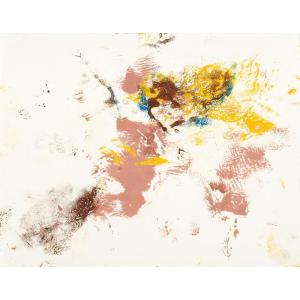
André Masson (1896 - 1987) — Migration, 1956
Artist: André Masson
MIGRATION, 1956
Gouache on paper, signed and dated '56' lower left.
63.5 x 50 cm.
History:
Cleto Polcina Arte Moderna Gallery, Rome.
Exhibition:
Masson, at the Heart of the Storm, Asian Period, 1947-1957, Cleto Polcina, Rome, 1991, reproduced in the exhibition catalogue under the title Animal Spirits, Hunter, with an incorrect format.
Provenance:
Private collection, France.
André Masson: From Surrealism to Abstract Expressionism, a 20th-Century Bridge
Originally from the Oise region, André Masson discovered painting at a very young age before training in Brussels, then in Paris where he studied fresco and obtained a scholarship to Tuscany. The First World War turned his life upside down: seriously wounded, he struggled to recover before finally beginning to paint in earnest during a stay near Martigues. In the 1920s, Masson lived between Céret and Paris, leading a bohemian existence before being supported by the Kahnweiler Gallery. His studio on Rue Blomet became a hub for the avant-garde, frequented by Artaud, Leiris, Miró, and Hemingway. He joined the Surrealist group in 1924 and experimented with automatic drawing, then created his first "sand paintings" in Sanary. At the end of the 1920s, he distanced himself from Surrealism, divorced, discovered Zen, and explored violence, notably through his experiences in slaughterhouses. The 1930s led him to the south of France, then to Spain where he drew inspiration from myths and bullfighting, before returning to France at the outbreak of war. World War II forced him into exile in the United States (1941-1945). Settling in Connecticut, he profoundly influenced young American artists, including Jackson Pollock. His painting became more calligraphic, imbued with telluric forces and Native American art. He definitively broke with Breton in 1943. After his return to France, Masson settled in Provence and then divided his time between Paris and the South. His "Asian period" flourished, as did his series inspired by the Provençal landscape and urban life, notably the "Feminine" series. He received significant institutional recognition, designed the dome of the Odéon, and was the subject of numerous retrospectives. He stopped painting in the early 1980s and died in 1987. A major figure of the 20th century, Masson was a key player in Surrealism and a crucial link between the pre-war period and American Abstract Expressionism.
Discover more of this artist's work on the gallery's website: https://www.galeriepentcheff.fr/fr/peintre-andre-masson
Gouache on paper, signed and dated '56' lower left.
63.5 x 50 cm.
History:
Cleto Polcina Arte Moderna Gallery, Rome.
Exhibition:
Masson, at the Heart of the Storm, Asian Period, 1947-1957, Cleto Polcina, Rome, 1991, reproduced in the exhibition catalogue under the title Animal Spirits, Hunter, with an incorrect format.
Provenance:
Private collection, France.
André Masson: From Surrealism to Abstract Expressionism, a 20th-Century Bridge
Originally from the Oise region, André Masson discovered painting at a very young age before training in Brussels, then in Paris where he studied fresco and obtained a scholarship to Tuscany. The First World War turned his life upside down: seriously wounded, he struggled to recover before finally beginning to paint in earnest during a stay near Martigues. In the 1920s, Masson lived between Céret and Paris, leading a bohemian existence before being supported by the Kahnweiler Gallery. His studio on Rue Blomet became a hub for the avant-garde, frequented by Artaud, Leiris, Miró, and Hemingway. He joined the Surrealist group in 1924 and experimented with automatic drawing, then created his first "sand paintings" in Sanary. At the end of the 1920s, he distanced himself from Surrealism, divorced, discovered Zen, and explored violence, notably through his experiences in slaughterhouses. The 1930s led him to the south of France, then to Spain where he drew inspiration from myths and bullfighting, before returning to France at the outbreak of war. World War II forced him into exile in the United States (1941-1945). Settling in Connecticut, he profoundly influenced young American artists, including Jackson Pollock. His painting became more calligraphic, imbued with telluric forces and Native American art. He definitively broke with Breton in 1943. After his return to France, Masson settled in Provence and then divided his time between Paris and the South. His "Asian period" flourished, as did his series inspired by the Provençal landscape and urban life, notably the "Feminine" series. He received significant institutional recognition, designed the dome of the Odéon, and was the subject of numerous retrospectives. He stopped painting in the early 1980s and died in 1987. A major figure of the 20th century, Masson was a key player in Surrealism and a crucial link between the pre-war period and American Abstract Expressionism.
Discover more of this artist's work on the gallery's website: https://www.galeriepentcheff.fr/fr/peintre-andre-masson
4 500 €
Period: 20th century
Style: Other Style
Condition: Good condition
Material: Gouache
Reference (ID): 1658067
Availability: In stock
Print