Louis Dage: Art Deco Plate Circa 1930
Artist: Louis Dage (1885-1961)
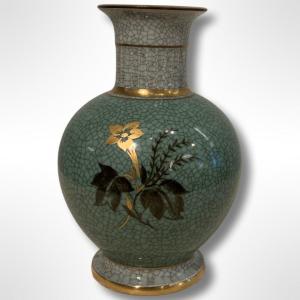
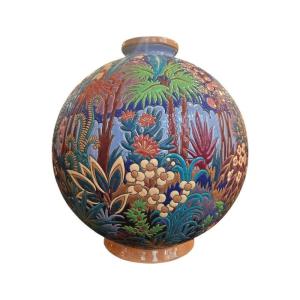
Exquisite ceramic dish with blue and silver petrol-grey decoration by Louis Dage, from the Art Deco period (1930s). The dish is encircled by a gilt brass band depicting a beaded frieze. Diameter 23.5 cm. Born in 1885 to a baker father and a seamstress mother, nothing seemed to destine Louis Dage for a career in ceramics. Little information exists regarding his initial training, but the archives describe him as a "painter on earthenware" as early as 1905. Louis then likely worked at the Nimy earthenware factory in Belgium and certainly for Maison Morda, specializing in stoneware. This professional wandering eventually led him to Antony, where he made his name in the world of ceramic arts. The Recognition of a Ceramist: Dage in Antony. Louis Dage's arrival in Antony marked a crucial turning point in his career. After a brief association with Louis Fontinelle, his creations, now signed solely with his own name, are tangible proof of his recognition as a ceramic artist. The man, who until then had been content to fulfill his employers' requests, broke free in Antony and gave free rein to his creativity. From this period, we find a large number of characteristic pieces, recognizable by the treatment of the background decoration. The pieces are covered with glazes that give a marbled effect, with variations in color, density, and finish. Dage often drew floral motifs on this background, particularly clusters of blue flowers or fruit and vine or maple leaves, the arrangement of which varied to suit the shapes of the pieces. Sometimes, he drew other types of flowers, using a broader color palette, and executed them in a slightly Cubist Art Deco style. From time to time, he combined these marbled backgrounds with drips, and a few rare pieces exist with black backgrounds decorated with pink bands and a frieze of stylized flowers in gold and silver. He also created non-figurative pieces with large areas of flat color on a black background. In addition, Dage used another technique consisting of applying very thick, vitrified glazes that retained significant relief, sometimes combined with drips. Some of these ceramics were adorned with metal circles and handles, often in bronze, and bear the signature "Val," for the company E. Val & Cie, with which Dage was associated. His production, marked by the Antony/Dage pottery factory, flourished until 1935. A voluntary exile: The Birth of the Adour Pottery. After separating from his wife, Louis Dage moved to the Landes region. His new marriage to Fernande Marianne Bilau, daughter of a potter, and the opening of a new pottery factory marked the beginning of a new era. With a certain Paul Bastard, Dage took over a struggling factory in Saint-Sever. Together, they renamed it "Faïencerie de l'Adour, Tradition de Samadet" (Adour Pottery, Tradition of Samadet). They employed up to 40 people and incorporated traditional Samadet designs into modern vases. Louis Dage also gave free rein to his love for metallic effects in gold and silver. However, with age, some of his creations became questionable, perhaps betraying a period of artistic and financial difficulty. Despite these fluctuations in quality, Louis Dage remained true to his passion for ceramics throughout his life. This persistence testifies to the strength of his vocation and the uniqueness of his techniques and styles. Plant motifs on a marbled background, however repetitive they may be, remain a recognized emblem of the art of Louis Dage, and testify to the mark he left on the world of ceramics.
190 €
Period: 20th century
Style: Art Deco
Condition: Perfect condition
Material: Ceramic
Reference (ID): 1653274
Availability: In stock
Print