THIS OBJECT WAS SOLD
William Laparra (1873-1920) The Nursery In 1916, Hautebraye (aisne) Great War






William LAPARRA
(Bordeaux 1873 – Hecho (Spain) 1920)
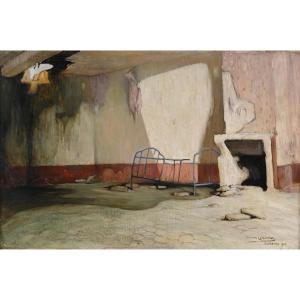
Children bedroom, Hautebraye (Aisne) 1916
Oil on canvas
H. 47 cm; L. 70 cm
Signed lower right, located, dated
Exhibition : 1930, Galerie Mona Lisa, Paris, rue Duphot, First exhibition of the Société des Artistes Camoufleurs
Provenance :
- Laparra studio sale (stamps on the back), probably in 2006
- Galerie Elseneur, Paris, 51 rue Sainte-Anne
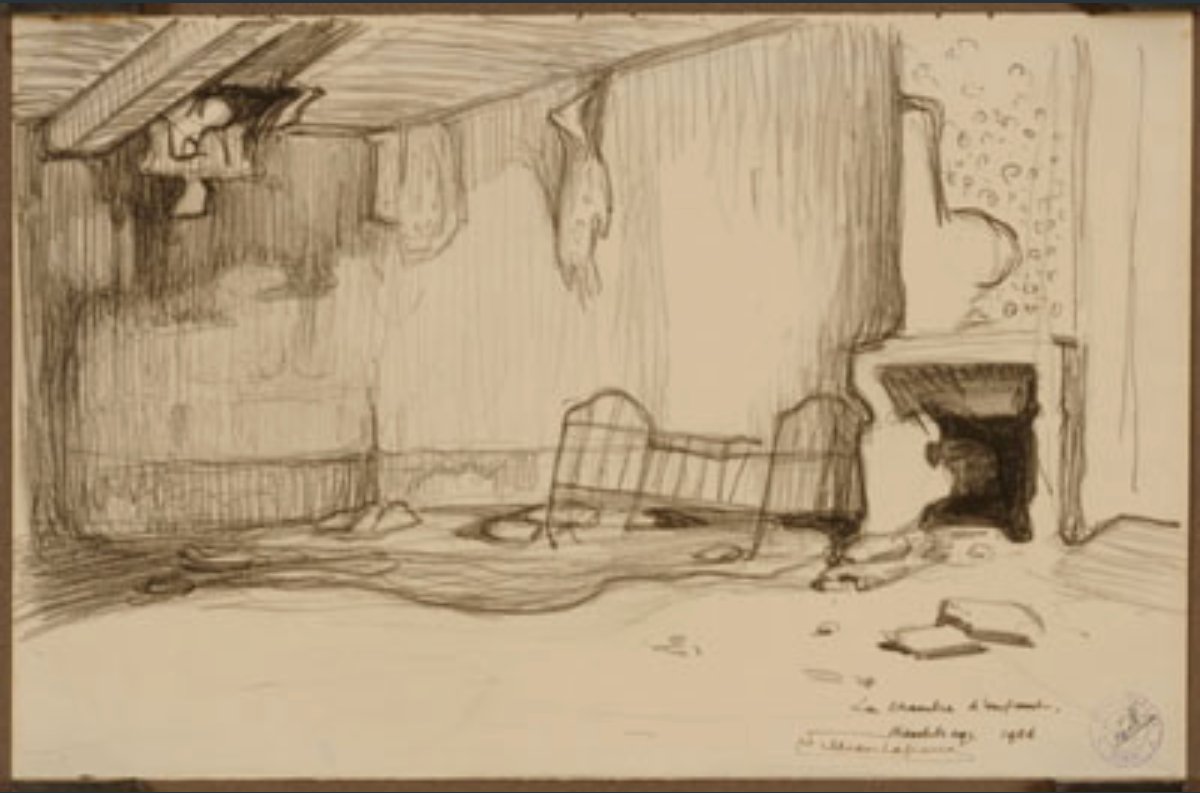
Related work : a preparatory sketch, in pencil, 19.7 x 29.4 cm – Musée La Contemporaine, Nanterre
William Laparra trained at the Bordeaux School of Fine Arts from 1888 to 1891, then in Paris at the Académie Julian where he received instruction from Tony Robert-Fleury, and at the Beaux-Arts from 1893, in the workshops of Jules Lefebvre and Bouguereau. An academic painter, he won the prestigious Prix de Rome in 1898 and exhibited at the Salon from 1899 until his death, primarily portraits. At the outbreak of war in 1914, Laparra, who was also a theater set designer, was mobilized in Bordeaux with the camouflage section. Under the guidance of the painter Guirand de Scevola (1871-1950), General de Castelnau assembled a team of talented artists (including, alongside Laparra, Jean-Louis Forain, Dunoyer de Segonzac, Devambez, and Abel-Truchet) to create painted canvases, various decoys, and illusionistic decorations designed to reduce the visibility of men, equipment, and lines of communication; this section was officially established in August 1915. These artists were true combatants, familiar with the daily life of all units in the field, in cantonments, in workshops, and at the front. Alongside their military duties, they were obviously witnesses to the fighting and atrocities of war, which they depicted in their own works. Thus, Laparra, mobilized on the Somme and Aisne fronts in the summer of 1916, produced a number of drawings and watercolors, several of which are held at the Musée d'Orsay, alongside other paintings by the artist. Our canvas, in fact, is based on one of these sketches (held at the Musée La Contemporaine) and shows an apartment destroyed by bombing in Hautebraye, one of the hamlets in the commune of Autrêches, on the border of the Oise and Aisne departments. This area suffered destruction as early as September 1914, as the Germans and French took and lost positions. The fighting continued there until the end of August 1918. It should be noted that Laparra, from 1917, worked at the camouflage workshop in Chantilly; he was a brigadier and team leader in the 1st group of the 10th Army, and was cited in the army orders in the following terms: "Demonstrated, on many occasions, calm, energy, and courage, particularly on August 30, 1916, when he successfully completed a dangerous mission during a heavy bombardment." It is quite possible that this bombardment is related to our painting. The latter was exhibited posthumously at the Camouflage Artists' Exhibition in March 1930, which brought together 163 works, two-thirds of which depicted the terrible war years. The art critic Eugène Soubeyre noted and described it thus in La Nouvelle Revue: “…a poor village room where rain pours through the holed ceiling onto a modest iron bed stripped of its bedding.” As the caption of the sketch drawn on site indicates, we are indeed in a child’s room, in tatters, now devoid of life, with its terracotta tiles coming loose, its ceiling burst open, and its mottled pink wallpaper peeling away from the plaster; the ruin of France is illustrated by this family home no longer standing; the base of the walls recalls the color of blood spilled in the trenches. The painting’s very luminous composition, which evokes the destruction of war in a raw, stark, and ascetic way, contrasts with the sadness of its subject, where the duty of remembrance takes center stage.
(Bordeaux 1873 – Hecho (Spain) 1920)
Children bedroom, Hautebraye (Aisne) 1916
Oil on canvas
H. 47 cm; L. 70 cm
Signed lower right, located, dated
Exhibition : 1930, Galerie Mona Lisa, Paris, rue Duphot, First exhibition of the Société des Artistes Camoufleurs
Provenance :
- Laparra studio sale (stamps on the back), probably in 2006
- Galerie Elseneur, Paris, 51 rue Sainte-Anne
Related work : a preparatory sketch, in pencil, 19.7 x 29.4 cm – Musée La Contemporaine, Nanterre
William Laparra trained at the Bordeaux School of Fine Arts from 1888 to 1891, then in Paris at the Académie Julian where he received instruction from Tony Robert-Fleury, and at the Beaux-Arts from 1893, in the workshops of Jules Lefebvre and Bouguereau. An academic painter, he won the prestigious Prix de Rome in 1898 and exhibited at the Salon from 1899 until his death, primarily portraits. At the outbreak of war in 1914, Laparra, who was also a theater set designer, was mobilized in Bordeaux with the camouflage section. Under the guidance of the painter Guirand de Scevola (1871-1950), General de Castelnau assembled a team of talented artists (including, alongside Laparra, Jean-Louis Forain, Dunoyer de Segonzac, Devambez, and Abel-Truchet) to create painted canvases, various decoys, and illusionistic decorations designed to reduce the visibility of men, equipment, and lines of communication; this section was officially established in August 1915. These artists were true combatants, familiar with the daily life of all units in the field, in cantonments, in workshops, and at the front. Alongside their military duties, they were obviously witnesses to the fighting and atrocities of war, which they depicted in their own works. Thus, Laparra, mobilized on the Somme and Aisne fronts in the summer of 1916, produced a number of drawings and watercolors, several of which are held at the Musée d'Orsay, alongside other paintings by the artist. Our canvas, in fact, is based on one of these sketches (held at the Musée La Contemporaine) and shows an apartment destroyed by bombing in Hautebraye, one of the hamlets in the commune of Autrêches, on the border of the Oise and Aisne departments. This area suffered destruction as early as September 1914, as the Germans and French took and lost positions. The fighting continued there until the end of August 1918. It should be noted that Laparra, from 1917, worked at the camouflage workshop in Chantilly; he was a brigadier and team leader in the 1st group of the 10th Army, and was cited in the army orders in the following terms: "Demonstrated, on many occasions, calm, energy, and courage, particularly on August 30, 1916, when he successfully completed a dangerous mission during a heavy bombardment." It is quite possible that this bombardment is related to our painting. The latter was exhibited posthumously at the Camouflage Artists' Exhibition in March 1930, which brought together 163 works, two-thirds of which depicted the terrible war years. The art critic Eugène Soubeyre noted and described it thus in La Nouvelle Revue: “…a poor village room where rain pours through the holed ceiling onto a modest iron bed stripped of its bedding.” As the caption of the sketch drawn on site indicates, we are indeed in a child’s room, in tatters, now devoid of life, with its terracotta tiles coming loose, its ceiling burst open, and its mottled pink wallpaper peeling away from the plaster; the ruin of France is illustrated by this family home no longer standing; the base of the walls recalls the color of blood spilled in the trenches. The painting’s very luminous composition, which evokes the destruction of war in a raw, stark, and ascetic way, contrasts with the sadness of its subject, where the duty of remembrance takes center stage.
Explore similar pieces and discover your ideal find:
modern paintings