

The Nun, Italian School, 18th Century
Artist: D'après Giuseppe Bonito
"The Nun, 18th century, Italian school"
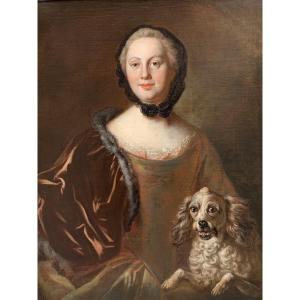
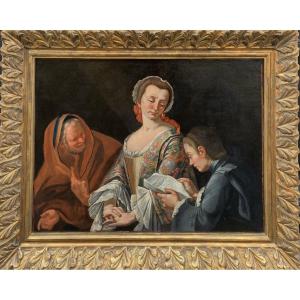
Oil on canvas, genre scene. This is probably Suzanne Simonin, the narrator of Denis Diderot's novel-memoir "The Nun." The novel was begun in 1760 as a hoax. The text was serialized between 1880 and 1882 and published posthumously in print in 1796. The 16-year-old girl is confined against her will in several convents because she is an illegitimate daughter and cannot claim a dowry for marriage, unlike her legitimate sisters. "The Nun" is an ode to the freedom to choose one's destiny. The scene depicted: "It was Father Séraphin, my mother's spiritual director; he had also been mine; thus, he had no trouble explaining the reason for his visit: it was to encourage me to take the habit." I protested at this strange proposal; and I declared to him clearly that I felt no inclination whatsoever for the religious life. "So much the worse," he said to me, "for your parents have given up everything for your sisters, and I no longer see what they could do for you in the narrow situation to which they have reduced themselves.
Think about it, mademoiselle; "You must either enter this house forever, or go to some provincial convent where you will be received for a modest pension, and from which you will only leave upon the death of your parents, which may be a long time coming…" I complained bitterly, and I shed a torrent of tears." In the 18th century, princes and kings asserted their sovereign power and sought to interfere in the internal affairs of monasteries as well as in the family sphere. Since the family was the basic unit of society, the king's desire to ensure domestic order was a means of consolidating his sovereignty and maintaining public order. When children refused to conform to their fathers' decisions regarding marriage and career, "family peace" and public tranquility were considered threatened. To allow parents to exercise coercive power over their children, recourse to royal decrees allowing the imprisonment or confinement of disobedient children increased. During the 18th century.
This is why we see the lettre de cachet in the hands of the male figure (also called a lettre close or lettre fermée), which, under the Ancien Régime in France, was a letter used to transmit a specific order from the king, allowing, for example, imprisonment without trial, exile, or even the internment of people deemed undesirable by the authorities. Lettres de cachet, the term for which dates back to the 16th century, but whose origin is more ancient, are letters bearing the signature of the king (even if not in his own handwriting) and that of a Secretary of State, and sealed because they were to be read only by the intended recipient. Relined, carved and gilded wooden frame.
Width: with frame: 130 cm; without frame: 100 cm.
Height: with frame: 100 cm, without frame: 70 cm. 18th century.
Italian School,
circle of Giuseppe Bonito.
Oil on canvas, genre scene. This is probably Suzanne Simonin, the narrator of Denis Diderot's novel-memoir "The Nun." The novel was begun in 1760 as a hoax. The text was serialized between 1880 and 1882 and published posthumously in print in 1796. The 16-year-old girl is confined against her will in several convents because she is an illegitimate daughter and cannot claim a dowry for marriage, unlike her legitimate sisters. "The Nun" is an ode to the freedom to choose one's destiny. The scene depicted: "It was Father Séraphin, my mother's spiritual director; he had also been mine; thus, he had no trouble explaining the reason for his visit: it was to encourage me to take the habit." I protested at this strange proposal; and I declared to him clearly that I felt no inclination whatsoever for the religious life. "So much the worse," he said to me, "for your parents have given up everything for your sisters, and I no longer see what they could do for you in the narrow situation to which they have reduced themselves.
Think about it, mademoiselle; "You must either enter this house forever, or go to some provincial convent where you will be received for a modest pension, and from which you will only leave upon the death of your parents, which may be a long time coming…" I complained bitterly, and I shed a torrent of tears." In the 18th century, princes and kings asserted their sovereign power and sought to interfere in the internal affairs of monasteries as well as in the family sphere. Since the family was the basic unit of society, the king's desire to ensure domestic order was a means of consolidating his sovereignty and maintaining public order. When children refused to conform to their fathers' decisions regarding marriage and career, "family peace" and public tranquility were considered threatened. To allow parents to exercise coercive power over their children, recourse to royal decrees allowing the imprisonment or confinement of disobedient children increased. During the 18th century.
This is why we see the lettre de cachet in the hands of the male figure (also called a lettre close or lettre fermée), which, under the Ancien Régime in France, was a letter used to transmit a specific order from the king, allowing, for example, imprisonment without trial, exile, or even the internment of people deemed undesirable by the authorities. Lettres de cachet, the term for which dates back to the 16th century, but whose origin is more ancient, are letters bearing the signature of the king (even if not in his own handwriting) and that of a Secretary of State, and sealed because they were to be read only by the intended recipient. Relined, carved and gilded wooden frame.
Width: with frame: 130 cm; without frame: 100 cm.
Height: with frame: 100 cm, without frame: 70 cm. 18th century.
Italian School,
circle of Giuseppe Bonito.
3 000 €
Period: 18th century
Style: Louis 14th, Regency
Condition: Perfect condition
Material: Oil painting
Width: avec cadre: 130 cm; sans cadre: 100 cm.
Height: avec cadre: 100 cm, sans cadre: 70 cm.
Reference (ID): 1650613
Availability: In stock
Print