THIS OBJECT WAS SOLD
Austrian Biscuit Porcelain Group Depicting Two Cherubs — Circa 1860–1880, In The Neoclassical Style


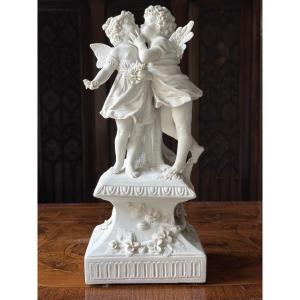


Austrian Biscuit Porcelain Group of Two Cherubs — Circa 1860–1880, Neoclassical Style. This delightful group of unglazed white (biscuit) porcelain cherubs, finely modeled in the round, depicts two tenderly embracing cherubs. One of the winged putti leans towards his companion in a pose of gentle affection. The delicacy of the features, the fluidity of the drapery, and the harmony of the proportions testify to the remarkable skill of 19th-century Austrian workshops. The square base, decorated with floral garlands in low relief and gadrooned moldings, reflects the decorative vocabulary of the Neoclassical style, highly prized during the reign of Franz Joseph.
This type of composition, inspired by French and Italian models, celebrates innocence and celestial grace in an aesthetic that blends romanticism and classical rigor.
Condition: very good overall. Note: a chip on the tip of the left wing of one of the cherubs, visible in the last photograph. This minor detail does not detract from the legibility or sculptural quality of the work. Dimensions: Height 29 cm; Base length 12.5 cm; Base width 9.7 cm. Weight: 1.160 kg. Mark: Made in Austria, numbered 4221 — molded stamp under the base, typical of Austrian biscuit porcelain productions from the second half of the 19th century.
A charming and collectible piece, ideal for enhancing a console table, display case, or period mantelpiece. Its satiny whiteness subtly captures the light, revealing every detail of the modeling and lending the piece a poetic and timeless presence.
This type of composition, inspired by French and Italian models, celebrates innocence and celestial grace in an aesthetic that blends romanticism and classical rigor.
Condition: very good overall. Note: a chip on the tip of the left wing of one of the cherubs, visible in the last photograph. This minor detail does not detract from the legibility or sculptural quality of the work. Dimensions: Height 29 cm; Base length 12.5 cm; Base width 9.7 cm. Weight: 1.160 kg. Mark: Made in Austria, numbered 4221 — molded stamp under the base, typical of Austrian biscuit porcelain productions from the second half of the 19th century.
A charming and collectible piece, ideal for enhancing a console table, display case, or period mantelpiece. Its satiny whiteness subtly captures the light, revealing every detail of the modeling and lending the piece a poetic and timeless presence.
Explore similar pieces and discover your ideal find:
Porcelain Figurines, Biscuit Porcelain