THIS OBJECT WAS SOLD
Roman Glass Bottle With Side Spout — Ancient Iridescence With Certificate Of Authenticity


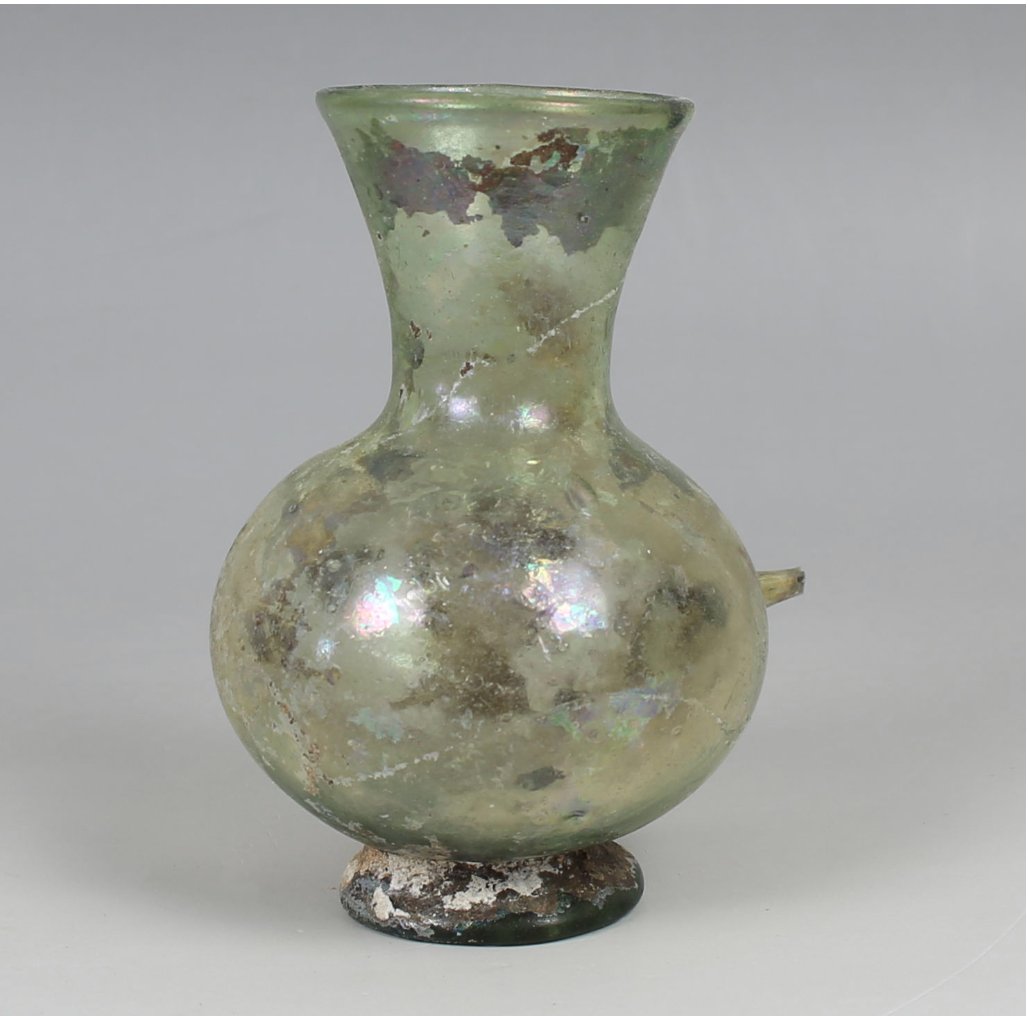
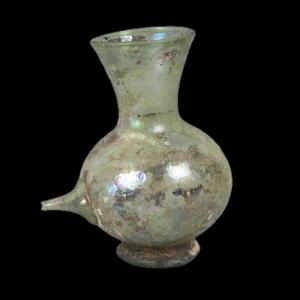


An elegant witness to late Roman glass craftsmanship, this small bottle, blown in translucent greenish glass, features a globular body, a flaring funnel-shaped neck, and a slender lateral pouring spout finely drawn while hot. The flattened annular foot, perfectly proportioned, ensures stability, while the fire-rounded rim, free from any modern reworking, preserves the integrity of its ancient shaping.
The surface of the glass, remarkably preserved, displays a silver and mauve iridescence, typical of long burial: hydration layers, micro-pitting, silicate veining, and calcareous encrustations are all authentic markers highly valued by collectors of ancient glass.
The spout, slightly worn at its tip from ancient use, testifies to genuine handling in antiquity. Inside, elongated bubbles and tensional striations visible under magnification confirm free-blown craftsmanship, followed by the manual application of the spout on the shoulder and its drawing out with an iron tool, in keeping with workshop practices of the 3rd–4th century A.D.
Object: Roman bottle with pouring spout (precision dispensing vessel)
Culture: Roman
Period: 3rd–4th century A.D.
Material: Greenish blown glass with natural archaeological iridescence
Form: Globular body, flaring neck, applied and drawn lateral spout, flattened annular base
Dimensions: H. 85 mm × D. 80 mm
Condition: Excellent state for the type; laminated iridescence, fine surface pitting, stable patina; minor ancient wear to rim and spout, intact structure
Provenance: Former private German collection, WF (Munich), acquired before 2000
Authenticity: Certificate of authenticity provided
The invention of glassblowing, around the turn of the first millennium, transformed Roman material culture. Glass became a daily material—light, hygienic, and inexpensive.
Small bottles with side spouts like this one were used for the precise dispensing of valuable liquids: perfumed oils, eye ointments, unguents, or medicinal syrups.
Some examples even served as ancient feeding bottles, allowing controlled flow. Their diffusion from the Eastern Mediterranean to the Danubian provinces illustrates the mobility of Roman artisanship and the fusion of function and elegance.
In such objects, the Roman sense of rational beauty emerges clearly: technical mastery becomes almost scientific, and the utilitarian transforms into art.
Blowing and assembly: Even walls; elongated bubbles in the neck; spout applied while hot, drawn with an iron tool; neck expanded by controlled flaring.
Rim and base: Fire-rounded rim; flattened annular base with traces of ancient circular wear.
Surface: Wide iridescent reflections in hues of silver, green, and mauve, created by long-term physico-chemical alteration of the glass—an admired hallmark of ancient burial.
Noble alterations: Calcareous deposits on the base, discontinuous silicate film, fine surface craquelures; no modern polishing; visible tool marks confirming ancient workshop origin.
Function: The short spout allowed drop-by-drop pouring or a continuous thin stream; the rounded body facilitated both grip and decantation.
This bottle perfectly embodies the union of technical mastery and functional elegance in Roman civilization.
Through the poetry of its iridescence, the purity of its form, and the didactic clarity of its construction, it exemplifies the modernity of ancient glass—an art of clarity, economy, and controlled gesture.
A miniature utilitarian masterpiece, it would grace any museum collection dedicated to Roman glass, combining refinement, authenticity, and historical resonance.
Provenance: WF Collection, Munich, assembled before 2000.
Full provenance documentation available upon request.
Certificate of authenticity provided to the buyer, guaranteeing compliance with international standards.
Explore similar pieces and discover your ideal find:
archeology