THIS OBJECT WAS SOLD
Christ In Chains, Carved In Linden Wood - Southern Germany, Franconian School - Circa 1500 - 81cm


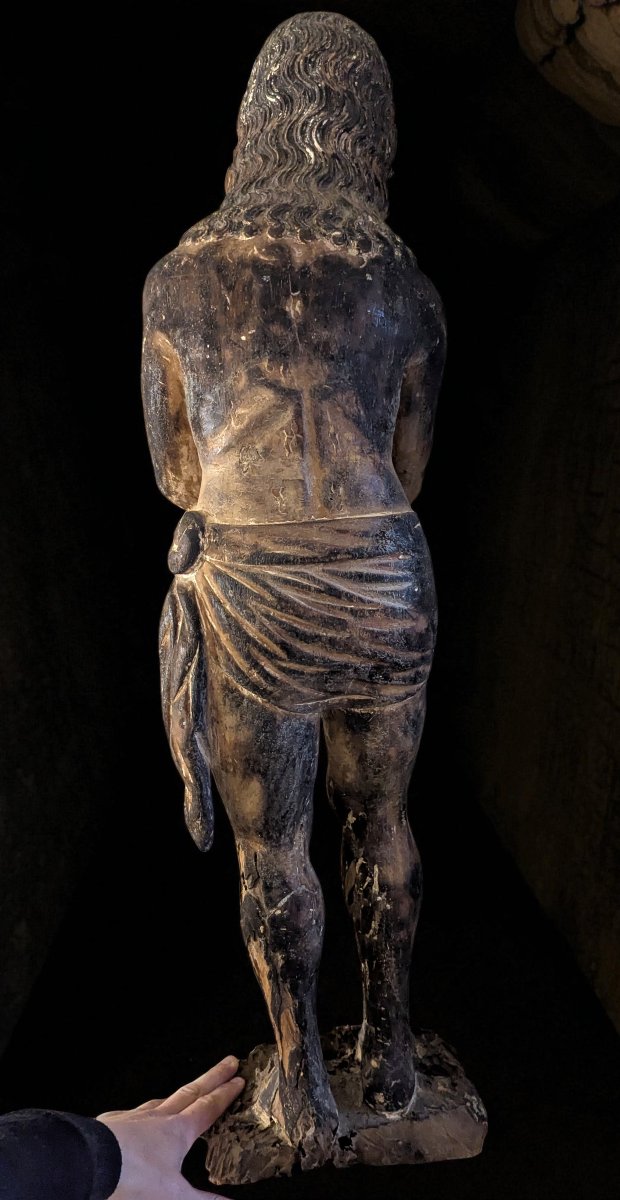
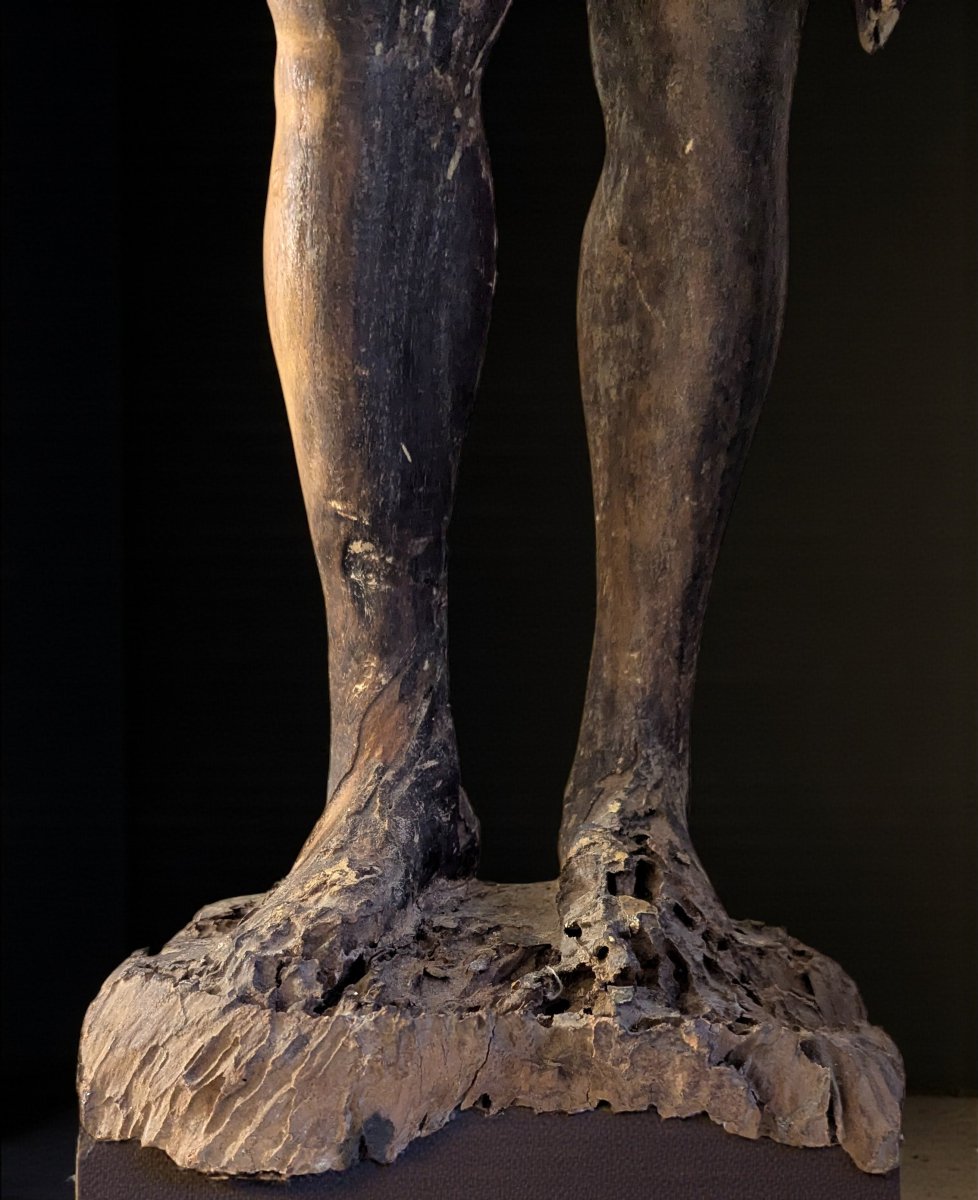


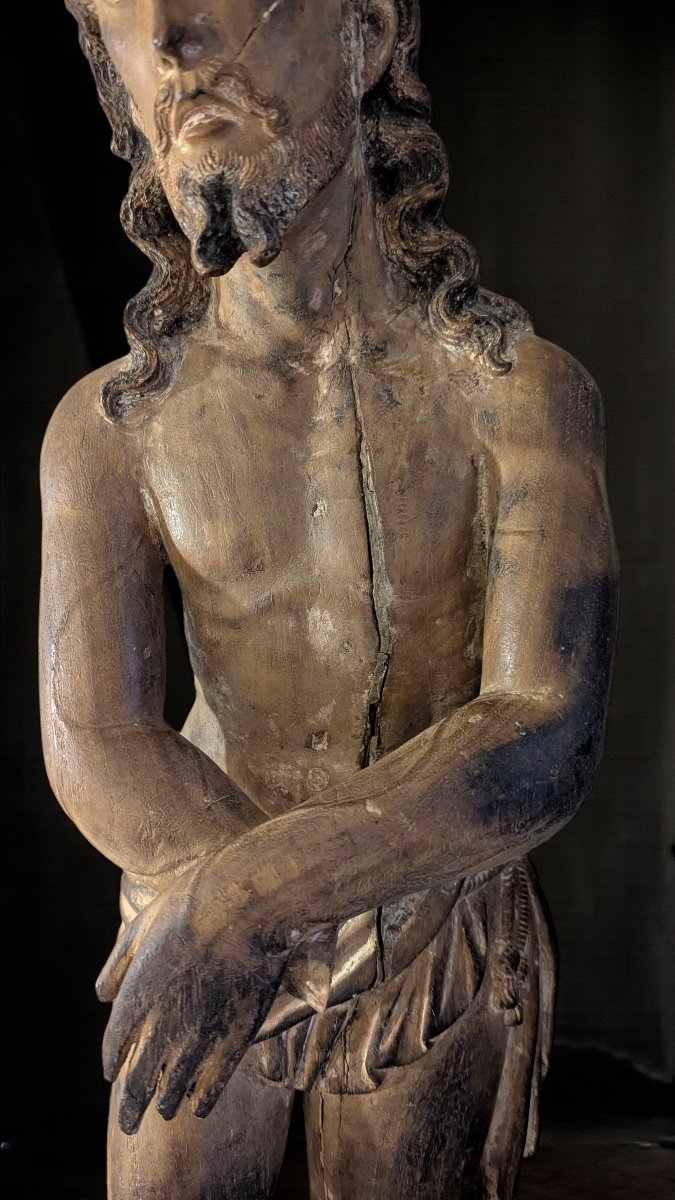



Carved from linden wood with remarkable skill, this Christ in Chains, Christus an der Geißelsäule, is a moving testament to German Renaissance sculpture. Standing 81 centimeters tall, the work was created around 1500, probably in a workshop in Franconian, and illustrates the excellence of the workshops in southern Germany, where a wood carving of spiritual intensity and striking realism flourished. This Christ in Chains stands in a posture of great, resigned gentleness. The slender, supple body leans slightly forward, as if exhausted by suffering yet still imbued with majesty. The arms are crossed over the stomach in a gesture of silent humility. The head, delicately inclined, expresses inner sadness rather than a cry of suffering, accentuated by the half-closed eyelids and the slightly open, almost whispering mouth. The face, of rare refinement, features elongated features, a precisely chiseled forked beard, and hair falling in wavy locks over the shoulders. The torso reveals the ribs and a slender musculature, modeled without exaggeration, reflecting a search for a balance between realism and spirituality. The loincloth, held at the hip, is draped in deep, irregular folds, giving the fabric a vibrant and expressive relief. The carefully worked reverse reveals a sculpted and polished surface, indicating that this figure was not intended to be placed against a wall but rather to be viewed in space, perhaps on an altar or at the center of an altarpiece. The back, marked by fine incisions, testifies to a hand attentive to anatomical structure: the shoulder blade, the spine, the tension of the drapery above the hips—all these are indications of a sculptor fully aware of volume and movement. Despite the ravages of time, the sculpture retains a striking intensity. The surface of the wood, darkened by centuries, reveals traces of ancient polychromy. A few longitudinal cracks underscore the nobility of the material and in no way compromise the overall stability. The base, carved with a rocky relief, anchors Christ in an earthly space, accentuating the contrast between his human presence and his sacred dimension. Everything in this work evokes the rigor and fervor of early 16th-century Franconian sculpture. The choice of linden wood, the careful rendering of the anatomy, and the restrained expression bring this figure closer to the creations of Tilman Riemenschneider's circle. The anonymous artist demonstrates a profound sense of restraint and an internalized spirituality, inherited from the great masters of Würzburg and their followers. A sculpture of rare meditative depth, this Christ in Chains powerfully illustrates the silent beauty of Germanic art at the dawn of the Renaissance. It bears traces of old wormholes in the base and on part of the legs, clearly visible in the photographs.
Explore similar pieces and discover your ideal find:
Wood Sculptures