THIS OBJECT WAS SOLD
Tsuba Maru Gata In Iron, Signed - Momoyama Period - D. 7.6 Cm.


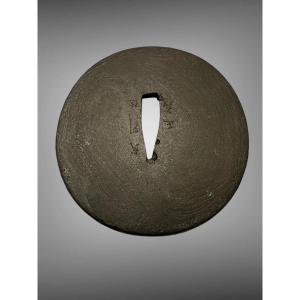


Object Tsuba (鍔) — saber guard
Type Ita tsuba (full)
Signature 兼 乗 (Kanenori)
Period 16th–17th century
Mino Region / Kyoto
Material Wrought iron, old patina
State Excellent
• Form: Maru-gata (丸 形) — circular
• Material: Wrought iron (tetsu), with visible forge grain (hada).
• Surface: Smooth, slightly wavy, showing the traces of the original hammering.
• Finish: Migaki-ji (磨 地) — polished surface without decor.
• Decor: None. The design of the metal alone constitutes the ornament.
• Nakago-ana (中 央 茎 穴) — central opening for the sword’s tang.
Signature (mei 銘)
• Engraved vertically on the right side of the nakago-ana.
• Reading: 兼 乗 (Kanenori).
• This name is attested in several lines of blacksmiths and tsuba manufacturers:
o Mino-den (美 濃 伝): forging tradition famous for its dense and dark iron.
o Kyoto-shu (京 都 住): artisans active at the beginning of Edo, making sober and refined tsuba.
• The style of writing (fine, regular, unornamented engraving) corresponds to the Momoyama–early Edo period (around 1570–1650). Signature (mei 銘)
• Engraved vertically on the right side of the nakago-ana.
• Reading: 兼 乗 (Kanenori).
• This name is attested in several lines of blacksmiths and tsuba manufacturers:
• Mino-den (美 濃 伝): forging tradition famous for its dense and dark iron.
• Kyoto-shu (京 都 住): artisans active at the beginning of Edo, making sober and refined tsuba.
• The style of writing (fine engraving, regular, not ornamented) corresponds to the period Momoyama–early Edo (around 1570–1650).
•
Type Ita tsuba (full)
Signature 兼 乗 (Kanenori)
Period 16th–17th century
Mino Region / Kyoto
Material Wrought iron, old patina
State Excellent
• Form: Maru-gata (丸 形) — circular
• Material: Wrought iron (tetsu), with visible forge grain (hada).
• Surface: Smooth, slightly wavy, showing the traces of the original hammering.
• Finish: Migaki-ji (磨 地) — polished surface without decor.
• Decor: None. The design of the metal alone constitutes the ornament.
• Nakago-ana (中 央 茎 穴) — central opening for the sword’s tang.
Signature (mei 銘)
• Engraved vertically on the right side of the nakago-ana.
• Reading: 兼 乗 (Kanenori).
• This name is attested in several lines of blacksmiths and tsuba manufacturers:
o Mino-den (美 濃 伝): forging tradition famous for its dense and dark iron.
o Kyoto-shu (京 都 住): artisans active at the beginning of Edo, making sober and refined tsuba.
• The style of writing (fine, regular, unornamented engraving) corresponds to the Momoyama–early Edo period (around 1570–1650). Signature (mei 銘)
• Engraved vertically on the right side of the nakago-ana.
• Reading: 兼 乗 (Kanenori).
• This name is attested in several lines of blacksmiths and tsuba manufacturers:
• Mino-den (美 濃 伝): forging tradition famous for its dense and dark iron.
• Kyoto-shu (京 都 住): artisans active at the beginning of Edo, making sober and refined tsuba.
• The style of writing (fine engraving, regular, not ornamented) corresponds to the period Momoyama–early Edo (around 1570–1650).
•
Explore similar pieces and discover your ideal find:
Edged Weapons