Allegory Of Vanity
Artist: Jean-baptiste Deshays De Colleville (1729-1765)
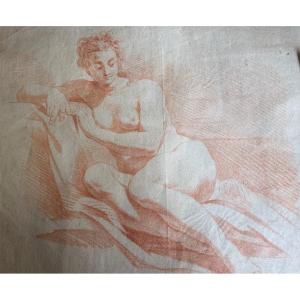
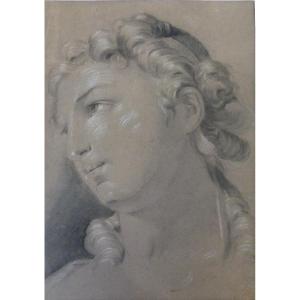
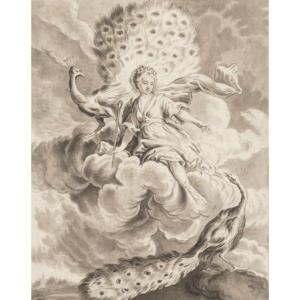
Attributed to Jean-Baptiste Deshays de Colleville (1729-1765) Black chalk and white chalk on blue paper, approx. 25 x 30 cm This drawing depicts a draped woman, her breast uncovered, sitting in front of an open chest from which she is extracting a necklace. At her side, a putto observes the scene attentively. The combination of the unveiled body, the brilliance of the jewels and the suspended gesture illustrates a theme dear to 18th-century painting: the allegory of Vanity, recalling the ephemeral nature of beauty and the fragility of earthly goods in the face of time and death. The putto, a symbol of innocence, highlights the contrast between the seduction of riches and their futility. The technique of black stone enhanced with white chalk on blue paper gives the model a luminous softness, while accentuating the draperies and the volumes of the body. Jean-Baptiste Deshays de Colleville (1729-1765), a student of François Boucher and son-in-law of Carle Van Loo, was one of the most promising painters of his generation. Close to Fragonard, whom he influenced, he distinguished himself with his religious and mythological scenes, where the expressiveness of the figures and the virtuosity of the draperies recall the nascent Rococo. His work, marked by great sensitivity, testifies to an art in transition between gallant grace and a certain dramatic intensity. This drawing, with its allegorical theme and refined treatment, fully illustrates the universe of Deshays and his artistic entourage.
7 000 €
Period: 18th century
Style: Louis 15th - Transition
Condition: En l'etat
Material: Paper
Width: 25
Height: 30
Reference (ID): 1637212
Availability: In stock
Print