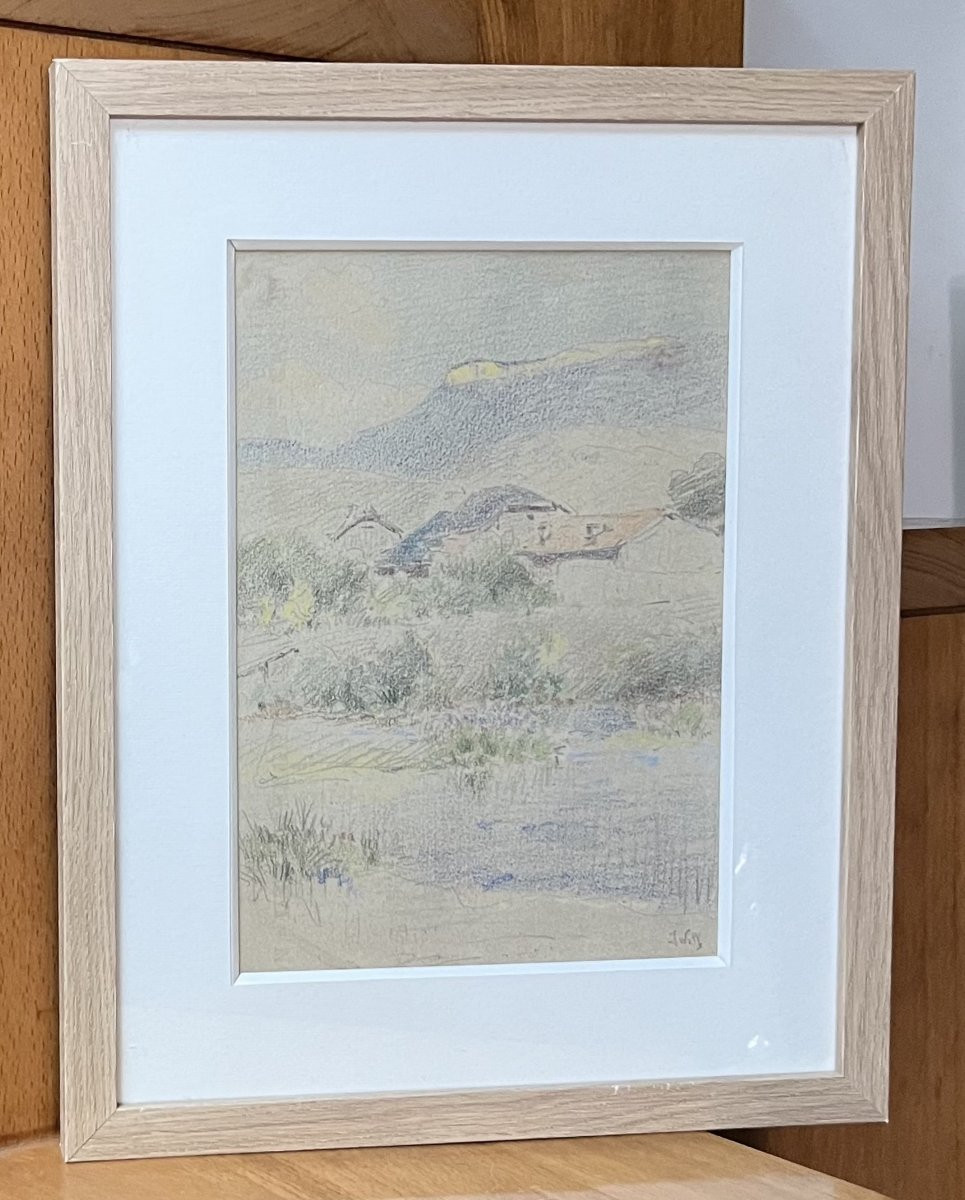


" Iwill, Marie Joseph Clavel Known As Iwill (1850-1923) Landscape With Village, Signed Drawing"
Marie Joseph Clavel known as Iwill (1850-1923)Landscape with a village,
signed lower right
color pencils on paper
27 x 18.5 cm
In good condition, a stain visible in the upper left corner
in a modern frame : 40.5 x 32.5 cm
This delicate landscape drawn with coloured pencils shows how the artist is trying out a technique that brings him closer to pointillism, here he is part of the contemporary post impressionist movement. A rare work and particularly interesting in this respect.
Marie-Joseph Léon Clavel was the son of Frédéric Clavel (1822-1902), an economist and philanthropist, and Amélie Philippe (1822-1904). He learned painting from Emmanuel Lansyer and Karl Joseph Kuwasseg.
Spending part of his childhood in Nancy, he finished his studies at the Lycée Bonaparte in Paris. In order to satisfy his father's plans, he began his active life in the trade.
In the early days of the 1870 war, he joined the imperial army and was appointed sergeant. In the aftermath of the disasters of the eastern army, he was imprisoned in Switzerland. There, struck by the grandeur and beauty of nature, he abandoned the idea of a career in business altogether. His father had a position in the secretariat of the National Assembly, and he in turn worked there as a parliamentary stenographer. From then on, however, his only interest was in contemplating and depicting natural landscapes.
As a bachelor, he lived at the Palais Bourbon with his parents. In February 1876, he married Marie Pauline Caroline Lacher-Ravaisson Mollien, daughter of Félix Ravaisson in Paris.
From 1875 onwards, under the pseudonym of Iwill, he exhibited at the Salon des artistes français, then a little later at the Salon de la Société nationale des beaux-arts, of which he was one of the founders. He participated in numerous orientalist, watercolour and pastelist exhibitions in France and abroad. He was awarded several prizes at the various universal exhibitions.
A member of the French Artists' Society in 1883, he received an honourable mention in 1884, and a silver medal at the Universal Exhibition of 1889. He was named Chevalier de la Légion d'honneur in 1894 and received a bronze medal at the 1900 Universal Exhibition.
Iwill was a great traveller, planting his easel on the outskirts of Paris as well as in Brittany, Normandy, Holland, Italy (Rome and Venice in particular) and New Zealand. His serene, even desolate landscapes are often overhung by heavy skies.
Works in public collections :
Béziers, Musée des Beaux-Arts
Bourg-en-Bresse, Musée municipal
Castres, Goya Museum
Dijon, Musée des Beaux-Arts
Rouen, Musée des Beaux-Arts














 Le Magazine de PROANTIC
 TRÉSORS Magazine
 Rivista Artiquariato