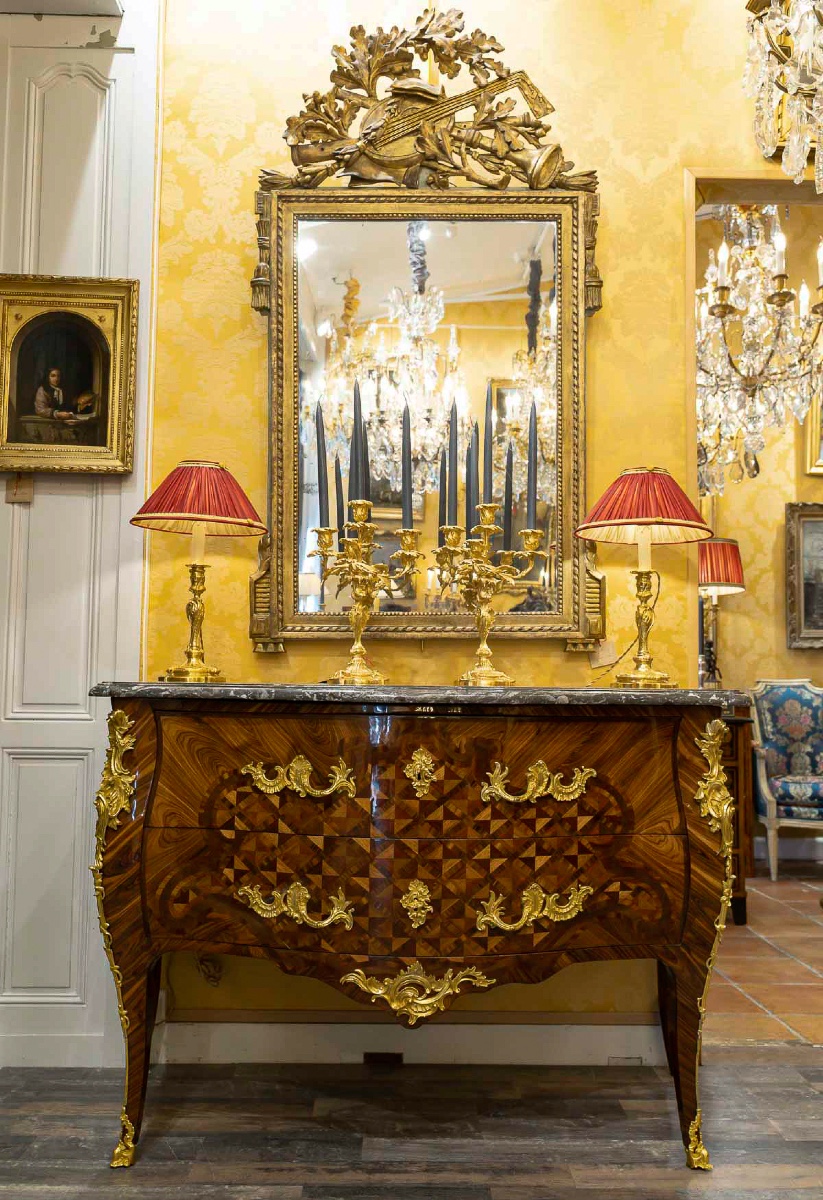
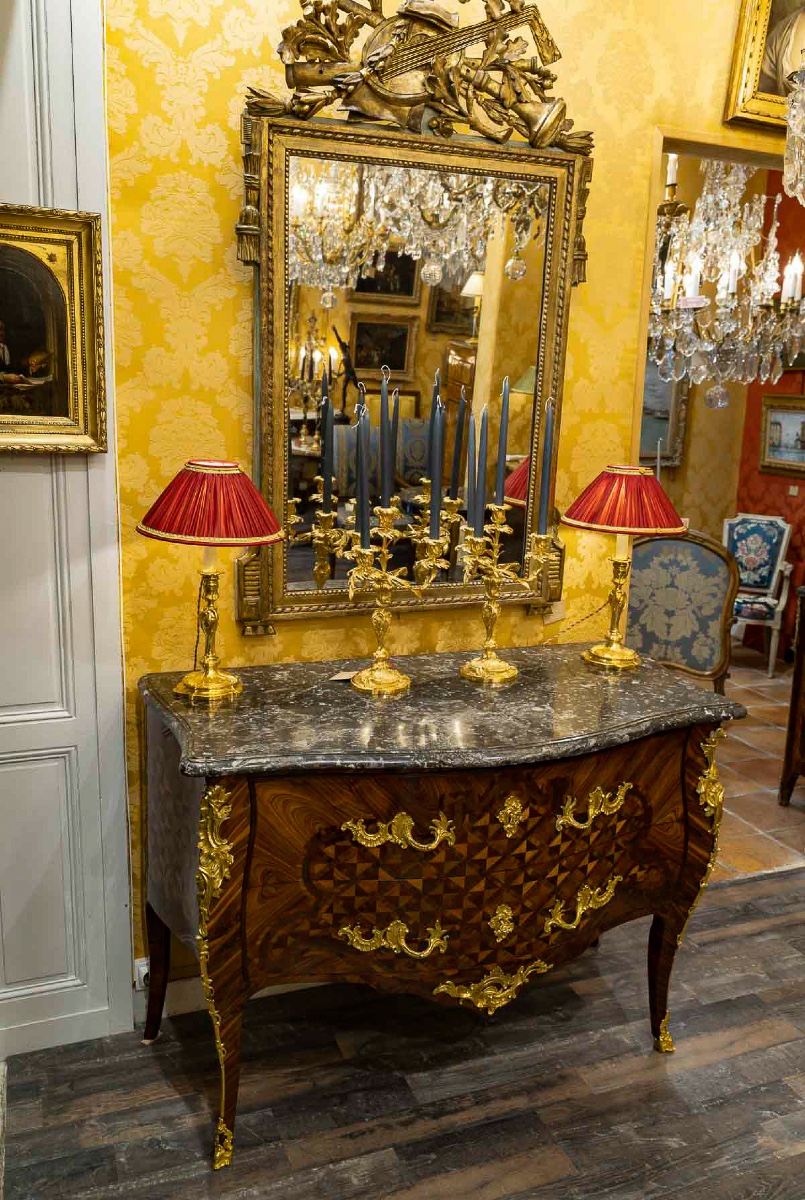
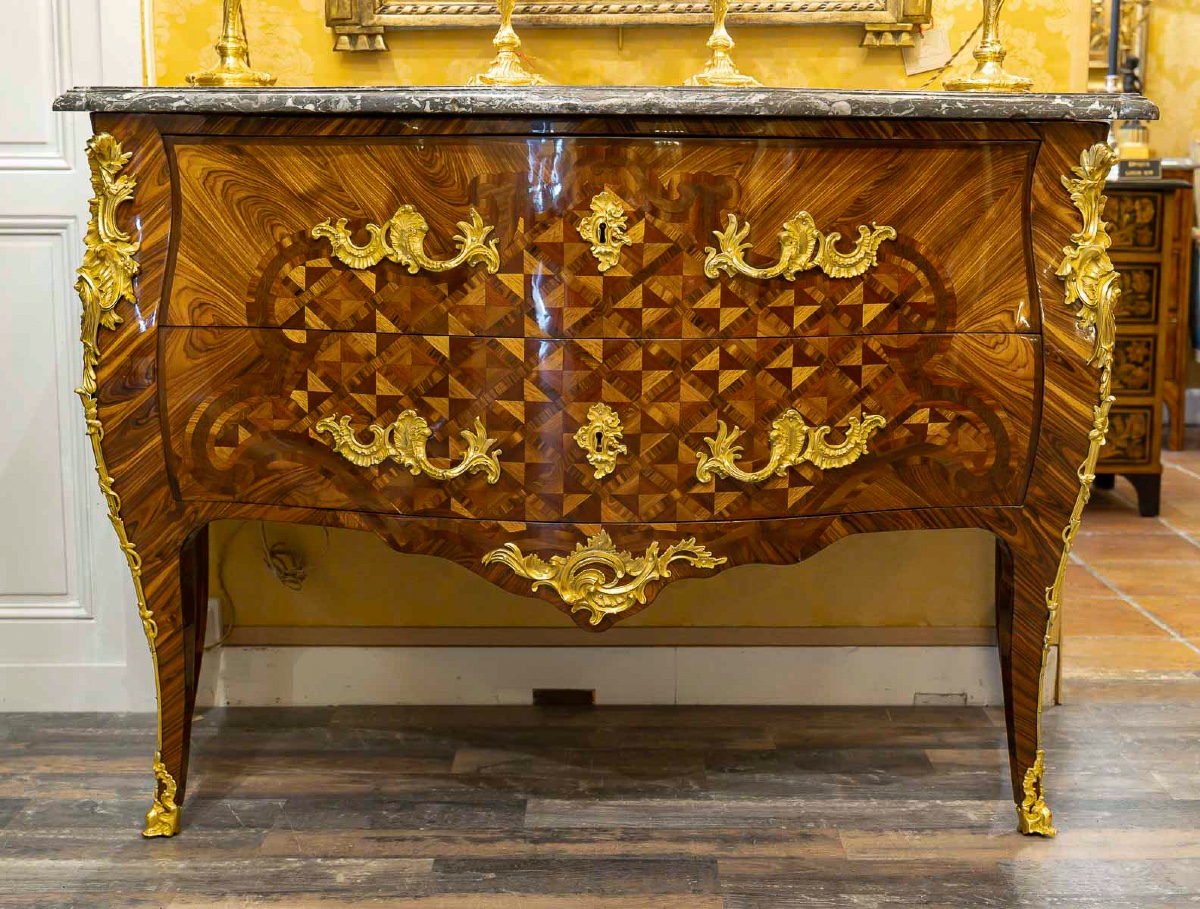






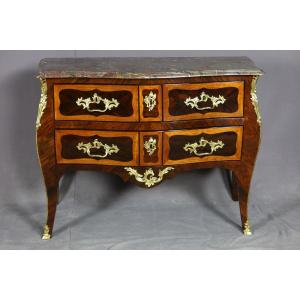
Gilles Joubert and Roger Vandercruse called Lacroix called RVLC – A Marquetry and Gilt-Bronze "Commode Sauteuse" Stamped with the C-Crowned Mark, Circa 1755
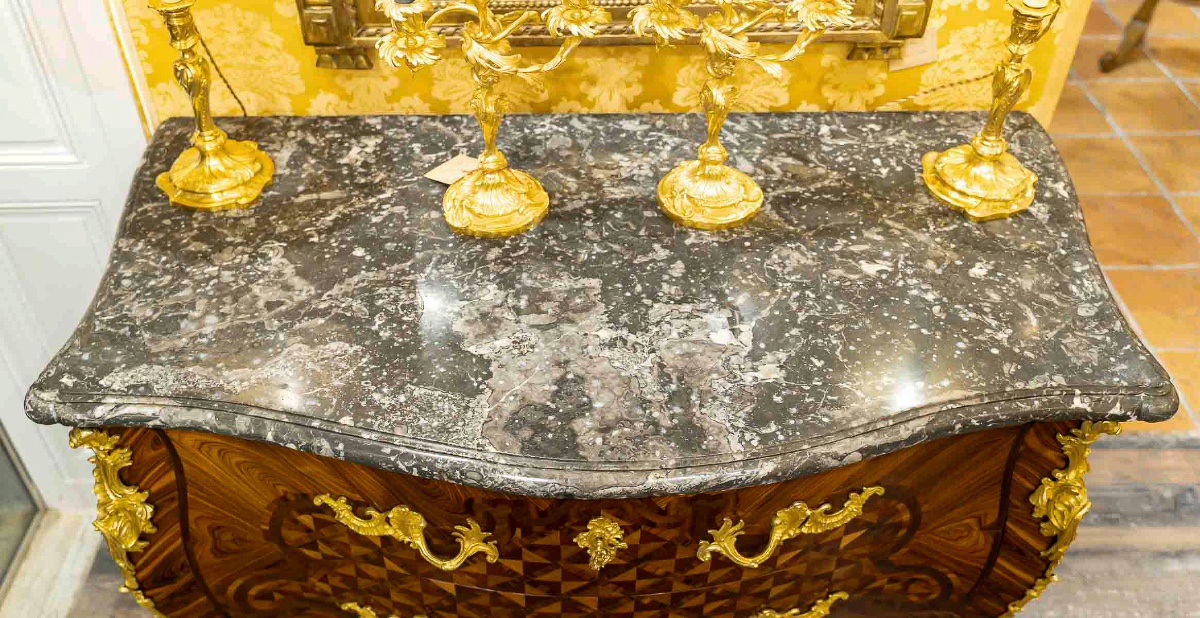
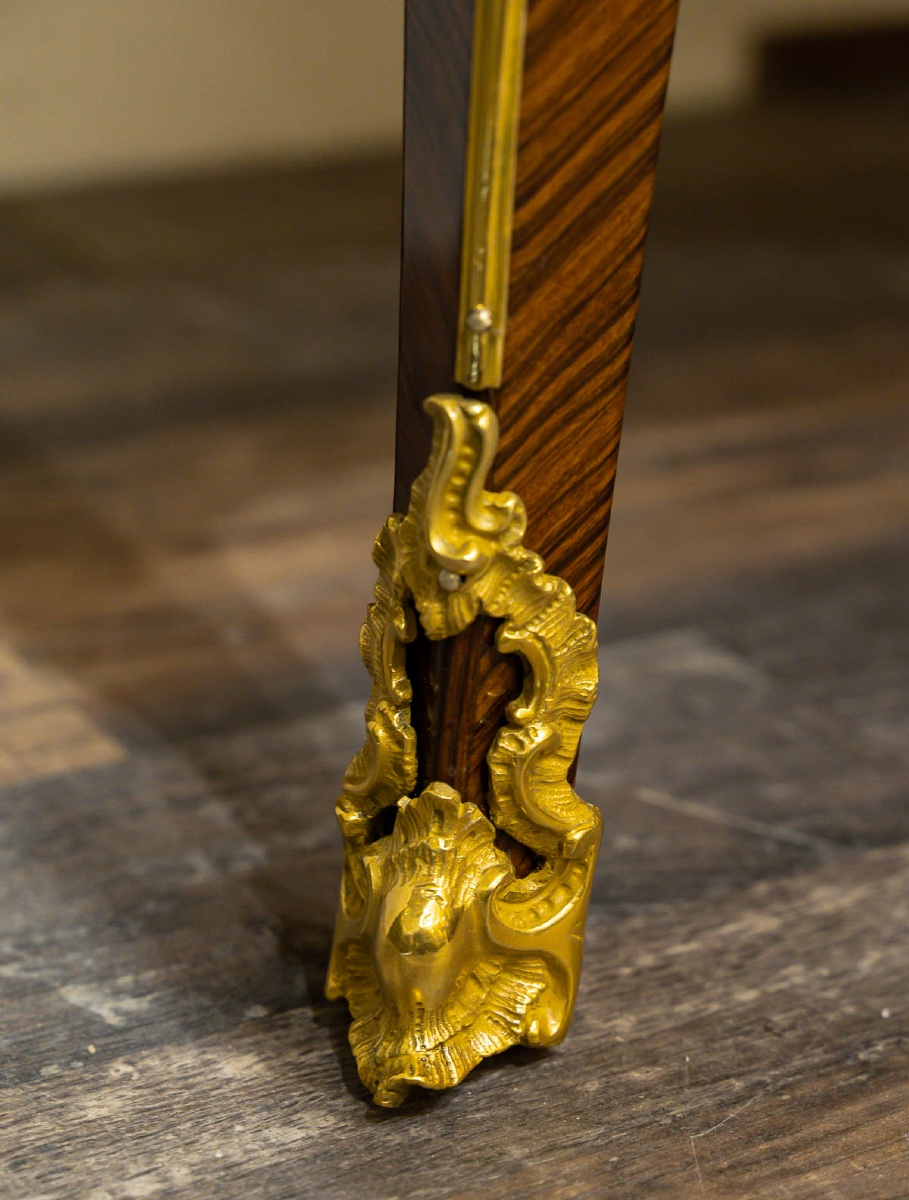
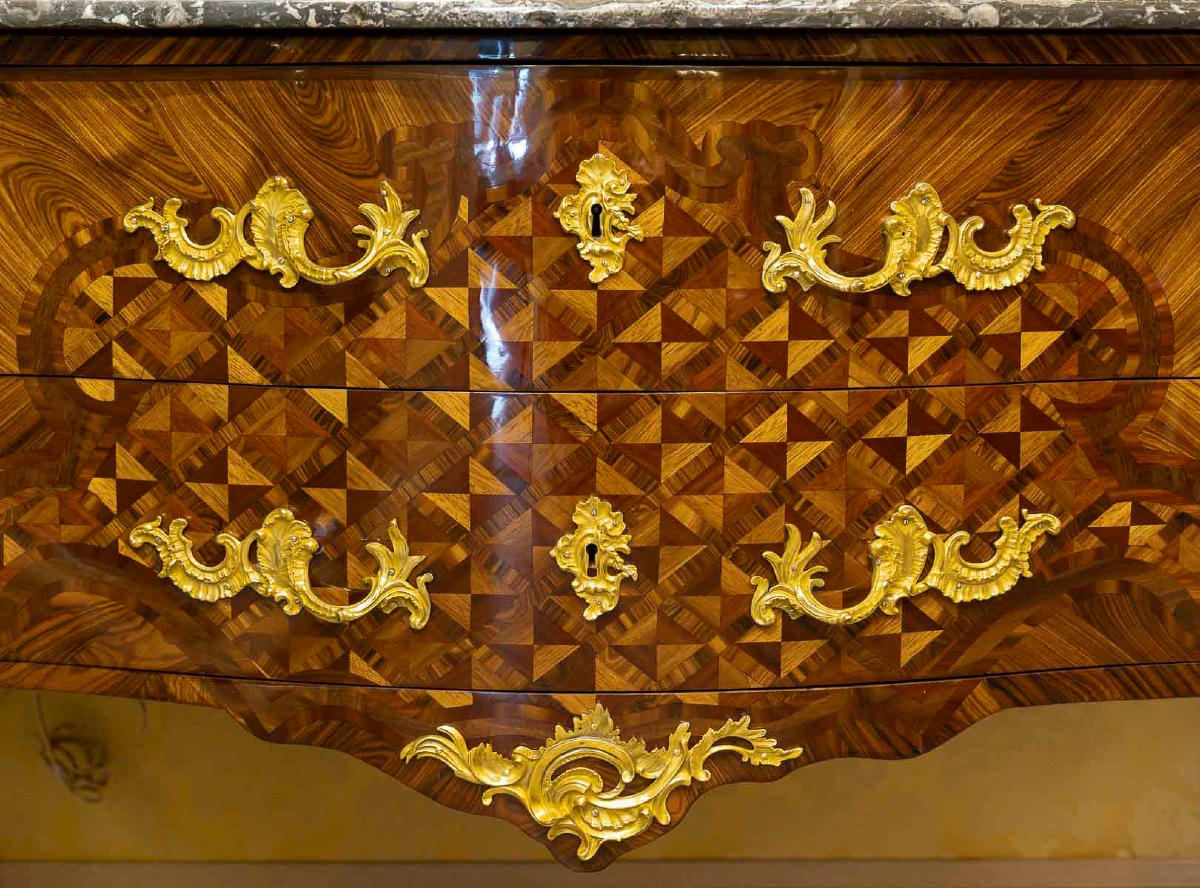
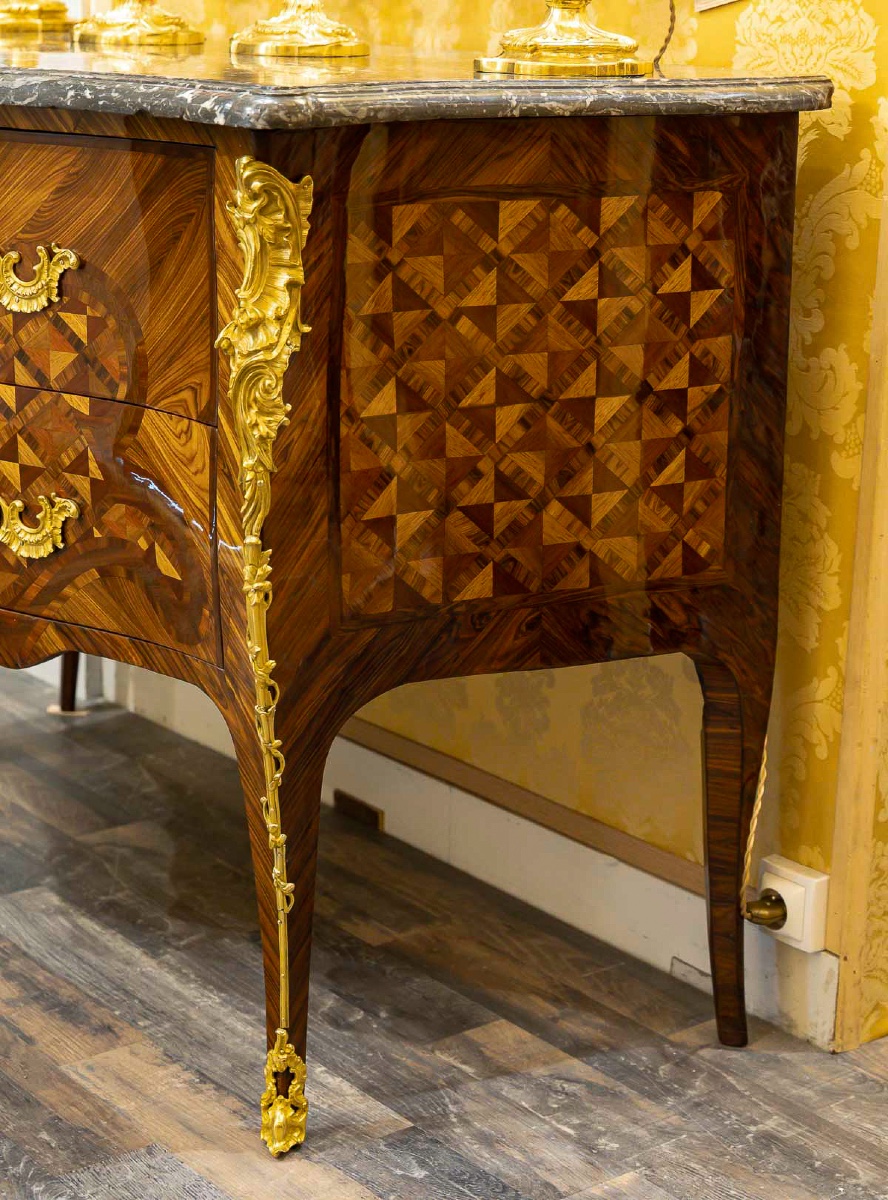
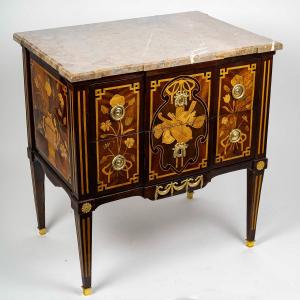
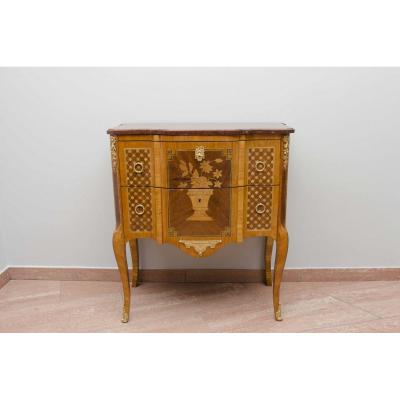
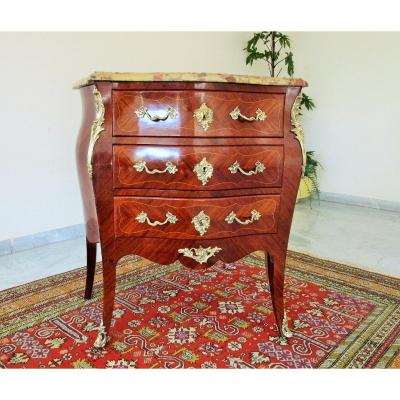
Museum Quality. An exceptional collaboration resulting in a remarkably rare commode sauteuse, featuring marquetry of amaranth, rosewood, and violetwood, enriched with finely chased and gilded bronze mounts marked with the C-crowned stamp. The veined gray marble top surmounts a façade with two drawers—devoid of a central stretcher—adorned with geometric marquetry reserves. The ensemble rests on elegantly curved legs, combining grace and sturdiness.
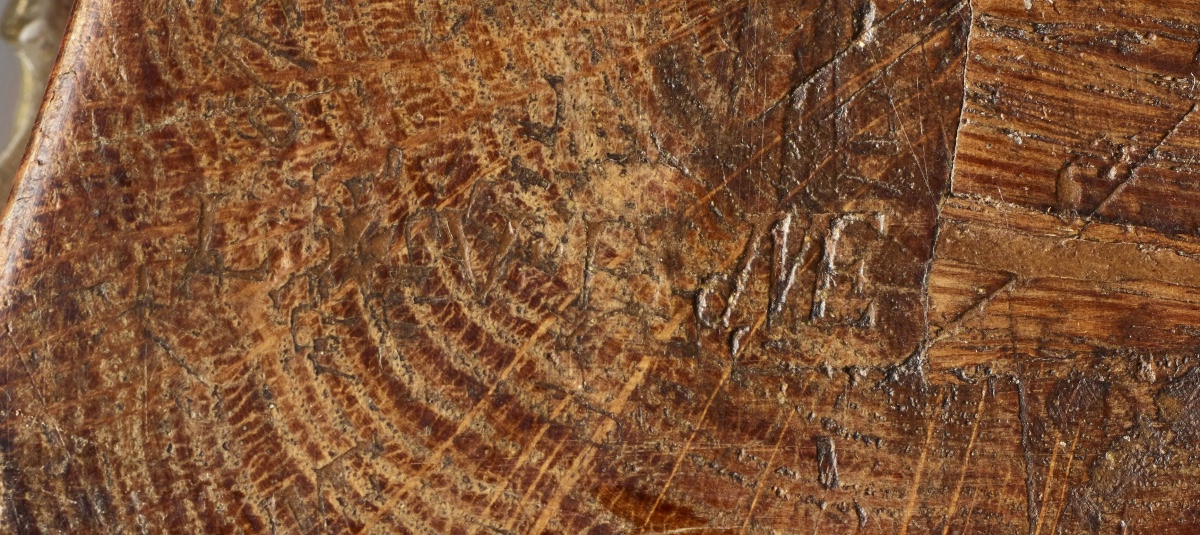
This commode can be compared to the works of Gilles Joubert, ébéniste du Roi (see Christie’s sale, December 19, 2007). It bears the stamp of Roger Vandercruse dit Lacroix (RVLC), as well as multiple marks from the Jurande des Menuisiers-Ébénistes (JME) on the front left stile, attesting to its authenticity and craftsmanship.
Dimensions:
Height: 34⅞ inches (88.5 cm)
Width: 49⅞ inches (126.5 cm)
Depth: 26 inches (66 cm)
Condition:
Excellent. This commode has been meticulously restored and recently refinished with a French polish, enhancing its luster.
Biographies :
1° – Gilles Joubert (1689–1775).
Gilles Joubert is believed to have attained his mastership between 1715 and 1720. He began working for the king in 1748, initially fulfilling occasional commissions. As royal orders grew increasingly frequent, his reputation flourished. In 1755, he was selected to craft two sumptuous corner cabinets (encoignures) intended to complement the medal cabinet delivered by Antoine-Robert Gaudreaus in 1739 for the King’s study at Versailles.
In 1758, he was appointed Ebéniste Ordinaire du Garde-Meuble de la Couronne, having previously served as an occasional supplier. By 1763, he earned the prestigious title of ébéniste du Roi, succeeding Jean-François Oeben, and also became dean of his guild.
With unceasing demand from the royal houses, Joubert was compelled to subcontract portions of his work. Consequently, many pieces delivered under his supervision—though recorded in the Journal du Garde-Meuble—often bear the stamps of his colleagues rather than his own. A quintessential exponent of the Louis XV style, Joubert also adapted to the times, producing Transitional-style pieces with neoclassical motifs. However, he was less at ease with the Louis XVI style.
Joubert stamped only a fraction of his output. Since the use of stamps was not mandatory for most of his career—and he was later exempted as Ebéniste du Roi—reconstructing the full scope of his prolific career remains challenging. Only the Journal du Garde-Meuble, preserved in the Archives Nationales, provides insight into the extent of his contributions.
Already advanced in age when stamp regulations were standardized, he showed little enthusiasm for compliance. He retired from business at eighty-five, shortly before his death in 1775.
Between 1748 and 1774, he delivered nearly 4,000 pieces of furniture to the Crown. Jean-Henri Riesener faced the daunting task of succeeding him in 1774.
Works in Public Collections:
Corner cabinets, commodes – Château de Versailles.
Commode – J. Paul Getty Museum.
Bibliography:
Le Mobilier Français du XVIIIe Siècle – Pierre Kjellberg, Les Éditions de l’Amateur, 2002.
Les Ébénistes Français de Louis XIV à la Révolution – Alexandre Pradère, Éditions Le Chêne, 1989.
Les Ébénistes du XVIIIe Siècle – Comte François de Salverte, Les éditions d’Art et d’Histoire, 1934.
2° – Roger Vandercruse dit Lacroix (RVLC) (1728–1799).
Roger Vandercruse, whose Flemish patronymic is reflected in his RVLC stamp (Roger Van der Croix), stands among the foremost ébénistes of his generation. Renowned for his craftsmanship, he catered to the Parisian nobility, including the duc d’Orléans, Madame du Barry, and the courts of Louis XV and Louis XVI.
Having achieved master status in 1755, he emerged as a leading figure in the Transitional style. His furniture, often more decorative than functional, is distinguished by refined marquetry and antique-inspired bronze mounts, influenced by his brother-in-law Jean-François Oeben (1721–1763), the first husband of his sister Françoise-Marguerite (who later married Jean-Henri Riesener).
Works in Public Collections:
United States: New York, Frick Collection – A commode with oak and mahogany marquetry and a Sarancolin marble top, executed in 1769 for Mademoiselle Victoire, the fourth daughter of Louis XV.
France: Paris, Musée Nissim de Camondo; Château de Versailles (numerous works preserved).
Bibliography:
Roger Vandercruse dit Lacroix – Clarisse Roinet, Les Cahiers du Mobilier, Éditions Perrin & Fils, 2000.
The Jurande des Menuisiers-Ébénistes (JME):
The Jurande oversaw the community of Menuisiers-Ébénistes (JME), comprising a warden (or syndic) and six jurors. Their duties included regulating guild affairs, examining masterpieces for qualification, monitoring the quality of Parisian workshops, and pursuing unlicensed craftsmen. The guild’s statutes, established in 1743 and registered in 1751, formalized the separation between joiners and sculptors, restoring the latter’s privileges.
From 1743 onward, jurors conducted quarterly inspections of workshops, affixing the Jurande’s mark to compliant pieces. A tax of ten sols was levied, and substandard works were confiscated. The official mark was struck on a lead block in Paris; in the provinces, only major production centers like Lyon enforced local regulations. Upholsterers who sourced from unlicensed workers risked penalties for using counterfeit stamps.
On August 20, 1751, Parliament ratified the establishment of the Jurande: “The court orders that the said letters patent be registered, in accordance with the charges, clauses, and conditions set forth by the decrees of the Court of July 12, 1745, January 20, 1749, and May 21, 1751…”













 Le Magazine de PROANTIC
 TRÉSORS Magazine
 Rivista Artiquariato