THIS OBJECT WAS SOLD
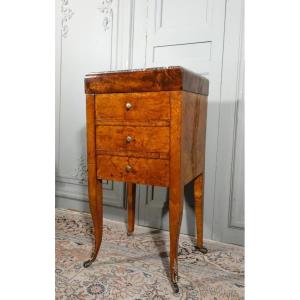
Marquetry Chiffonnière Table Attributed To The Demoulin Workshop, Dijon, Louis XVI Period.


Small living room cabinet opening on the front with three stacked drawers and a side pull, resting on four tapered legs. The front has a technical peculiarity: the absence of a visible crosspiece between the upper drawer and the middle drawer. This crosspiece is simulated by an inlaid decoration, while a real crosspiece clearly separates the middle drawer from the lower drawer. This refined process visually lightens the front and illustrates the mastery of the cabinetmaker. The cabinet retains its three period locks, particularly remarkable with a double-barreled lock, requiring a double-bitted key (now missing). This rare device in the 18th century illustrates the technical requirements and the search for security specific to precious furniture. The bronze lock escutcheons and pull knobs are also original. On the left, a side writing pull gives this small piece of furniture the versatility specific to "moving furniture", intended to be moved as needed in a living room. The back, treated in a more sober manner but nevertheless veneered with burr walnut, frequently used by cabinetmakers in Eastern France, confirms that this chiffonier was designed to be placed against a wall while allowing a certain mobility. The top is decorated with an inlaid musical trophy (violin, flutes, music score, tambourine, ribbon and doves), executed in precious wood inscribed in a frame of green-tinted Greek-style fillets. This sophisticated decorative vocabulary is found in several works stamped Jean-Baptiste Demoulin, active in Dijon from 1780 and appointed cabinetmaker to the Prince of Condé in 1781. The frieze of simulated fluting on the first drawer further illustrates this taste for illusionism that can be found on comparable chests of drawers and secretaries (see Musée des Beaux-Arts de Dijon; B. Mura-Todesco, Les Ébénistes de Bourgogne et de Franche-Comté). The false fluting is made with a single light wood species, using the hot sand technique, allowing for a trompe-l'oeil effect. The walnut and softwood frame, rare in Paris but typical of Dijon practices, confirms the attribution to this workshop. State of preservation: exceptional. The furniture retains a very beautiful integrity of its veneer and has only required minor restorations (some gluing). The finish has been redone with French polish, restoring all the freshness of the decoration intended by Demoulin. Another Dijon cabinetmaker is known in particular for the use of simulated fluting using the same technique: Jean-Baptiste Courte or Kurt. Courte's chests of drawers at the Musée des Beaux-Arts in Dijon clearly show the frieze of simulated fluting, but with a more sober overall vocabulary. The works stamped Demoulin, on the contrary, combine this illusionist frieze with a more luxurious ornamental research, with precious veneers, colored fillets and trophies. By its refined decoration, its complex marquetry and its ornamental vocabulary, this chiffonier can be attributed with plausibility to the Demoulin workshop in Dijon, in the 1780s, while fully illustrating the regional cabinetmaking school of Burgundy which knew how to rival Paris by the quality of its productions. Dimensions: H. 74.5 cm – W. 51 cm – D. 33.5 cm
Explore similar pieces and discover your ideal find:
Side Tables