


Ottoman School (19th Century) Portrait Of Sultan Murad I. Gouache And Watercolour #8
OTTOMAN SCHOOL (19th century)
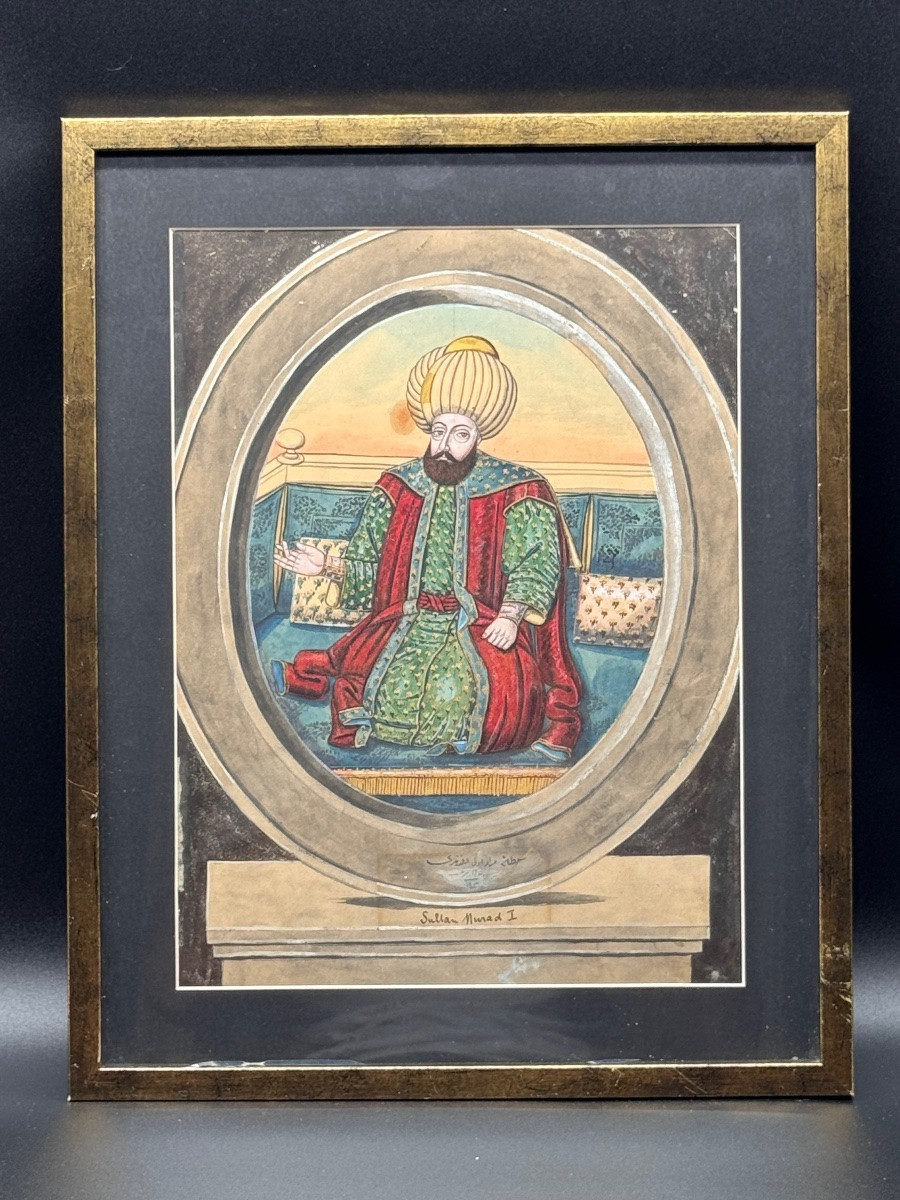
Portrait of Sultan Murad I.
Gouache and watercolour on paper.
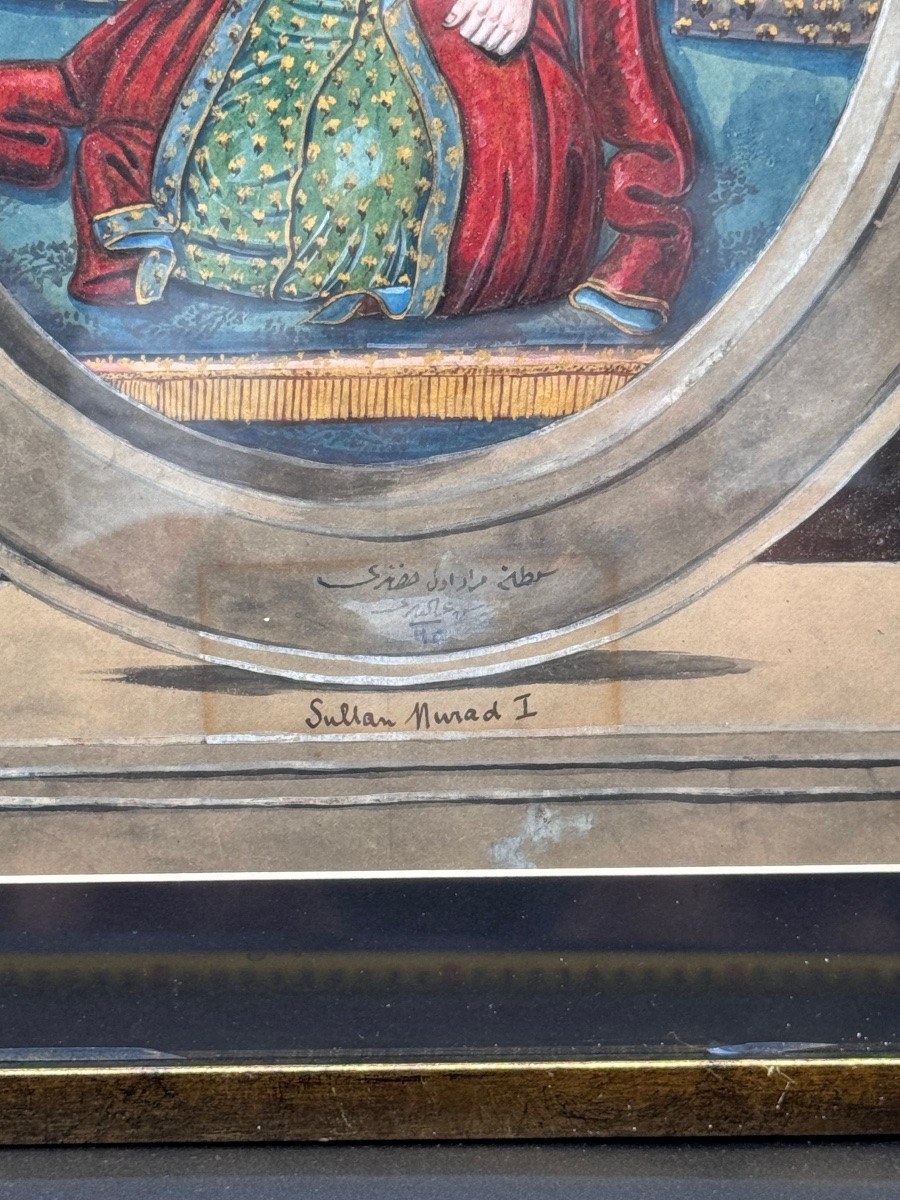
Inscribed at the bottom in a cartouche in Arabic and Latin script: ‘Sultan Murad’.
Framed under glass.
H_28 cm, W_20 cm (visible dimensions)
Good condition
#8 Murad I. Khodāvandgār, literally "the devotee of God," meaning "ruler" in this context, born on June 29, 1326, and died on June 15, 1389, was Sultan of the Ottoman Empire from 1362 to 1389. He was the son of Orhan Gazi and Nilüfer Hatun. Murad I ascended the throne after the death of his elder half-brother, Süleyman Pasha. Murad I conquered Adrianople in the 1360s and made it the new capital of the Ottoman Sultanate. He then expanded the Ottoman kingdom into Southern Europe, bringing most of the Balkans under Ottoman rule and forcing the princes of Serbia and Bulgaria, as well as the Byzantine emperor John V Palaiologos, to pay him tribute. Murad I administratively divided his sultanate into two provinces: Anatolia (Asia Minor) and Rumelia (the Balkans). According to Ottoman sources, Murad I's titles included Bey, Emir-i a'zam (Grand Emir), Ghazi, Hüdavendigâr, Khan, Padishah, Sultanü's-selâtîn (Sultan of Sultans), and Melikü'l-mülûk (Malik of Maliks), while in Bulgarian and Serbian sources, he was called Tsar. In a Genoese document, he was called dominus armiratorum Turchie (Master lord of the Turks).
Portrait of Sultan Murad I.
Gouache and watercolour on paper.
Inscribed at the bottom in a cartouche in Arabic and Latin script: ‘Sultan Murad’.
Framed under glass.
H_28 cm, W_20 cm (visible dimensions)
Good condition
#8 Murad I. Khodāvandgār, literally "the devotee of God," meaning "ruler" in this context, born on June 29, 1326, and died on June 15, 1389, was Sultan of the Ottoman Empire from 1362 to 1389. He was the son of Orhan Gazi and Nilüfer Hatun. Murad I ascended the throne after the death of his elder half-brother, Süleyman Pasha. Murad I conquered Adrianople in the 1360s and made it the new capital of the Ottoman Sultanate. He then expanded the Ottoman kingdom into Southern Europe, bringing most of the Balkans under Ottoman rule and forcing the princes of Serbia and Bulgaria, as well as the Byzantine emperor John V Palaiologos, to pay him tribute. Murad I administratively divided his sultanate into two provinces: Anatolia (Asia Minor) and Rumelia (the Balkans). According to Ottoman sources, Murad I's titles included Bey, Emir-i a'zam (Grand Emir), Ghazi, Hüdavendigâr, Khan, Padishah, Sultanü's-selâtîn (Sultan of Sultans), and Melikü'l-mülûk (Malik of Maliks), while in Bulgarian and Serbian sources, he was called Tsar. In a Genoese document, he was called dominus armiratorum Turchie (Master lord of the Turks).
3 500 €
Period: 18th century
Style: Orientalism
Condition: Good condition
Material: Paper
Reference (ID): 1602743
Availability: In stock
Print