

Ottoman School (19th Century) Portrait Of Sultan Osman Gazi. Gouache And Watercolour #3
OTTOMAN SCHOOL (19th century)
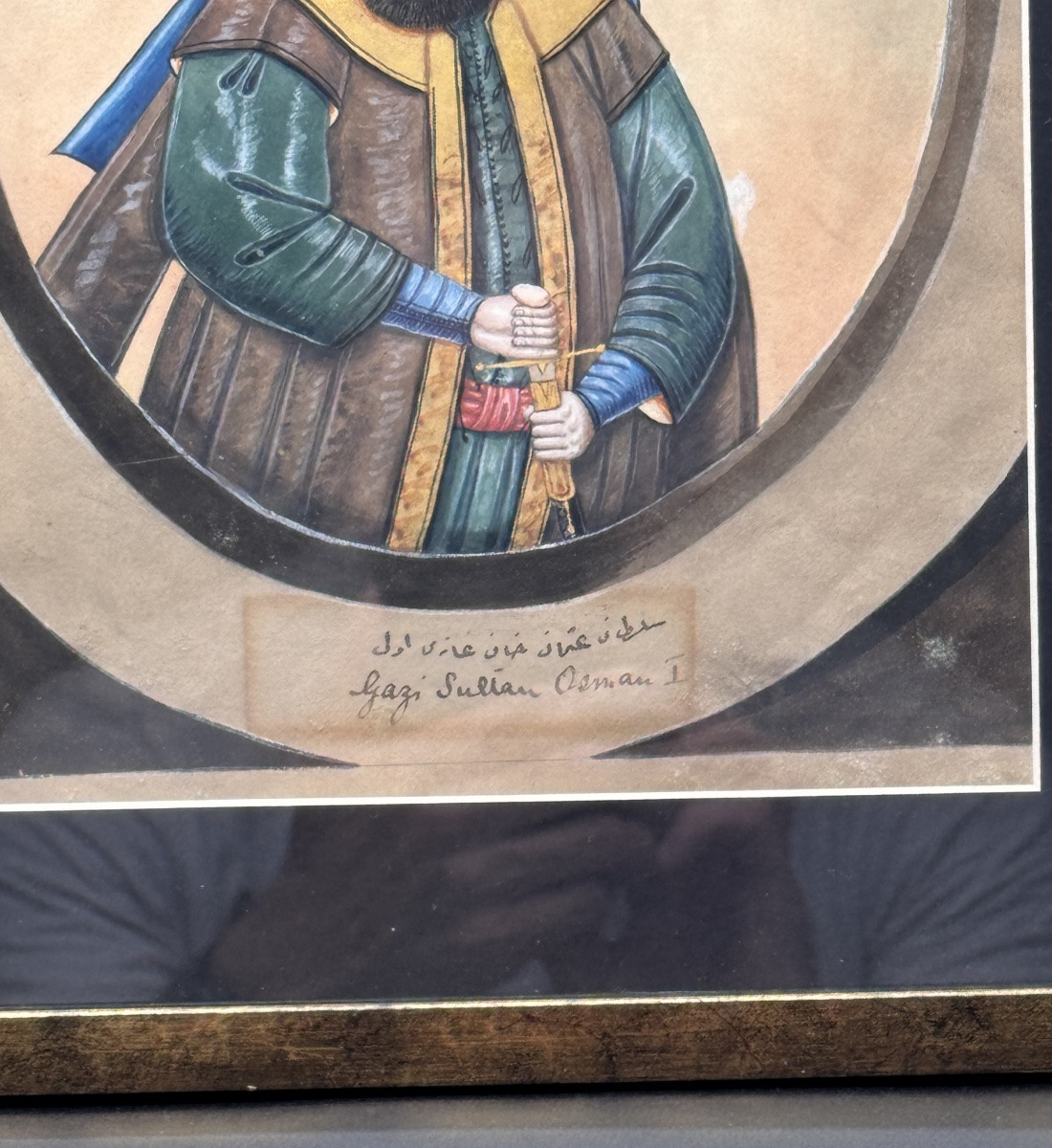
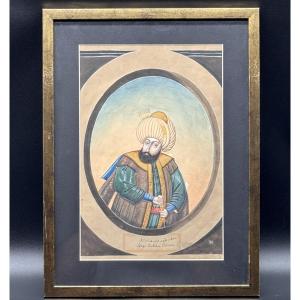
Portrait of Sultan Osman Gazi.
Gouache and watercolour on paper,
inscribed at the bottom in a cartouche in Arabic and Latin script: ‘Sultan Osman’.
Framed under glass (visible)
H_28 cm W_25 cm
Good condition.
#3 Osman Gazi (died 1323/4) was the eponymous founder of the Ottoman Empire (first known as a beylik or emirate). Initially a small Turkmen principality during Osman's lifetime, his beylik grew into a vast empire in the centuries following his death. It existed until 1922, shortly after the end of World War I, when the sultanate was abolished. Due to the scarcity of historical sources dating from his time, very little factual information about Osman has survived. No written records of Osman's reign remain, and the Ottomans did not record his life story until the 15th century, more than a hundred years after his death.[18] Consequently, historians struggle to separate fact from myth in the many stories surrounding him. One historian even went so far as to declare it impossible, describing the period of Osman's life as a "black hole." According to later Ottoman tradition, Osman's ancestors were descendants of the Kayı tribe of the Oghuz Turks. However, many scholars of the early Ottoman Empire consider this a later invention intended to bolster dynastic legitimacy. The Ottoman principality was one of several Anatolian beyliks that emerged in the second half of the 13th century. Located in the Bithynia region of northern Asia Minor, Osman's principality was particularly well-positioned to launch attacks against the vulnerable Byzantine Empire, which his descendants eventually conquered.
Portrait of Sultan Osman Gazi.
Gouache and watercolour on paper,
inscribed at the bottom in a cartouche in Arabic and Latin script: ‘Sultan Osman’.
Framed under glass (visible)
H_28 cm W_25 cm
Good condition.
#3 Osman Gazi (died 1323/4) was the eponymous founder of the Ottoman Empire (first known as a beylik or emirate). Initially a small Turkmen principality during Osman's lifetime, his beylik grew into a vast empire in the centuries following his death. It existed until 1922, shortly after the end of World War I, when the sultanate was abolished. Due to the scarcity of historical sources dating from his time, very little factual information about Osman has survived. No written records of Osman's reign remain, and the Ottomans did not record his life story until the 15th century, more than a hundred years after his death.[18] Consequently, historians struggle to separate fact from myth in the many stories surrounding him. One historian even went so far as to declare it impossible, describing the period of Osman's life as a "black hole." According to later Ottoman tradition, Osman's ancestors were descendants of the Kayı tribe of the Oghuz Turks. However, many scholars of the early Ottoman Empire consider this a later invention intended to bolster dynastic legitimacy. The Ottoman principality was one of several Anatolian beyliks that emerged in the second half of the 13th century. Located in the Bithynia region of northern Asia Minor, Osman's principality was particularly well-positioned to launch attacks against the vulnerable Byzantine Empire, which his descendants eventually conquered.
3 500 €
Period: 18th century
Style: Orientalism
Condition: Good condition
Material: Paper
Reference (ID): 1602734
Availability: In stock
Print