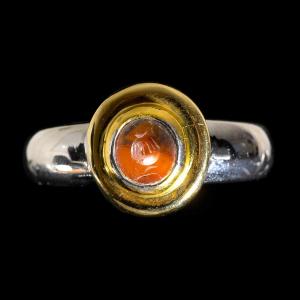
Gold Ring With An Intaglio Of A Goat-headed Rhyton. Greek, 6th–4th Century B.c.
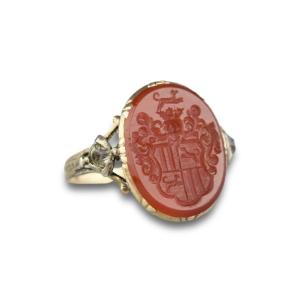
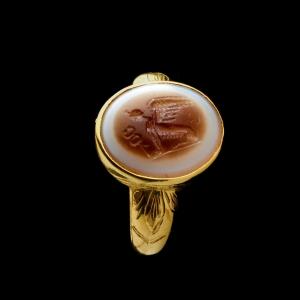
Carnelian Intaglio of a Goat-Headed Rhyton, Mounted in a Modern Gold Ring.
Eastern Mediterranean, likely Greek, 6th–4th century B.C.
Later mount and repair, modern
Ring size: UK Q / US 8 / EU 57
Bezel: 2.2 × 1.7 cm
Weight: 8.56 grams
An oval carnelian intaglio engraved with a depiction of a goat-headed rhyton. The vessel terminates in the forepart of a recumbent wild goat, the head rendered in profile with elegantly arched horns, pronounced muzzle, and carefully incised eye. The neck of the rhyton rises in a conical form behind the goat, its surface decorated with diagonal and cross-hatched incision suggesting ribbing or chased metalwork. The engraving is executed with a confident hand, showing particular sensitivity to the anatomy of the animal and the volumetric play of the vessel’s form. A small triangular area at the top left of the stone has been repaired in gold; both the repair and the present gold ring mount are modern additions.
The subject—a rhyton terminating in an animal protome—belongs to a well-established tradition in Eastern Greek and Achaemenid art of the late Archaic and Classical periods, in which zoomorphic libation vessels were used in ritual and ceremonial contexts. Goat-headed rhyta, though less commonly preserved in glyptic media, are attested in silver and ceramic examples, notably from Asia Minor and Thrace. The stylised horned animal, here likely a wild goat or ibex, is associated with vitality and mountain symbolism, while the rhyton itself signals elite drinking culture and votive use.
The use of carnelian is typical of high-quality glyptic production in the 6th to 4th century BC, valued for its durability and ability to take a fine polish. The style and iconography suggest an Eastern Mediterranean origin, most probably Ionian or Anatolian.
References:
For rhyta of similar form and iconography, compare the silver and gold animal-headed rhyta from the Panagyurishte and Derveni Treasures (Seipel, W., Antike Goldschmiedekunst, Vienna, 1980). A rhyton terminating in a goat protome from the 5th century BC is in the collection of the Metropolitan Museum of Art, New York (acc. no. 1989.281.15).
Eastern Mediterranean, likely Greek, 6th–4th century B.C.
Later mount and repair, modern
Ring size: UK Q / US 8 / EU 57
Bezel: 2.2 × 1.7 cm
Weight: 8.56 grams
An oval carnelian intaglio engraved with a depiction of a goat-headed rhyton. The vessel terminates in the forepart of a recumbent wild goat, the head rendered in profile with elegantly arched horns, pronounced muzzle, and carefully incised eye. The neck of the rhyton rises in a conical form behind the goat, its surface decorated with diagonal and cross-hatched incision suggesting ribbing or chased metalwork. The engraving is executed with a confident hand, showing particular sensitivity to the anatomy of the animal and the volumetric play of the vessel’s form. A small triangular area at the top left of the stone has been repaired in gold; both the repair and the present gold ring mount are modern additions.
The subject—a rhyton terminating in an animal protome—belongs to a well-established tradition in Eastern Greek and Achaemenid art of the late Archaic and Classical periods, in which zoomorphic libation vessels were used in ritual and ceremonial contexts. Goat-headed rhyta, though less commonly preserved in glyptic media, are attested in silver and ceramic examples, notably from Asia Minor and Thrace. The stylised horned animal, here likely a wild goat or ibex, is associated with vitality and mountain symbolism, while the rhyton itself signals elite drinking culture and votive use.
The use of carnelian is typical of high-quality glyptic production in the 6th to 4th century BC, valued for its durability and ability to take a fine polish. The style and iconography suggest an Eastern Mediterranean origin, most probably Ionian or Anatolian.
References:
For rhyta of similar form and iconography, compare the silver and gold animal-headed rhyta from the Panagyurishte and Derveni Treasures (Seipel, W., Antike Goldschmiedekunst, Vienna, 1980). A rhyton terminating in a goat protome from the 5th century BC is in the collection of the Metropolitan Museum of Art, New York (acc. no. 1989.281.15).
8 700 €
Period: Before 16th century
Style: Rome and Antic Greece
Condition: Good condition
Material: Gold
Reference (ID): 1588227
Availability: In stock
Print