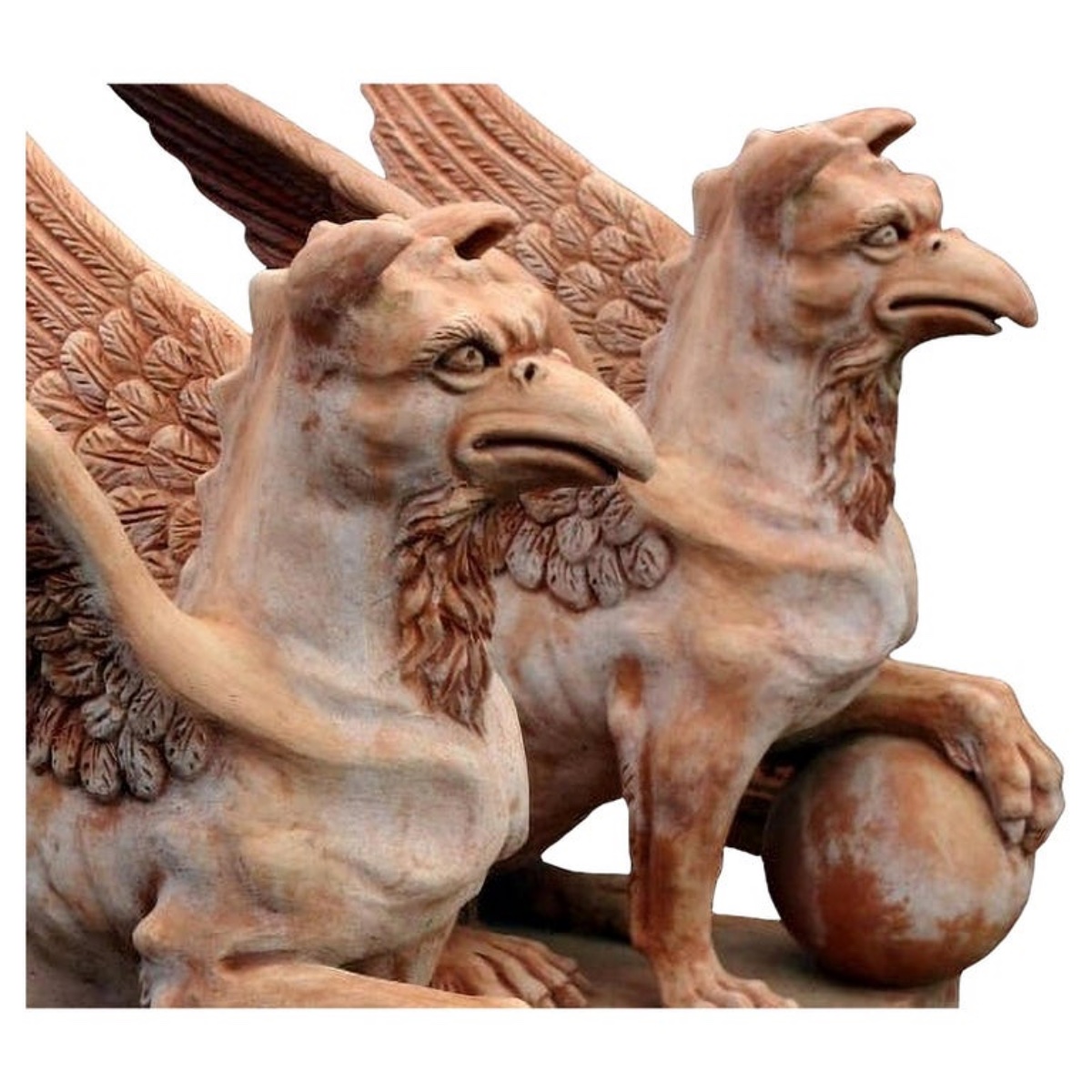
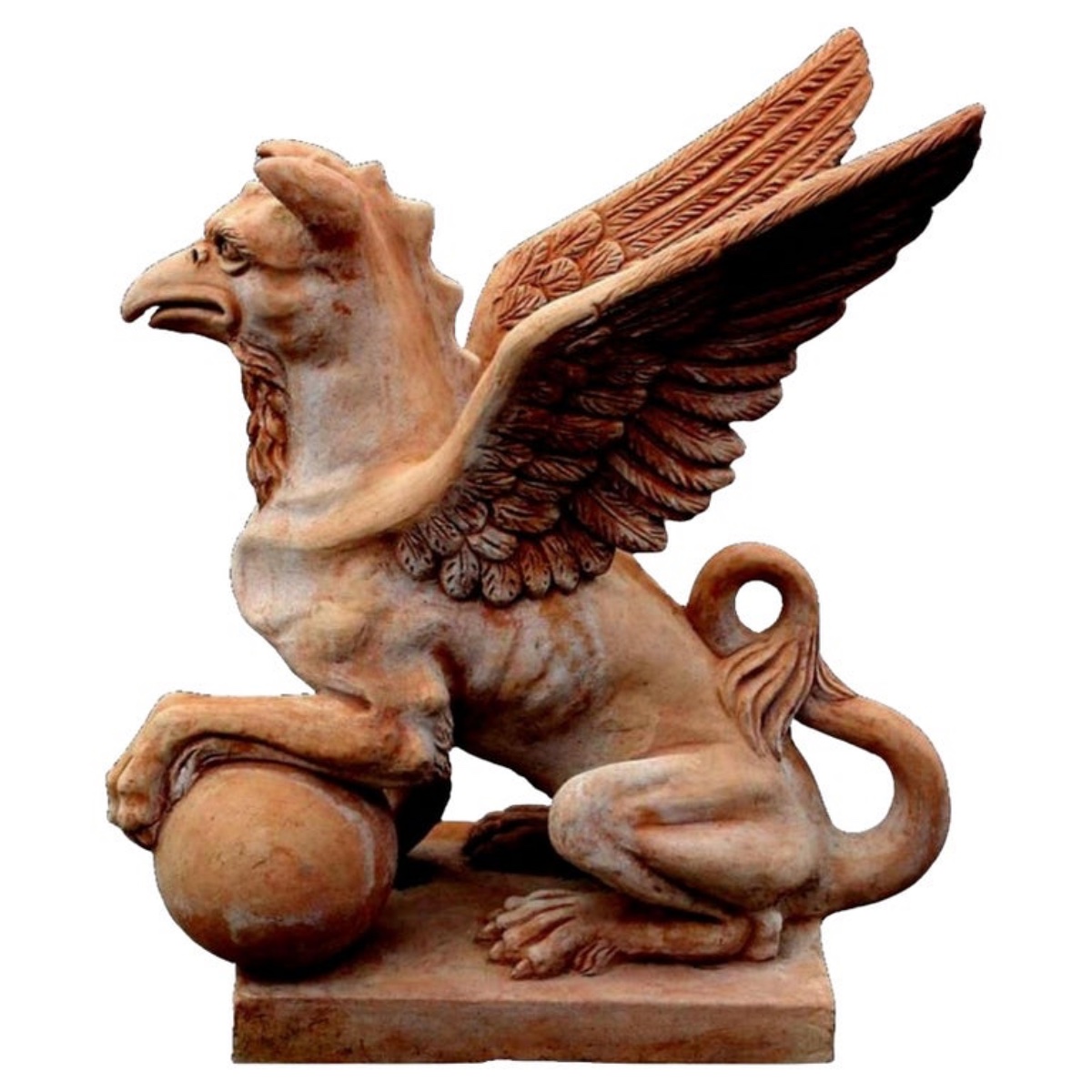
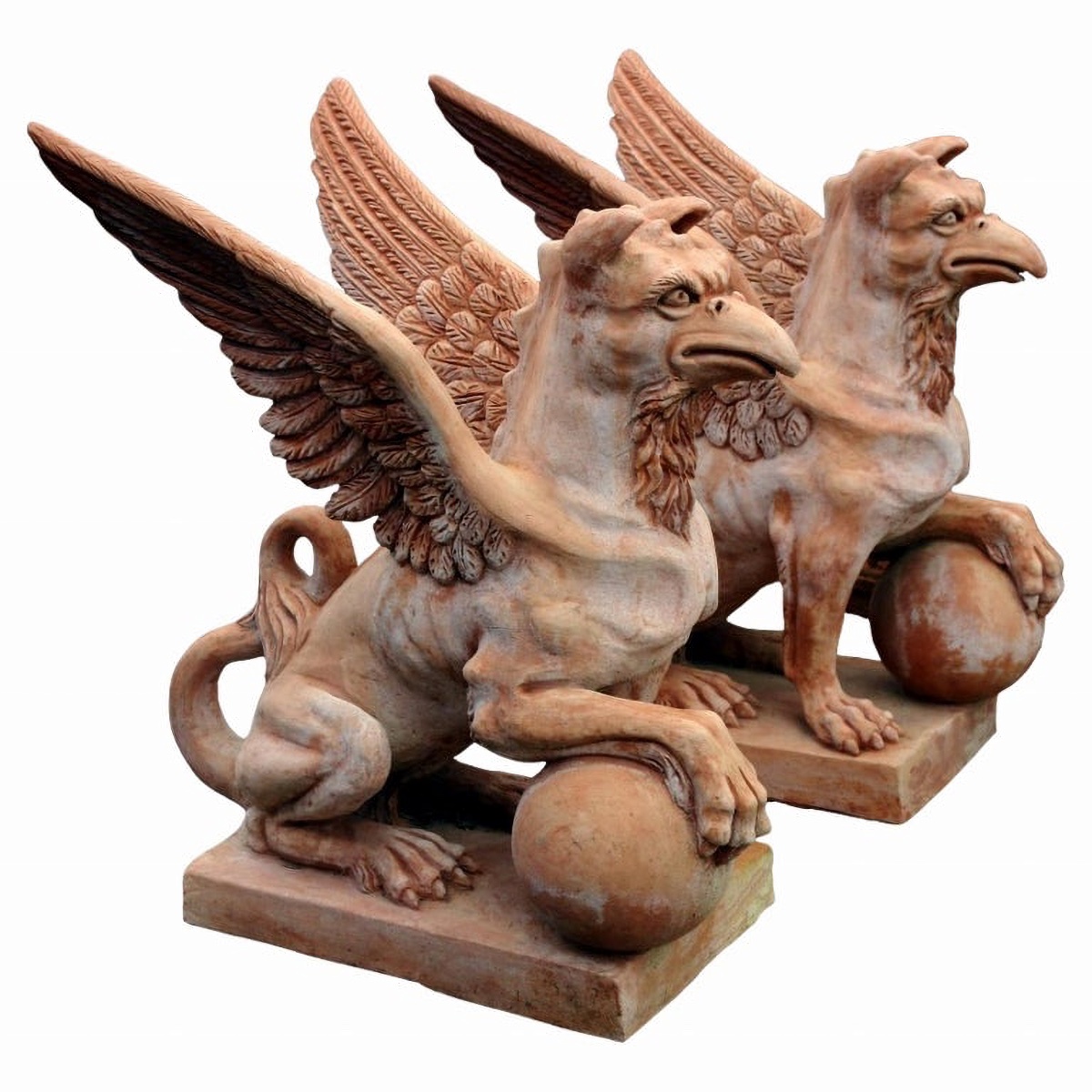


Large Terracotta Griffins, 20th Century
LARGE TERRACOTTA GRIFFONS, 20th centuryCopy of antique Renaissance griffins.Terracotta from Impruneta.Made in TuscanyHEIGHT 73 cmWIDTH 30 cmDEPTH 64 cmWEIGHT 25 kgMANUFACTURE Made in TuscanyMATERIAL TerracottaThe griffin is a legendary creature with the body of a lion and the head of an eagle. This hybrid creature is particularly represented in Minoan, Mycenaean and Greek art. However, some archetypal figures, or at least correlated with it, are found in various civilizations of the Mediterranean and Anterior Asia. Its name comes from the griffin, also called gringo or cignardo. In Egypt, the oldest representation evoking a griffin is found on the "palette of the two dogs", dating from the Predynastic period (5,500 - 3,100 BC), discovered at Hieracompolis. Although there are no known representations of it from the Old Kingdom, it reappears in some tombs of high dignitaries near Beni Hassan and Bersheh in the Middle Kingdom. Another possible archetype of the griffin could instead be identified in the terrible Anzû, personification of the storm, wind and rain, represented or mentioned as early as the 3rd millennium BC on Sumerian reliefs discovered near Telloh, although he was depicted not with an eagle's head, but with a lion's. Another creature with a similar description is Asakku, also a storm spirit, a demon carrying diseases[5]. In Mesopotamian mythologies, creatures formed from the union of several predatory animals or snakes were demons or deities with harmful characteristics. Fresco depicting a griffin in the throne room of Knossos. This hybrid figure gradually spread in the imagination of various populations, particularly due to the syncretism that characterized the religions of the time, but not without differentiating and adapting to the cultural and mythological context. For example, the griffins in the throne room of Knossos, Crete, are distinguished by their apterity, their voluminous feathers overhanging the eagle's face and their feline body, closer to the leopard than the lion. They were generally quite common in Minoan and Mycenaean art. Among the Greeks, it was linked to the solar cult, playing the role of companion-servant of Phoebus or Apollo. In a Greek myth, griffins were in an eternal struggle against the Arimaspes, a mythical people from the north, who were trying to seize Apollo's treasure, which they guarded. In Athens, the figure of the griffin was also popularized thanks to its adoption as a symbol by the Achaemenid dynasty. Famous are the two polychrome marble griffins of Ascoli Satriano, probably the work of a Daunian master or from Magna Graecia in Apulia; they are depicted with large colored wings, not those of a bird of prey, an eagle's beak, a snake's neck, or, in any case, a reptilian body, a lion. It found an almost definitive form in the Greek collective imagination after 400 BC. BC with the dissemination of two works: The Histories (Ἰστορίαι, Historìai) by Herodotus of Halicarnassus (described as an inhabitant of the mountains between the Hyperboreans and Arimaspe, where he preserved the gold of the North) and The History of Persia (Περσικά) by Ctesias of Cnidus.
6 500 €
Period: 20th century
Style: Other Style
Condition: Excellent condition
Material: Terracotta
Width: 30cm
Height: 73cm
Depth: 64cm
Reference (ID): 1544293
Availability: In stock
Print