THIS OBJECT WAS SOLD
Berlin Adorant , 19th Century Bronze After The Antique


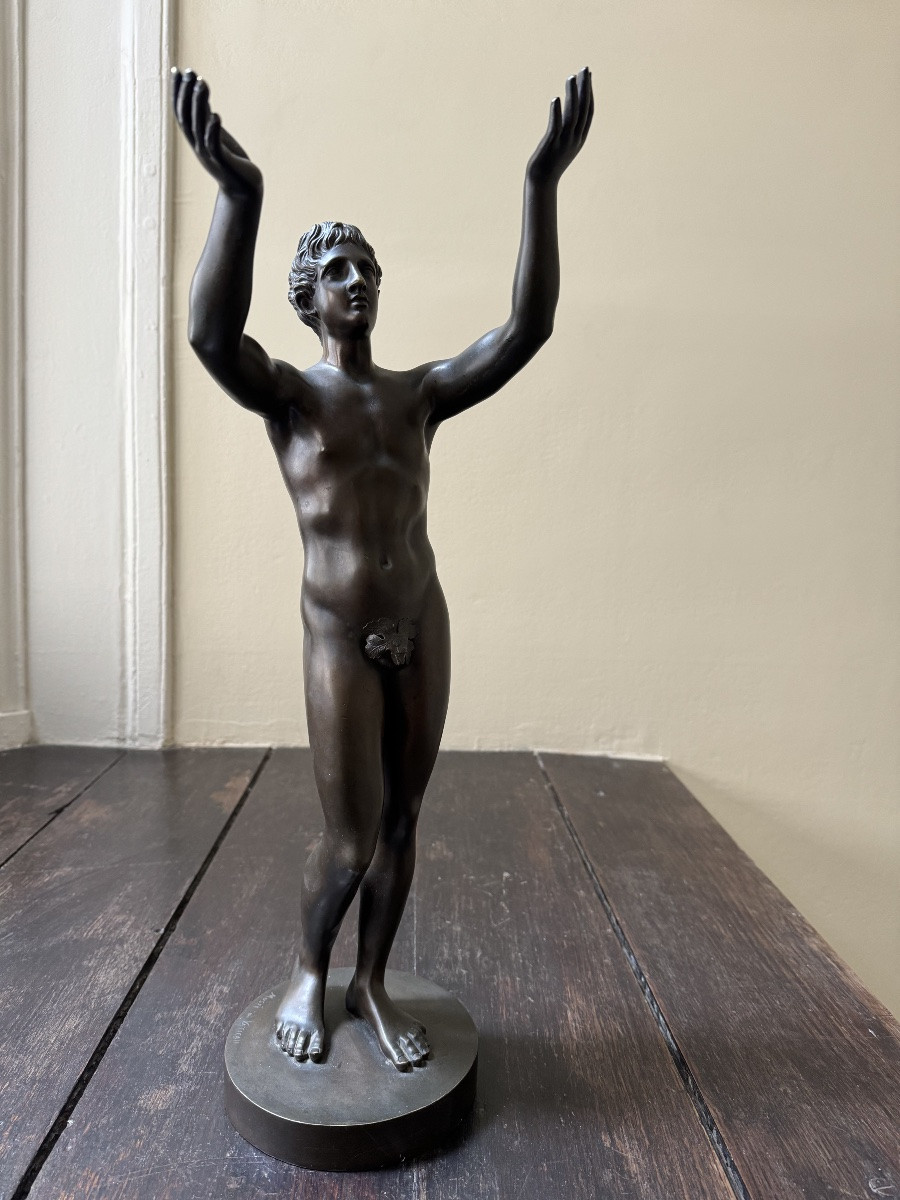


The Young Man Praying, also called the Adorant of the Villa Albani. Bronze with brown patina after a bronze from the 4th century BC. Beautiful patina, very good condition.
Patinated bronze representing the Young Man Praying ( Der Betender Knabe in german), an ancient statue kept at the Antikensammlung in Berlin. The original bronze model, dated to the 2nd century BC, was discovered in Rome in the 18th century, then acquired by Frederick II of Prussia for his collection. In 1806, the sculpture was transferred to Paris on the orders of Napoleon after the Prussian campaign and exhibited at the Musée Napoléon (later Louvre), before being returned to Berlin in 1815.
This reduction follows the ancient model: the young man is represented naked, standing, his arms raised in a posture of adoration or offering. The penis is covered with a fig leaf, as was often the case on reproductions distributed in the 19th century.
The base bears the inscription in French “Vatican Museum”, although the original model is now kept in Berlin. This mention is probably explained by a common usage among 19th-century founders: the names of prestigious museums were sometimes used to designate the origin or ancient inspiration of a model, even when the exact attribution was known. It is also possible that for political and cultural reasons at the time of the war and Franco-Prussian tensions, the founder preferred to mention a place of conservation of the bronze other than Berlin. This would date the object between approximately 1870 and 1880.
Patinated bronze representing the Young Man Praying ( Der Betender Knabe in german), an ancient statue kept at the Antikensammlung in Berlin. The original bronze model, dated to the 2nd century BC, was discovered in Rome in the 18th century, then acquired by Frederick II of Prussia for his collection. In 1806, the sculpture was transferred to Paris on the orders of Napoleon after the Prussian campaign and exhibited at the Musée Napoléon (later Louvre), before being returned to Berlin in 1815.
This reduction follows the ancient model: the young man is represented naked, standing, his arms raised in a posture of adoration or offering. The penis is covered with a fig leaf, as was often the case on reproductions distributed in the 19th century.
The base bears the inscription in French “Vatican Museum”, although the original model is now kept in Berlin. This mention is probably explained by a common usage among 19th-century founders: the names of prestigious museums were sometimes used to designate the origin or ancient inspiration of a model, even when the exact attribution was known. It is also possible that for political and cultural reasons at the time of the war and Franco-Prussian tensions, the founder preferred to mention a place of conservation of the bronze other than Berlin. This would date the object between approximately 1870 and 1880.
Explore similar pieces and discover your ideal find:
bronze sculptures