Indo-portuguese Mughal Casket, West India, 17th Century
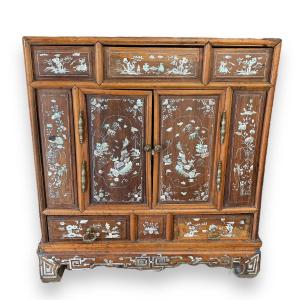
Precious wooden chest with numerous bone inlays from the 17th century. Its flap reveals six drawers. This delicate object was intended to hold the personal belongings of merchants and travelers, such as important papers and jewelry. The removable handles attest to the portable nature of the piece. We can assume that the large drawer on the upper level of our chest may have housed a few precious notes and contracts, the other smaller drawers being intended for valuables. These chests were made in Western India, which was the nerve center for the exchange of luxury goods. A few 17th-century English travelers testify to the quality of these chests. European demand was very strong. Our chest most likely comes from one of the main trading centers in Western India under Portuguese influence.
Goa, Gujarat, Surat, and Cambay were indeed cosmopolitan trading centers with a strong European presence. In these places, it is possible to buy already made objects or to hire the craftsman by providing him with certain materials or the necessary sums to acquire the raw materials. In India, these craftsmen are called "Sutar", "Barhi", "Mistri", "Asari" or "Vadrangi". The know-how is passed down from generation to generation and the techniques are jealously guarded, they are not passed on to outsiders to the family. The most luxurious creations, like our box, were traded in the largest commercial centers in India.
From the 16th century, Portugal opened several trading posts in India, the aims were religious but also economic. The commercial competition that took place between the European powers was dominated by Portugal. The city of Goa became the capital of a mixed art between Portuguese influences and local know-how, whether for sculpture, painting or furniture. It is called the "Rome of the East". The creations of Gujarat, possibly the city that witnessed the creation of our box, are also renowned. (Cups, basins, powder flasks, etc.).
Our box is abundantly veneered and inlaid with bone on all its faces as well as on the back of the flap with plant motifs, foliage, bouquets, etc. The themes of nature, exotic plants and flowers were very popular in Europe in the 17th century. We find these motifs on our box on which we can see the abundant and generous decoration of numerous intertwined flowers, plants, trees. We can also add that floral motifs are very important in Indian art of the early 17th century, they are not secondary decorations but the main and central theme. This phenomenon has its source in the art of the Mughal Empire, hence the name sometimes given to this type of object of "Mughal Box". Portugal indeed maintained privileged links with the Mughal Empire from the 16th century.
It is important to note that unlike other Indo-Portuguese boxes, ours is also adorned with a veneer with fine decorations on the back. It was therefore intended to be placed in the center of a table after a long journey on the roads of India so that it could be contemplated from all angles, and not against a wall. The meeting of Western forms of large and small furniture with Indian materials and decorative techniques is at the origin of a wide range of luxury products including boxes, armchairs, cabinets, tables ... of superb production and therefore very appreciated by Europeans. This is the case of the piece we are presenting.
In the book "Luxury Goods from India: The Art of the Indian Cabinet-Maker", the author Amin Jaffer specifies that certain productions were intended to be offered as diplomatic gifts.
Period 17th century. Usual restorations in particular the filled lock and the four small feet added.
Goa, Gujarat, Surat, and Cambay were indeed cosmopolitan trading centers with a strong European presence. In these places, it is possible to buy already made objects or to hire the craftsman by providing him with certain materials or the necessary sums to acquire the raw materials. In India, these craftsmen are called "Sutar", "Barhi", "Mistri", "Asari" or "Vadrangi". The know-how is passed down from generation to generation and the techniques are jealously guarded, they are not passed on to outsiders to the family. The most luxurious creations, like our box, were traded in the largest commercial centers in India.
From the 16th century, Portugal opened several trading posts in India, the aims were religious but also economic. The commercial competition that took place between the European powers was dominated by Portugal. The city of Goa became the capital of a mixed art between Portuguese influences and local know-how, whether for sculpture, painting or furniture. It is called the "Rome of the East". The creations of Gujarat, possibly the city that witnessed the creation of our box, are also renowned. (Cups, basins, powder flasks, etc.).
Our box is abundantly veneered and inlaid with bone on all its faces as well as on the back of the flap with plant motifs, foliage, bouquets, etc. The themes of nature, exotic plants and flowers were very popular in Europe in the 17th century. We find these motifs on our box on which we can see the abundant and generous decoration of numerous intertwined flowers, plants, trees. We can also add that floral motifs are very important in Indian art of the early 17th century, they are not secondary decorations but the main and central theme. This phenomenon has its source in the art of the Mughal Empire, hence the name sometimes given to this type of object of "Mughal Box". Portugal indeed maintained privileged links with the Mughal Empire from the 16th century.
It is important to note that unlike other Indo-Portuguese boxes, ours is also adorned with a veneer with fine decorations on the back. It was therefore intended to be placed in the center of a table after a long journey on the roads of India so that it could be contemplated from all angles, and not against a wall. The meeting of Western forms of large and small furniture with Indian materials and decorative techniques is at the origin of a wide range of luxury products including boxes, armchairs, cabinets, tables ... of superb production and therefore very appreciated by Europeans. This is the case of the piece we are presenting.
In the book "Luxury Goods from India: The Art of the Indian Cabinet-Maker", the author Amin Jaffer specifies that certain productions were intended to be offered as diplomatic gifts.
Period 17th century. Usual restorations in particular the filled lock and the four small feet added.
9 500 €
Period: 17th century
Style: Asian art
Condition: Good condition
Material: Bone
Length: 23.5
Height: 14.5
Depth: 17.5
Reference (ID): 1534269
Availability: In stock
Print