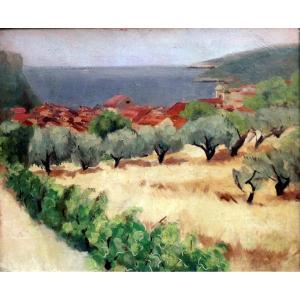
Auguste Chabaud (1882-1955) Bird's Eye View Of An Olive Tree Field In The Alpilles
Artist: Auguste Chabaud (1882-1955)
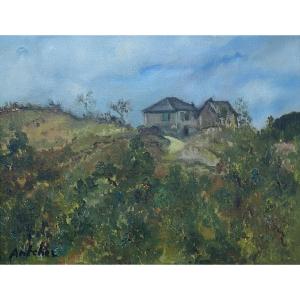
A tireless surveyor of the scrubland and landscapes around Les Baux de Provence, the artist has once again demonstrated modernity, strength and audacity in creating this painting.
Two mineral rock masses, softened by their round and sensual shape on the right, dominate a vegetal valley, planted with olive trees, crossed by the "white road" that is so often found in his Provençal representations.
Contforms to his first draft technique, with a sure and minimalist line that gives this work from 1930 a modern orientation and is compatible with contemporary interior decoration.
The work is presented in a modern black frame with blue Marie-Louise that measures 99 cm by 89 cm and 85 cm by 75 cm for the cardboard alone.
It bears the signature stamp at the bottom right, on the back a label from the estate inventory bearing the number 134, the date 1930 and the title "View of a Field of Olive Trees".
A powerful and modern work by a major Provençal artist.
Auguste Chabaud entered the Avignon School of Fine Arts in 1896, where he studied under Pierre Grivolas.
In 1899, he left for Paris to continue his studies at the Académie Julian and the École des Beaux-Arts, in the studio of Fernand Cormon (1845-1924).
He met Henri Matisse and André Derain.
His parents' wine estate suffered the crisis of 1900, forcing Auguste Chabaud to return to the South of France.
In 1901, Auguste Chabaud had to leave Paris to earn a living, so he embarked as a pilot (or pilot) on a ship and discovered the West African coast.
The same year his father died; he and his brother inherited the vineyard and land, which his brother alone would manage. During this period, Chabaud worked extensively on butcher's paper. From 1903 to 1906, he did his military service in Tunisia, from where he returned with sketchbooks filled with local images, including numerous drawings of soldiers, natives, and bar scenes populated by girls and sailors.
Back in Paris, Chabaud made his debut in 1907 at the Salon des Indépendants, exhibiting among the Fauves.
He would discover a new life, that of Parisian nightlife and cabarets.
Collectors began to take an interest in his work.
In Montmartre, where he had his studio, he painted lively or deserted streets and squares, scenes of nightlife, and brothels.
In 1911, he began his Cubist period, working in large formats and sculpting.
Numerous exhibitions followed, including the one in New York in 1913, where he exhibited alongside Henri Matisse, André Derain, Maurice de Vlaminck, and Pablo Picasso, then in Chicago and Boston.
His paintings from the Fauvist period depict Parisian nightlife: cabarets, café-theaters, prostitutes, in bright shades (yellow, red) contrasting with the colors of the night (navy blue, black).
Upon his return from the First World War in 1919, Auguste Chabaud settled permanently in Graveson, in the Alpilles.
From 1920, he began his blue period (he used Prussian blue in its pure state), in which Provence, its characters, and its customs were highlighted.
The South, which he never stopped painting, even in his Parisian period, would henceforth occupy him exclusively.
Like Paul Cézanne with the Sainte-Victoire mountain, Auguste Chabaud immortalized "la montagnette," painting countryside scenes of peasants roaming the hills and paths of the Alpilles.
He remained there until the end of his life, living as a recluse in his house with his wife and seven children.
Nicknamed the "hermit of Graveson," he died in 1955.
Some of his works can be seen in Marseille at the Cantini Museum, in Paris at the Musée National d'Art Moderne, the Musée d'Art Moderne de la Ville de Paris, and in Geneva at the Petit Palais.
In 1992, the PACA regional council opened a museum in his honor in Graveson.
Painters regularly pay tribute to him, such as Claude Viallat in 2003.
Auguste Chabaud wrote poems and books such as: L'Estocade de vérité, Le Tambour Gautier, Je me suis pris pour Démosthène. Works in public collections in France
Toulon, art museum: Villeneuve-lès-Avignon, oil on cardboard, 53 × 76 cm.
Troyes, museum of modern art: La Gare, 1907, oil on canvas, 73 × 100 cm.
Centre National Pompidou Beaubourg Museum Paris
Hermitage Museum Saint Petersburg
Vatican Museum Rome
Switzerland Geneva, Petit Palais Museum.
Two mineral rock masses, softened by their round and sensual shape on the right, dominate a vegetal valley, planted with olive trees, crossed by the "white road" that is so often found in his Provençal representations.
Contforms to his first draft technique, with a sure and minimalist line that gives this work from 1930 a modern orientation and is compatible with contemporary interior decoration.
The work is presented in a modern black frame with blue Marie-Louise that measures 99 cm by 89 cm and 85 cm by 75 cm for the cardboard alone.
It bears the signature stamp at the bottom right, on the back a label from the estate inventory bearing the number 134, the date 1930 and the title "View of a Field of Olive Trees".
A powerful and modern work by a major Provençal artist.
Auguste Chabaud entered the Avignon School of Fine Arts in 1896, where he studied under Pierre Grivolas.
In 1899, he left for Paris to continue his studies at the Académie Julian and the École des Beaux-Arts, in the studio of Fernand Cormon (1845-1924).
He met Henri Matisse and André Derain.
His parents' wine estate suffered the crisis of 1900, forcing Auguste Chabaud to return to the South of France.
In 1901, Auguste Chabaud had to leave Paris to earn a living, so he embarked as a pilot (or pilot) on a ship and discovered the West African coast.
The same year his father died; he and his brother inherited the vineyard and land, which his brother alone would manage. During this period, Chabaud worked extensively on butcher's paper. From 1903 to 1906, he did his military service in Tunisia, from where he returned with sketchbooks filled with local images, including numerous drawings of soldiers, natives, and bar scenes populated by girls and sailors.
Back in Paris, Chabaud made his debut in 1907 at the Salon des Indépendants, exhibiting among the Fauves.
He would discover a new life, that of Parisian nightlife and cabarets.
Collectors began to take an interest in his work.
In Montmartre, where he had his studio, he painted lively or deserted streets and squares, scenes of nightlife, and brothels.
In 1911, he began his Cubist period, working in large formats and sculpting.
Numerous exhibitions followed, including the one in New York in 1913, where he exhibited alongside Henri Matisse, André Derain, Maurice de Vlaminck, and Pablo Picasso, then in Chicago and Boston.
His paintings from the Fauvist period depict Parisian nightlife: cabarets, café-theaters, prostitutes, in bright shades (yellow, red) contrasting with the colors of the night (navy blue, black).
Upon his return from the First World War in 1919, Auguste Chabaud settled permanently in Graveson, in the Alpilles.
From 1920, he began his blue period (he used Prussian blue in its pure state), in which Provence, its characters, and its customs were highlighted.
The South, which he never stopped painting, even in his Parisian period, would henceforth occupy him exclusively.
Like Paul Cézanne with the Sainte-Victoire mountain, Auguste Chabaud immortalized "la montagnette," painting countryside scenes of peasants roaming the hills and paths of the Alpilles.
He remained there until the end of his life, living as a recluse in his house with his wife and seven children.
Nicknamed the "hermit of Graveson," he died in 1955.
Some of his works can be seen in Marseille at the Cantini Museum, in Paris at the Musée National d'Art Moderne, the Musée d'Art Moderne de la Ville de Paris, and in Geneva at the Petit Palais.
In 1992, the PACA regional council opened a museum in his honor in Graveson.
Painters regularly pay tribute to him, such as Claude Viallat in 2003.
Auguste Chabaud wrote poems and books such as: L'Estocade de vérité, Le Tambour Gautier, Je me suis pris pour Démosthène. Works in public collections in France
Toulon, art museum: Villeneuve-lès-Avignon, oil on cardboard, 53 × 76 cm.
Troyes, museum of modern art: La Gare, 1907, oil on canvas, 73 × 100 cm.
Centre National Pompidou Beaubourg Museum Paris
Hermitage Museum Saint Petersburg
Vatican Museum Rome
Switzerland Geneva, Petit Palais Museum.
8 000 €
Period: 20th century
Style: Modern Art
Condition: Excellent condition
Material: Oil painting on cardboard
Length: 75 cm
Height: 85 cm
Reference (ID): 1528275
Availability: In stock
Print