THIS OBJECT WAS SOLD
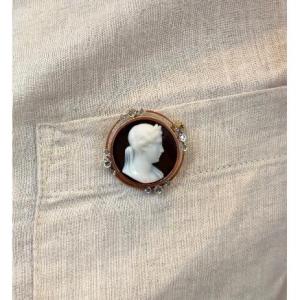
Large Cameo Brooch On Shell, Late 19th Century


Large oval cameo brooch on shell depicting a profile of a man wearing a Phrygian cap, this is a representation of the bust of Paris made by Canova in 1809. Solid silver setting, tested but no visible hallmark.
Late 19th century.
Dimensions: H 5 x W 4 x D 1 cm, gross weight: 18 grams
The bust of Paris by Antonio Canova, Italian sculptor (1757–1822)
The marble bust of Paris sculpted by Antonio Canova is kept at The Art Institute of Chicago. It was made in 1809.
Other versions of this bust exist, such as the one commissioned by Empress Josephine, now in the State Hermitage Museum in Saint Petersburg. Documents indicate that Canova made four full-length marble statues and at least seven busts of Paris, which clearly testifies to the popularity of this sculpture.
Canova sculpted this bust for his friend Antoine Quatremère de Quincy, a French neoclassical theorist and critic who greatly influenced his artistic ideals. Upon receiving it, Quatremère declared, "There is a mixture of heroism and voluptuousness, of nobility and love. I do not believe that in any other work you have ever combined such life, such sweetness, and such chaste purity."
It depicts the moment in Greek mythology when the shepherd Paris, summoned by Zeus to judge who was the most beautiful between Hera, Athena, and Aphrodite, turns to the three goddesses.
Late 19th century.
Dimensions: H 5 x W 4 x D 1 cm, gross weight: 18 grams
The bust of Paris by Antonio Canova, Italian sculptor (1757–1822)
The marble bust of Paris sculpted by Antonio Canova is kept at The Art Institute of Chicago. It was made in 1809.
Other versions of this bust exist, such as the one commissioned by Empress Josephine, now in the State Hermitage Museum in Saint Petersburg. Documents indicate that Canova made four full-length marble statues and at least seven busts of Paris, which clearly testifies to the popularity of this sculpture.
Canova sculpted this bust for his friend Antoine Quatremère de Quincy, a French neoclassical theorist and critic who greatly influenced his artistic ideals. Upon receiving it, Quatremère declared, "There is a mixture of heroism and voluptuousness, of nobility and love. I do not believe that in any other work you have ever combined such life, such sweetness, and such chaste purity."
It depicts the moment in Greek mythology when the shepherd Paris, summoned by Zeus to judge who was the most beautiful between Hera, Athena, and Aphrodite, turns to the three goddesses.
Explore similar pieces and discover your ideal find:
Brooches