THIS OBJECT WAS SOLD
Louis XV Clock In Gilt Bronze And Brown Patina With Bull - The Rape Of Europa - Circa 1870


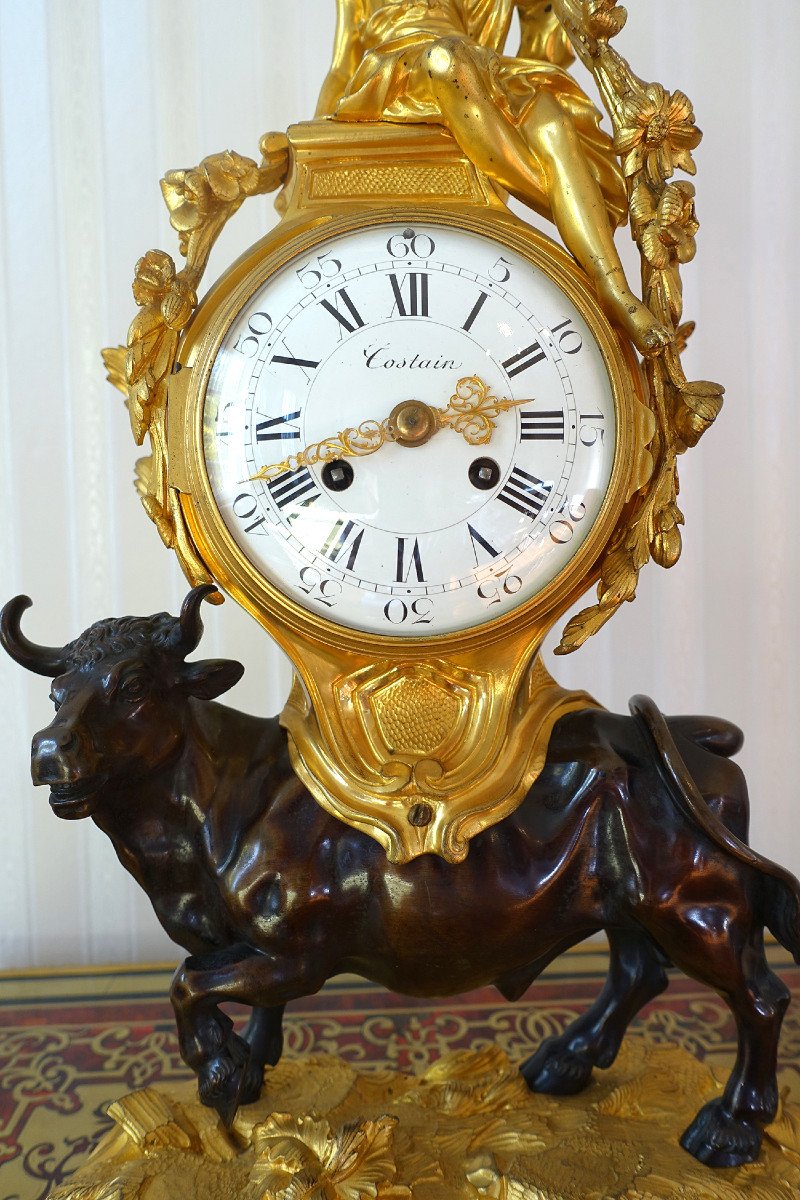


This "bull" clock takes us back to Louis XV, under whose reign animal clocks were very successful. The capital's bronze makers integrated the movement into a rocaille decor, most often carried by an exotic animal or by a bull when, accompanied by a graceful female figure, it could be likened to Zeus. According to the stories of ancient mythology, Zeus coveted Europa, the daughter of the king of Tyre in Phoenicia. Of great beauty, she loved to walk on the beach. The powerful God had the idea of transforming himself into a beautiful white bull to attract her to him. As soon as she saw the animal, Europa approached to caress it. He lay down, invited her to climb on his back and fled across the sea to Crete. Thus Zeus abducted Europa. The greatest bronze makers of the 18th century seized on the myth of the Abduction of Europa.
In our late 19th century copy, we find the attributes of the large bull clocks symbolizing this allegory.
In gilded chiseled bronze and bronze with brown patina, the enamel dial signed "Costain" with Roman numerals for the hours and Arabic numerals for the minutes. It is surmounted by a young woman representing Princess Europe, holding a garland of flowers. She is carried by a bull on a rock terrace. Cut-out, engraved and gilded brass hands. Brocot-type suspension movement, striking at the hour and half hour with a count wheel on the rear plate.
French work, circa 1870.
Height: 51 cm Length: 38 cm Depth: 16 cm
Complete clock with its winding key, its pendulum and its bell. Mechanism in working order.
In our late 19th century copy, we find the attributes of the large bull clocks symbolizing this allegory.
In gilded chiseled bronze and bronze with brown patina, the enamel dial signed "Costain" with Roman numerals for the hours and Arabic numerals for the minutes. It is surmounted by a young woman representing Princess Europe, holding a garland of flowers. She is carried by a bull on a rock terrace. Cut-out, engraved and gilded brass hands. Brocot-type suspension movement, striking at the hour and half hour with a count wheel on the rear plate.
French work, circa 1870.
Height: 51 cm Length: 38 cm Depth: 16 cm
Complete clock with its winding key, its pendulum and its bell. Mechanism in working order.
Explore similar pieces and discover your ideal find:
Mantel Clocks