THIS OBJECT WAS SOLD
Museum, Wooden Carved Jalet Crossbow, Italy Circa 1600






Late 16th or early 17th century
EXCEPTIONAL CARVED WOOD JALET CROSSBOW (fruit wood, maybe cherry?)
ITALY (Lombardy?) around 1600
The jalet crossbow or so-called "bullet" projected not arrows but small projectiles - clay or lead balls, stones,... with a relatively short range - about twenty or thirty meters... was used for hunting birds and small game.
Its diffusion, especially among the nobility, means that many crossbow specimens are true works of art, decorated and garved in their woodwork and/or metal components.
Its diffusion, especially for nobility, means that many crossbow specimens are true works of art, decorated and engraved in their woodwork and/or metal components.
The weapon's stringing system consisted of a double rope of woven hemp threads, held in place vertically by wooden struts and attached to the ends of the steel bow, covered with leather trimmings. The housing of the ball consists of a leather pocket or a small basket made of braided rope placed in the middle of the ropes (Please check photo of the general model of the jalet arabalete). The difficulty of this kind of work lay in the perfect balance to be found so that the planned projectile would go in the desired direction, so much so that there are today only a few rare archers or gunsmiths who are able to remake these ropes to the crossbow.
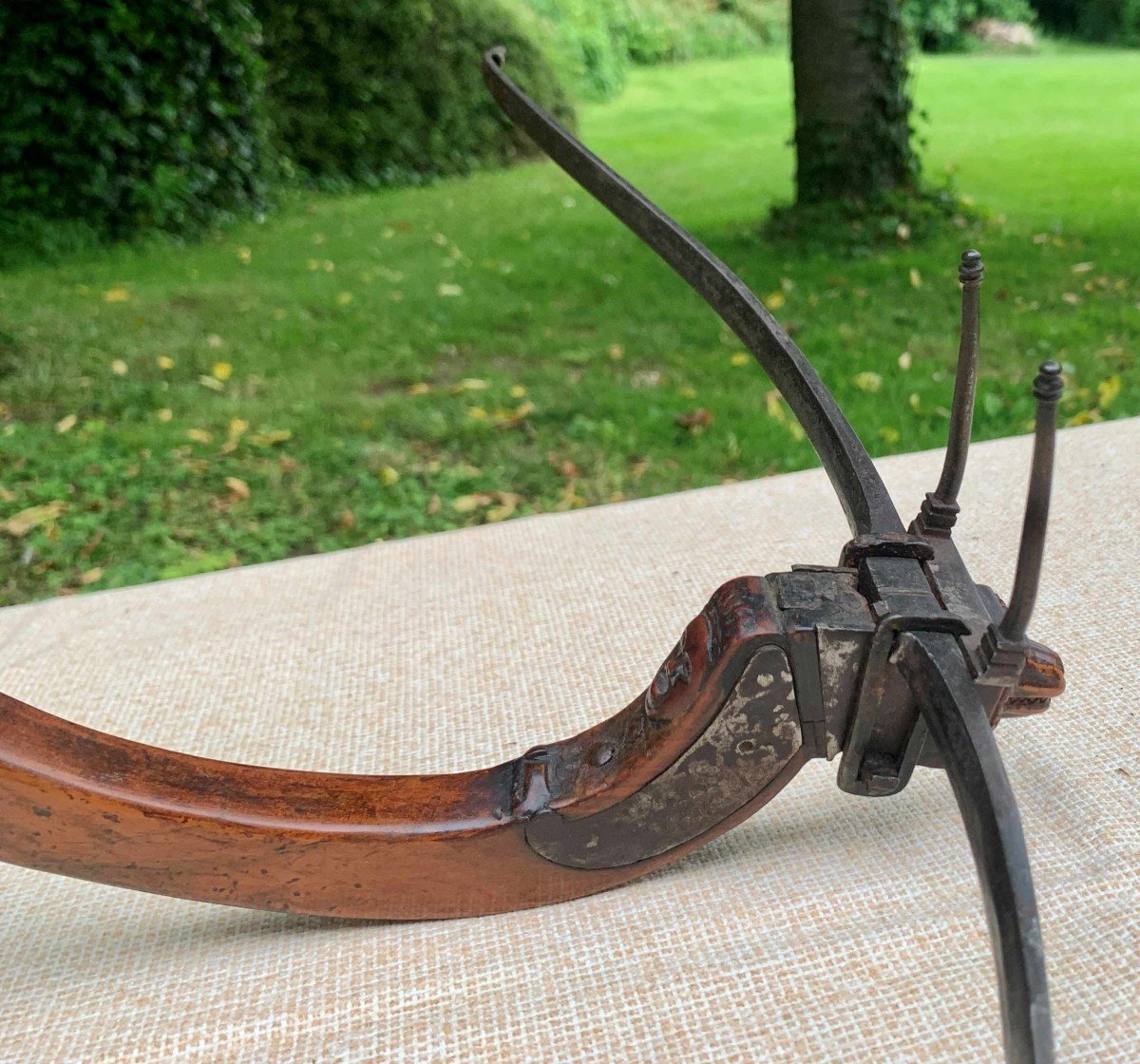
Perfect condition: the crossbow has been carved in a drastically selected species and part of wood, to guarantee its resistance and durability. The curve shape of the weapon, of relatively modest dimensions, is exceptional in purity.
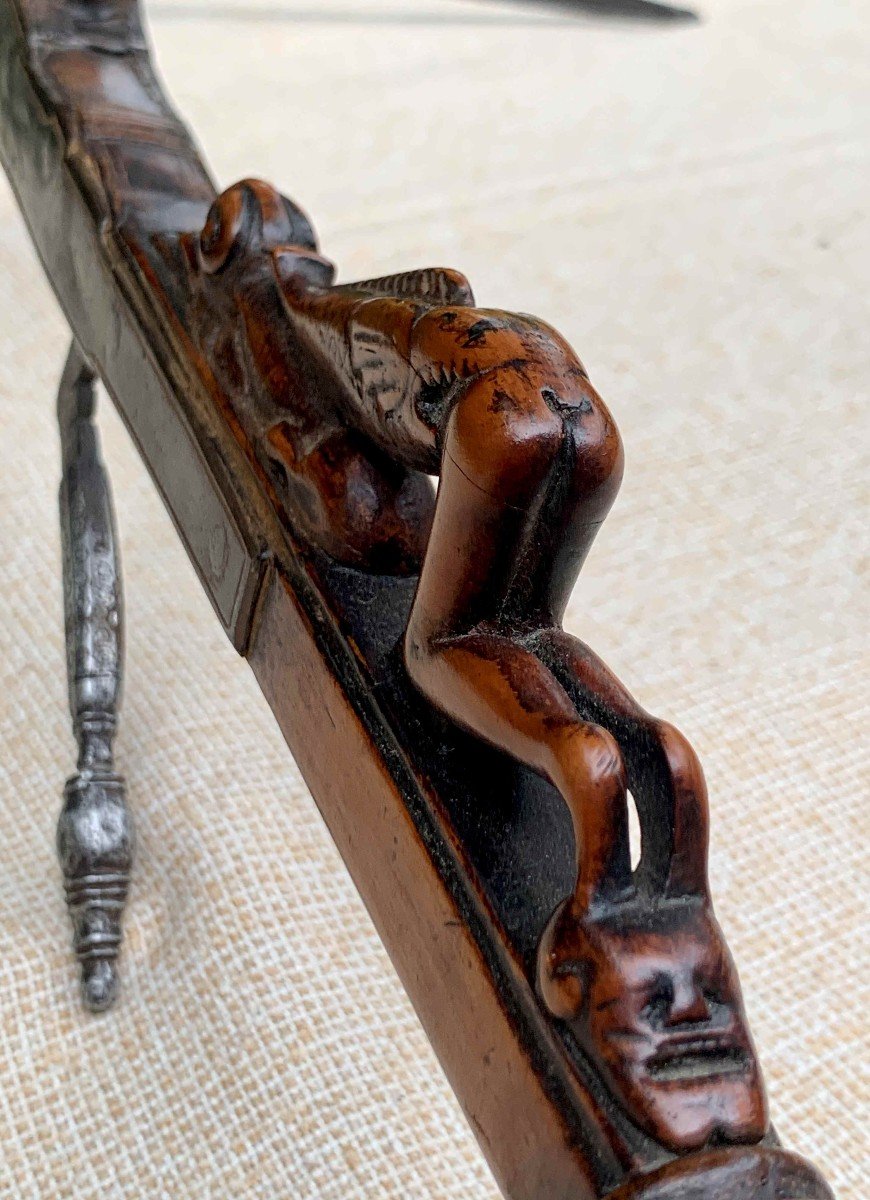
Of particular note here is the exceptional care taken with relief sculptures in relief and the round circle: a lion's muffle at the front, grotesque masks and above all an enigmatic and delightful SUBJECT OF TORTURED above the crosier, at the back of the tienne, behind the click of the nut: a naked man, kneeling on all fours is literally swallowed by a sea monster. The giant fish itself rests on a reclining ram, forming the support for this scene as funny as it is surprising. All that appears of this poor guy is his bare posterior, exposed to everyone's vue... This part also had the function of offering a good support for shooting.
The work on the shape of the end of the stock is also remarkable for its finesse, balance and refinement.
The iron parts, support, front sight and sighting table, all original, are treated here in a rather simple and refined way, while the curved ends of the bow, the trigger tail, or the crossbow sighting fork are more refined.
This crossbow is to be compared with several exceptional examples to:
*another one, part of the collections of the Louvre Museum (No Inv MRR33; P405428), Medieval, Renaissance to 17th cty department
*another from the collections of the Fine Arts museum of Lyon (No inv H250)
*and finally the exceptional crossbow with jalet known as "Catherine de Medicis", kept at the Army Museum in Paris (Côte L115ROB, another inventory no. MS13 Musée des Souverains)
Sizes
75cm length *
52,5cm large and
16cm depth
Our jalet crossbow is distinguished by the originality of the subject sculpted on its crosier, and by its exemplary condition.
EXCEPTIONAL CARVED WOOD JALET CROSSBOW (fruit wood, maybe cherry?)
ITALY (Lombardy?) around 1600
The jalet crossbow or so-called "bullet" projected not arrows but small projectiles - clay or lead balls, stones,... with a relatively short range - about twenty or thirty meters... was used for hunting birds and small game.
Its diffusion, especially among the nobility, means that many crossbow specimens are true works of art, decorated and garved in their woodwork and/or metal components.
Its diffusion, especially for nobility, means that many crossbow specimens are true works of art, decorated and engraved in their woodwork and/or metal components.
The weapon's stringing system consisted of a double rope of woven hemp threads, held in place vertically by wooden struts and attached to the ends of the steel bow, covered with leather trimmings. The housing of the ball consists of a leather pocket or a small basket made of braided rope placed in the middle of the ropes (Please check photo of the general model of the jalet arabalete). The difficulty of this kind of work lay in the perfect balance to be found so that the planned projectile would go in the desired direction, so much so that there are today only a few rare archers or gunsmiths who are able to remake these ropes to the crossbow.
Perfect condition: the crossbow has been carved in a drastically selected species and part of wood, to guarantee its resistance and durability. The curve shape of the weapon, of relatively modest dimensions, is exceptional in purity.
Of particular note here is the exceptional care taken with relief sculptures in relief and the round circle: a lion's muffle at the front, grotesque masks and above all an enigmatic and delightful SUBJECT OF TORTURED above the crosier, at the back of the tienne, behind the click of the nut: a naked man, kneeling on all fours is literally swallowed by a sea monster. The giant fish itself rests on a reclining ram, forming the support for this scene as funny as it is surprising. All that appears of this poor guy is his bare posterior, exposed to everyone's vue... This part also had the function of offering a good support for shooting.
The work on the shape of the end of the stock is also remarkable for its finesse, balance and refinement.
The iron parts, support, front sight and sighting table, all original, are treated here in a rather simple and refined way, while the curved ends of the bow, the trigger tail, or the crossbow sighting fork are more refined.
This crossbow is to be compared with several exceptional examples to:
*another one, part of the collections of the Louvre Museum (No Inv MRR33; P405428), Medieval, Renaissance to 17th cty department
*another from the collections of the Fine Arts museum of Lyon (No inv H250)
*and finally the exceptional crossbow with jalet known as "Catherine de Medicis", kept at the Army Museum in Paris (Côte L115ROB, another inventory no. MS13 Musée des Souverains)
Sizes
75cm length *
52,5cm large and
16cm depth
Our jalet crossbow is distinguished by the originality of the subject sculpted on its crosier, and by its exemplary condition.
Explore similar pieces and discover your ideal find:
Edged Weapons