



Carpet / Tapestry After Paul Klee
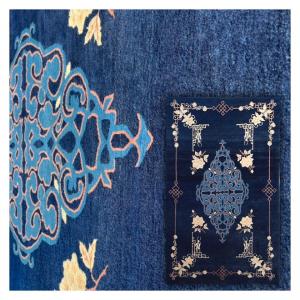
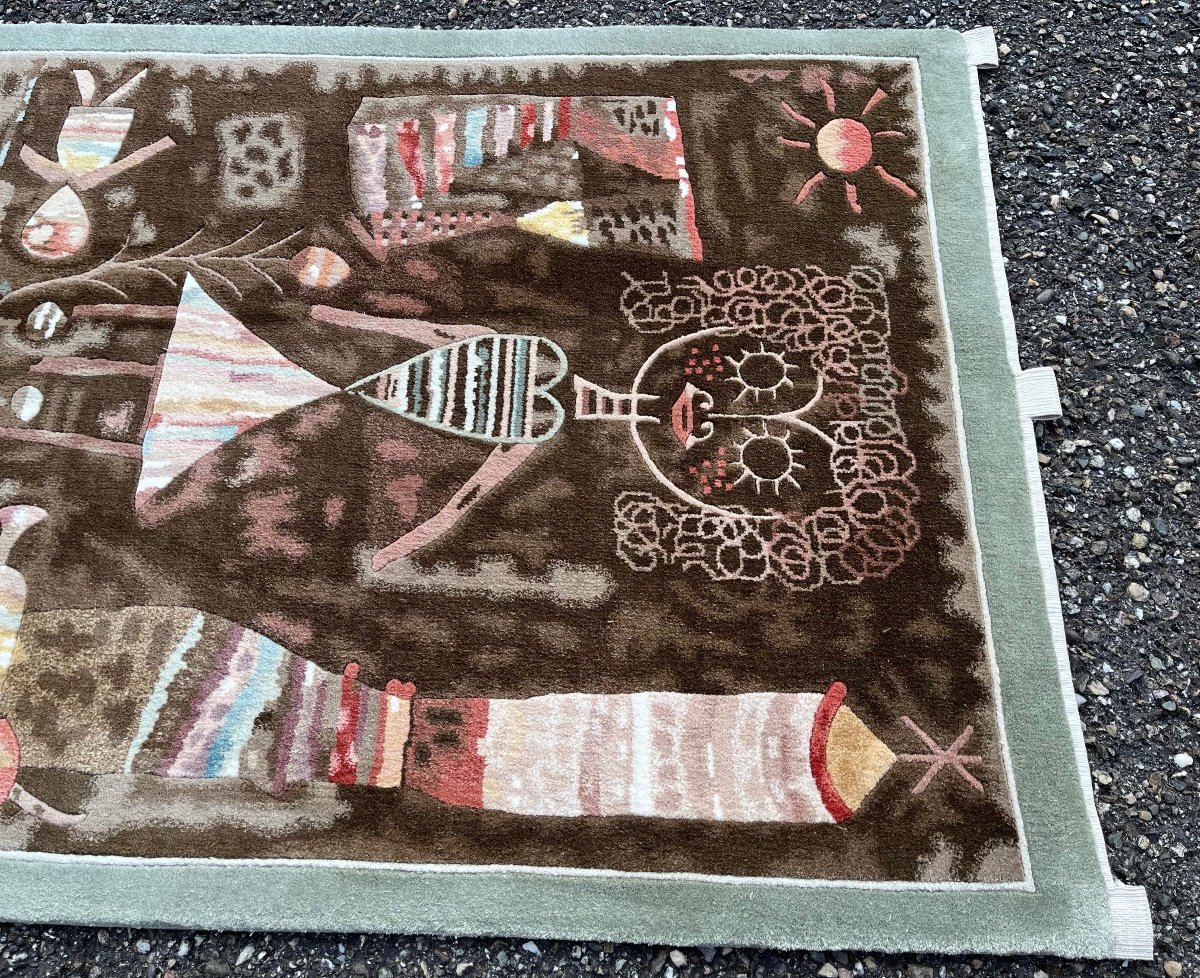
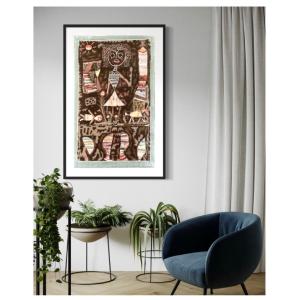
PAUL KLEE. After. Tapestry / artist's carpet, Puppet Theater. Cotton, silk.
A poet of abstraction, fascinated by the light of distant countries and the magic of nature, Paul Klee (1879 – 1940) is as much a talented painter as a great watercolorist. A professor at the Bauhaus, during the interwar period, the theoretical painter developed a unique approach to color. Considered Jewish by the Nazis, classified in the category of degenerate painters, he had to flee Germany and died at the beginning of the Second World War. A tragic fate for a dreamer painter. His work, although colorful and focused on an inner reality, also reflects the oppressions he experienced.
Paul Klee was born in Switzerland, in the canton of Bern. The artist's childhood was immersed in music, his father being a teacher and his mother a singer. The young boy played the violin. If music was his first vocation, painting also attracted him and it was finally towards the plastic arts that he turned.
With an abstract tendency, Paul Klee's art is made of colors and symbols. The artist is a mystic, fascinated by the magic of nature but does not reproduce reality in an illusionist way. For him, art is a way to access an unfathomable truth, deeper than the visible surface of things.
Appointed professor at the Bauhaus after the war (where he taught art theory in particular), Klee exhibited more and more and went to Egypt in 1929. In Germany, his work was frowned upon by the Nazis who considered him a degenerate artist and banned his painting. He moved to Switzerland. During the 1930s, an incurable illness broke out and Klee was condemned. He died in 1940, three years after the Nazis exhibited 17 of his works in the “Degenerate Art” exhibition in Munich.
Dimensions: 122x76 cm
Condition: Good, slight wear to the velvet, more pronounced on the green border.
Wall hanging strip.
MY COMPLETE GALLERY
A poet of abstraction, fascinated by the light of distant countries and the magic of nature, Paul Klee (1879 – 1940) is as much a talented painter as a great watercolorist. A professor at the Bauhaus, during the interwar period, the theoretical painter developed a unique approach to color. Considered Jewish by the Nazis, classified in the category of degenerate painters, he had to flee Germany and died at the beginning of the Second World War. A tragic fate for a dreamer painter. His work, although colorful and focused on an inner reality, also reflects the oppressions he experienced.
Paul Klee was born in Switzerland, in the canton of Bern. The artist's childhood was immersed in music, his father being a teacher and his mother a singer. The young boy played the violin. If music was his first vocation, painting also attracted him and it was finally towards the plastic arts that he turned.
With an abstract tendency, Paul Klee's art is made of colors and symbols. The artist is a mystic, fascinated by the magic of nature but does not reproduce reality in an illusionist way. For him, art is a way to access an unfathomable truth, deeper than the visible surface of things.
Appointed professor at the Bauhaus after the war (where he taught art theory in particular), Klee exhibited more and more and went to Egypt in 1929. In Germany, his work was frowned upon by the Nazis who considered him a degenerate artist and banned his painting. He moved to Switzerland. During the 1930s, an incurable illness broke out and Klee was condemned. He died in 1940, three years after the Nazis exhibited 17 of his works in the “Degenerate Art” exhibition in Munich.
Dimensions: 122x76 cm
Condition: Good, slight wear to the velvet, more pronounced on the green border.
Wall hanging strip.
MY COMPLETE GALLERY
700 €
Period: 20th century
Style: Other Style
Condition: Good condition
Material: Wool
Length: 122
Width: 76
Diameter: n°318
Reference (ID): 1379647
Availability: In stock
Print