THIS OBJECT WAS SOLD
Egyptomania Candelabra With Swan-like Figures
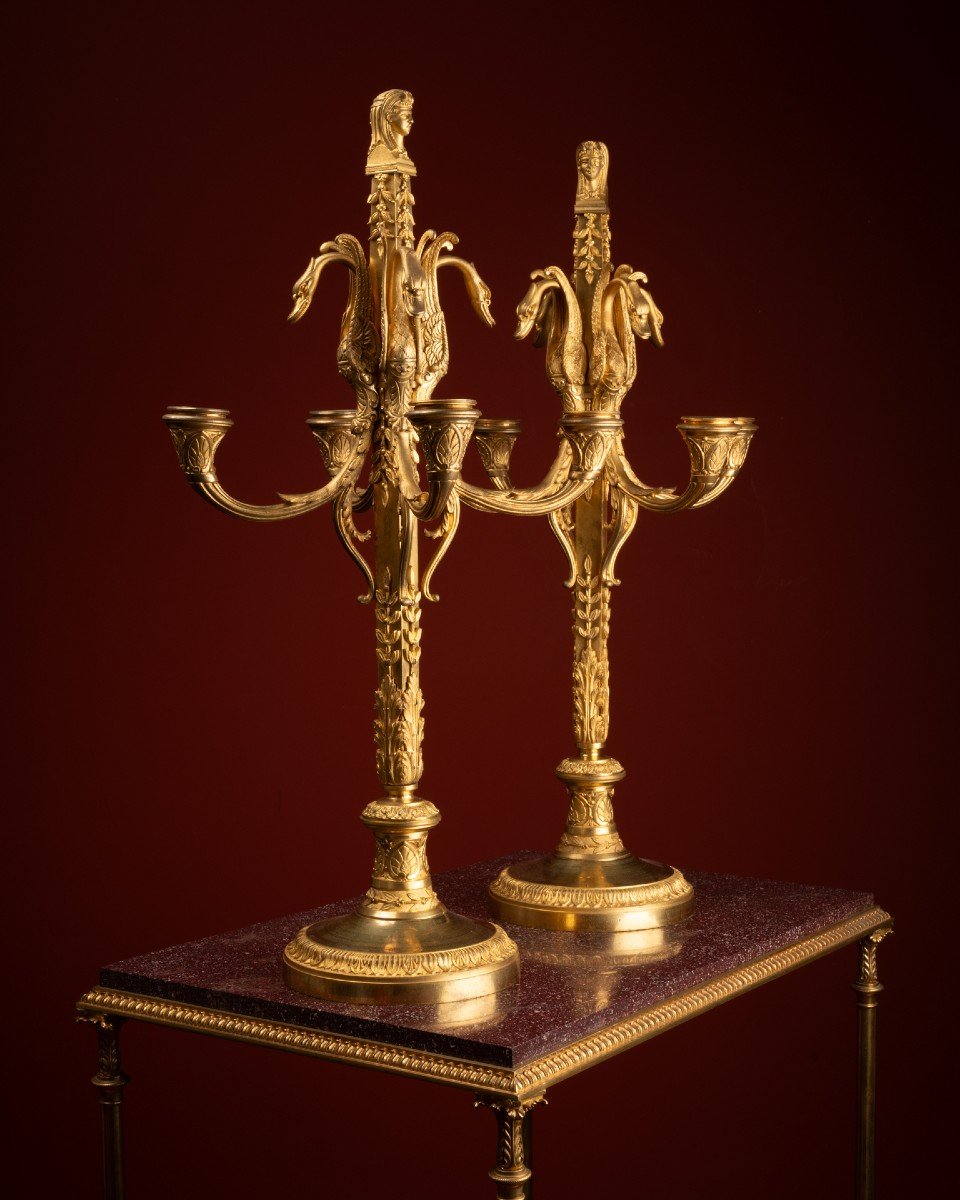
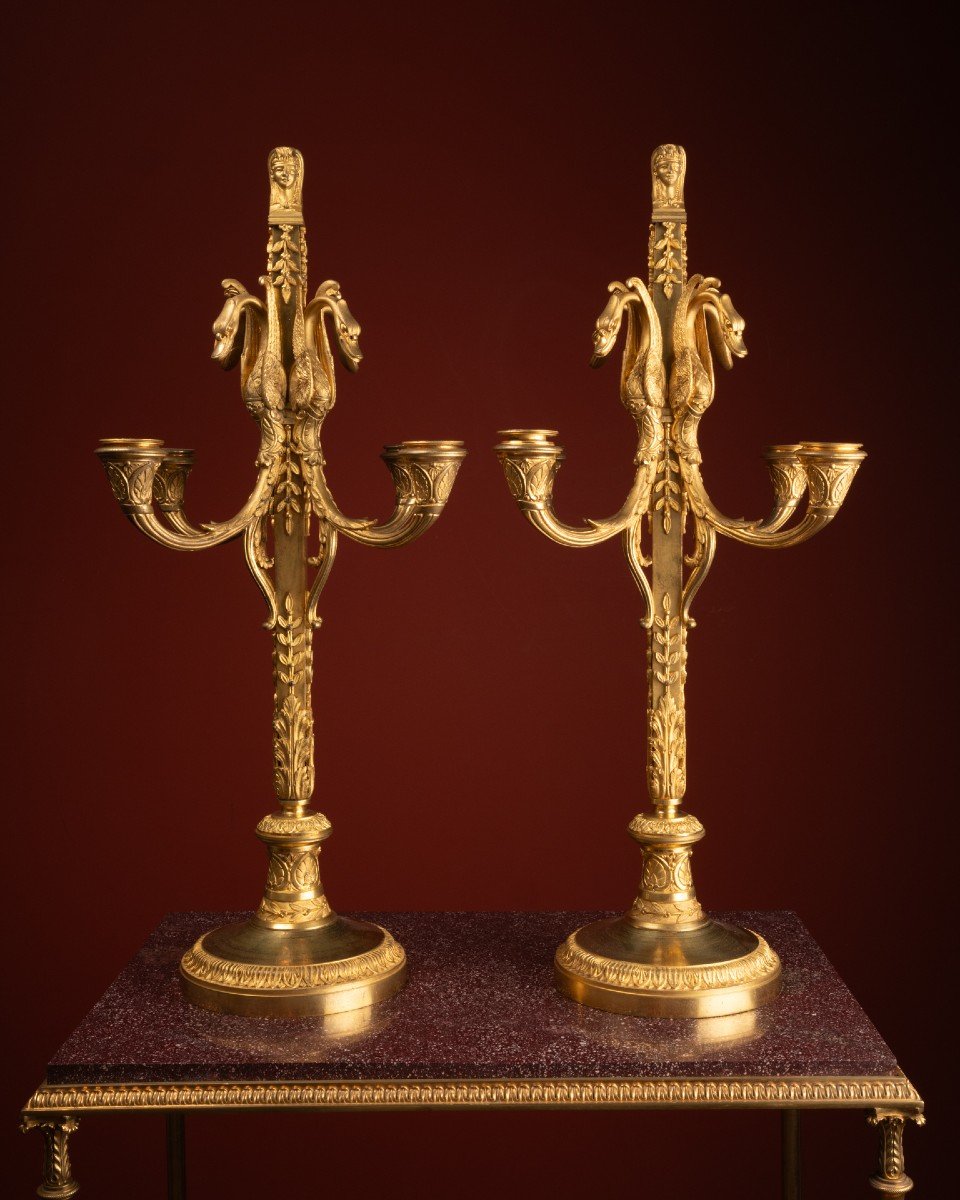


Pair of Egyptomania candelabra with swan-like figures.
Ormolu.
Italy.
Late 18th century, 19th century.
h. 22 in. ; l. 9 in.
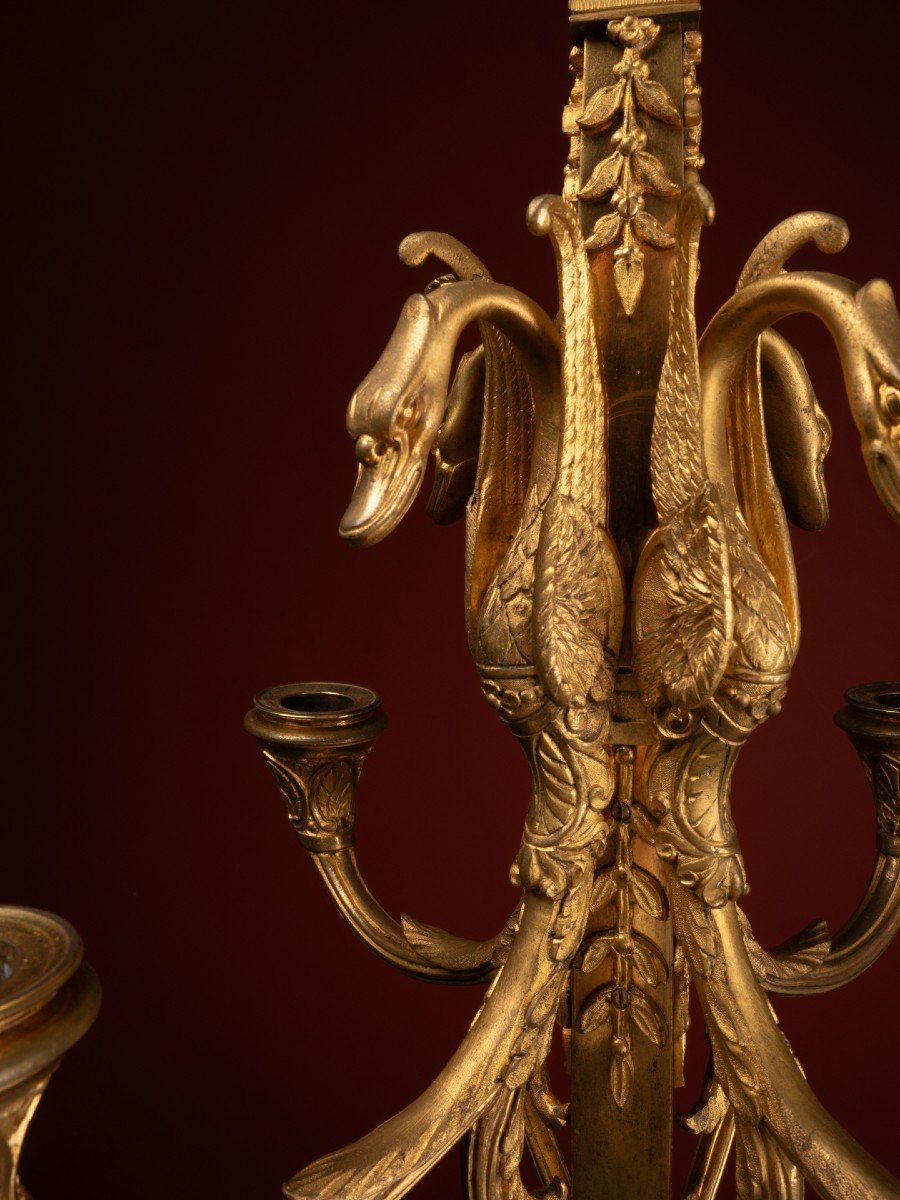
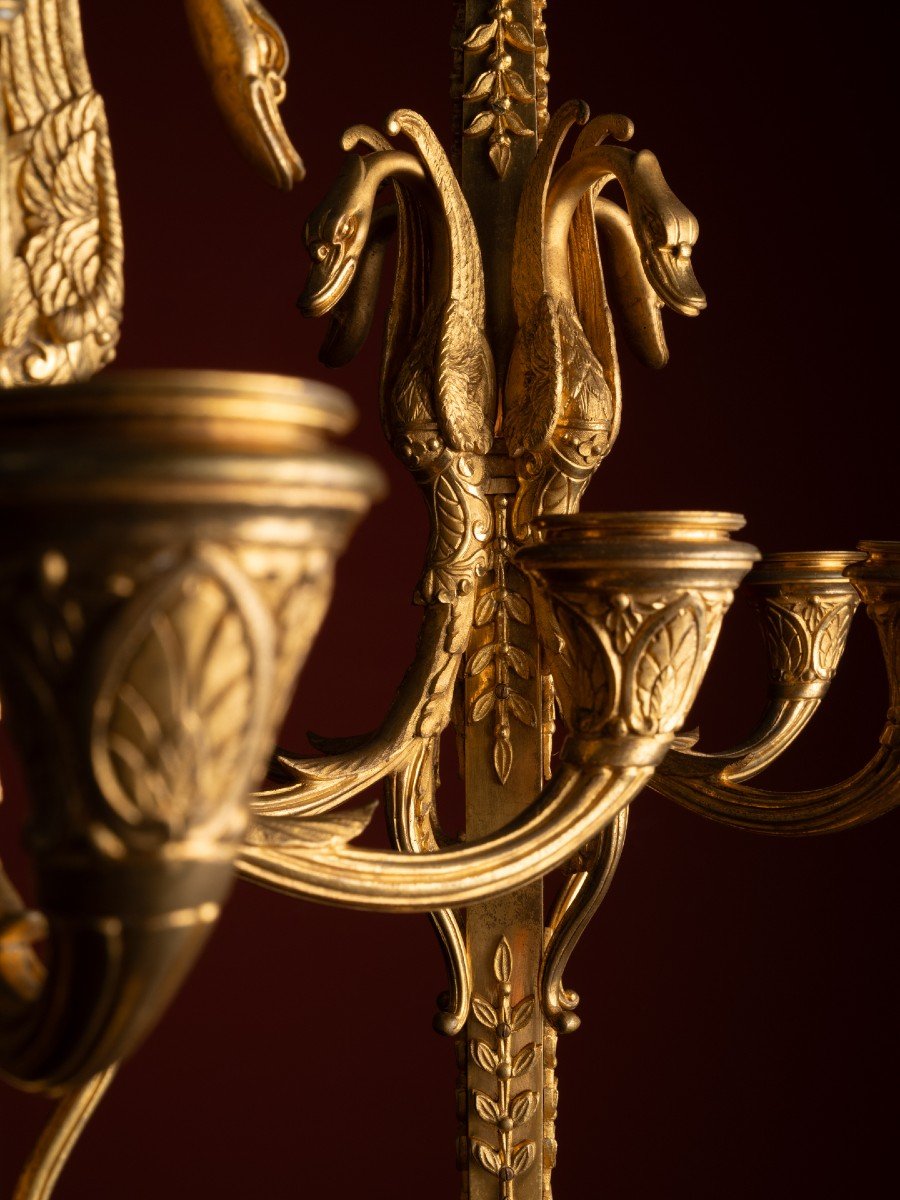
Unique pair of four-light candelabra, in chased and gilt bronze, richly decorated with leaf-and-dart motifs, garlands, waterleaves and acanthus leaves, rosettes, palmettes and scrolls on the swan bodies.
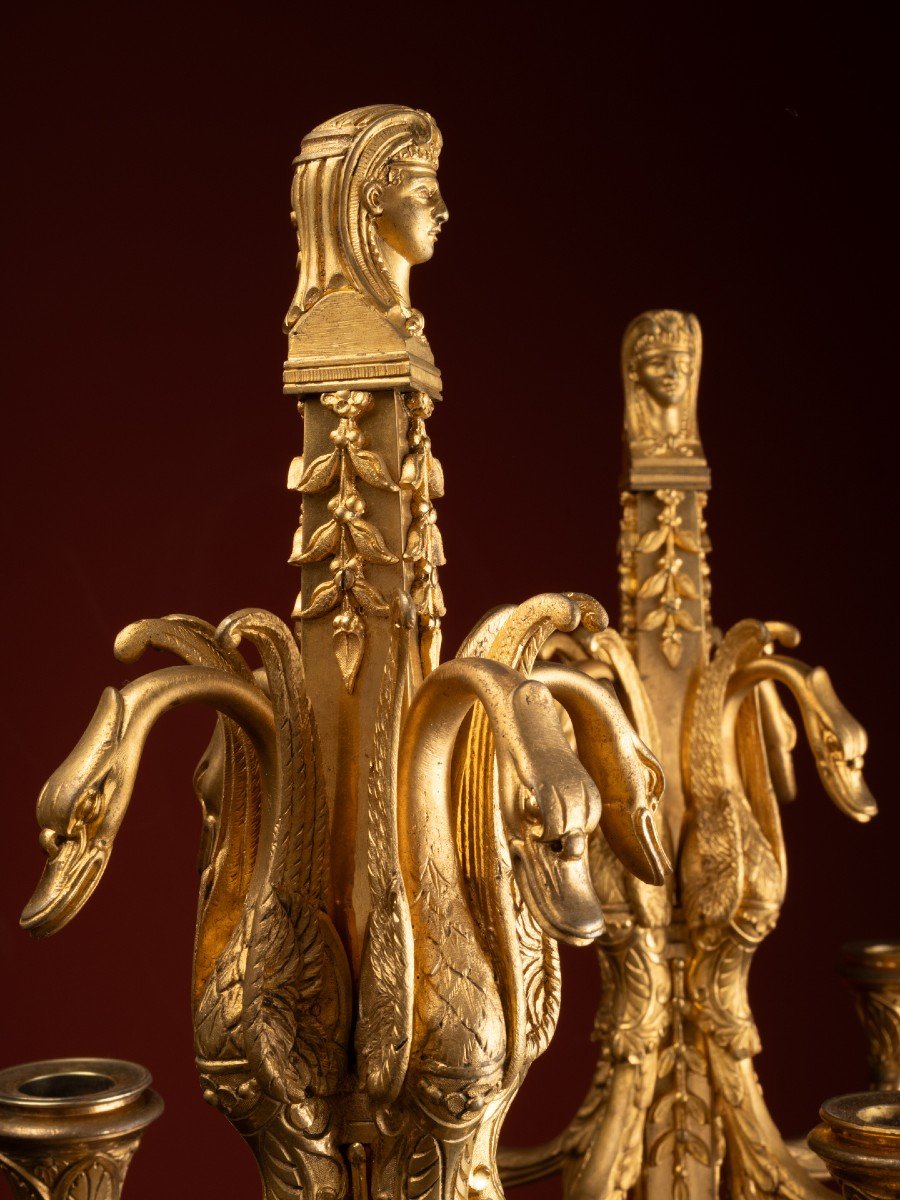
Perhaps the most remarkable feature of these candelabra is the carving and chasing of the swans : the plumes of their wings and on their chest is chased with incredible care, their faces are severe, human-like and expressive. It was not the naturalistic, faithful representation of a swan that was sought, yet some details, such as the tubercle, a small outgrowth growing from the beak of male swans, which distinguishes them from the female, show that the sculptor made a measured choice in the imitation of nature and the search for symbolism.
The same is true of the bust that tops the shaft of each candelabrum. Here again, the sculptor has consciously chosen between imitation and fantasy : it is a bust coming from an dreamy Egypt, wearing a nemes, as depicted in the Montfaucon’s or Caylüs’ engraved plates, but a fantastic one which khat changes into almost rococo scrolls.
The mixture of all these elements makes dating these candelabra difficult : the profusion of the ornaments, and in particular its curves, the volutes of the nemes or the scrolls of acanthus leaves, would indicate that these candelabra are from a period of transition between the rococo and the neoclassical. The very type of these ornements is reminiscent of the repertoire of the Italian draughtsman and designer Michelangelo Pergolesi, known for his decorative work in England under the direction of Robert and James Adam. Moreover, a type of Egyptomania is in the iconography, closer to the Italian capriccio than it is historically accurate. This iconography had mostly fallen out of fashion after Denon's Voyage in Egypt and Champollion's studies ; this was the period of the frescoes of the Caffè degli Inglesi, familiar to British Grand tourists visiting Rome in the 1760s and immortalised by Piranesi in his Diverse maniere d'adornare i cammini, published in 1769.
Looking at the quadrangular shape of the shaft, however, and some elements in the assemblage of these candelabras, one could argue it is a work of the 19th century, closer to the Egyptian Revival and the Regency. They could then be compared to other candelabra of the same kind, notably a pair supplied ca. 1811 to then-Regent George IV by Alexis Decaix or, according to other hypotheses, by goldsmiths Philip Rundell and John Bridge.
Sources
John Aldam Heaton, Furniture and Decoration in England during the Eighteenth Century. Facsimile Reproductions of the Choicest Examples from the Works of Chippendale, Adam, Richardson, Heppelwhite, Sheraton, Pergolesi, and Others, 4 vol., London, 1889-1892.
Egyptomania. L'Egypte dans l'art occidental. 1730-1930, Paris, 1995.
Enrico Colle et al., Bronzi decorativi in Italia, Milano, 2001.
Ormolu.
Italy.
Late 18th century, 19th century.
h. 22 in. ; l. 9 in.
Unique pair of four-light candelabra, in chased and gilt bronze, richly decorated with leaf-and-dart motifs, garlands, waterleaves and acanthus leaves, rosettes, palmettes and scrolls on the swan bodies.
Perhaps the most remarkable feature of these candelabra is the carving and chasing of the swans : the plumes of their wings and on their chest is chased with incredible care, their faces are severe, human-like and expressive. It was not the naturalistic, faithful representation of a swan that was sought, yet some details, such as the tubercle, a small outgrowth growing from the beak of male swans, which distinguishes them from the female, show that the sculptor made a measured choice in the imitation of nature and the search for symbolism.
The same is true of the bust that tops the shaft of each candelabrum. Here again, the sculptor has consciously chosen between imitation and fantasy : it is a bust coming from an dreamy Egypt, wearing a nemes, as depicted in the Montfaucon’s or Caylüs’ engraved plates, but a fantastic one which khat changes into almost rococo scrolls.
The mixture of all these elements makes dating these candelabra difficult : the profusion of the ornaments, and in particular its curves, the volutes of the nemes or the scrolls of acanthus leaves, would indicate that these candelabra are from a period of transition between the rococo and the neoclassical. The very type of these ornements is reminiscent of the repertoire of the Italian draughtsman and designer Michelangelo Pergolesi, known for his decorative work in England under the direction of Robert and James Adam. Moreover, a type of Egyptomania is in the iconography, closer to the Italian capriccio than it is historically accurate. This iconography had mostly fallen out of fashion after Denon's Voyage in Egypt and Champollion's studies ; this was the period of the frescoes of the Caffè degli Inglesi, familiar to British Grand tourists visiting Rome in the 1760s and immortalised by Piranesi in his Diverse maniere d'adornare i cammini, published in 1769.
Looking at the quadrangular shape of the shaft, however, and some elements in the assemblage of these candelabras, one could argue it is a work of the 19th century, closer to the Egyptian Revival and the Regency. They could then be compared to other candelabra of the same kind, notably a pair supplied ca. 1811 to then-Regent George IV by Alexis Decaix or, according to other hypotheses, by goldsmiths Philip Rundell and John Bridge.
Sources
John Aldam Heaton, Furniture and Decoration in England during the Eighteenth Century. Facsimile Reproductions of the Choicest Examples from the Works of Chippendale, Adam, Richardson, Heppelwhite, Sheraton, Pergolesi, and Others, 4 vol., London, 1889-1892.
Egyptomania. L'Egypte dans l'art occidental. 1730-1930, Paris, 1995.
Enrico Colle et al., Bronzi decorativi in Italia, Milano, 2001.
Explore similar pieces and discover your ideal find:
Candelabra