THIS OBJECT WAS SOLD
Sleeping Ariadne - 19th Century Bronze Sculpture - Barbedienne
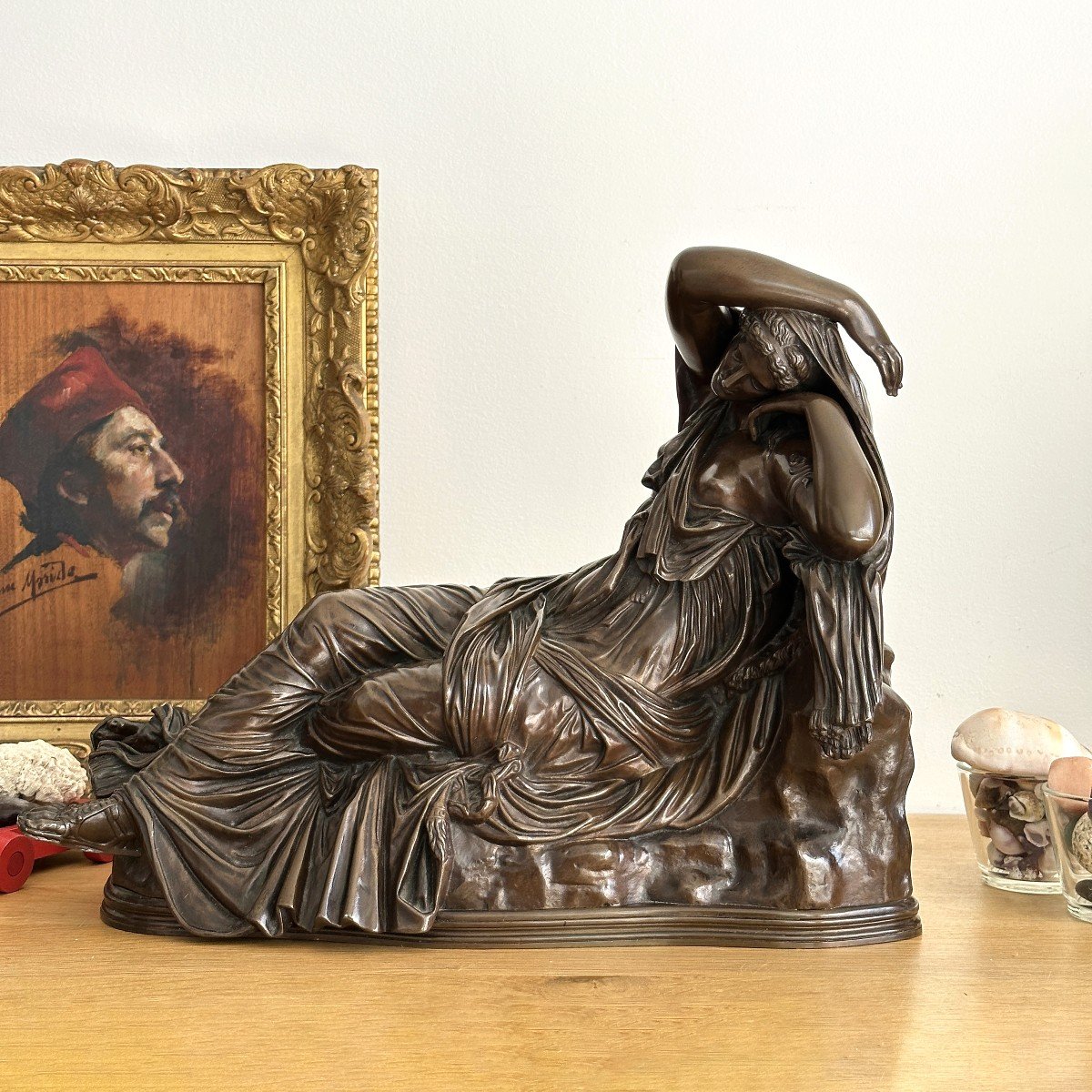


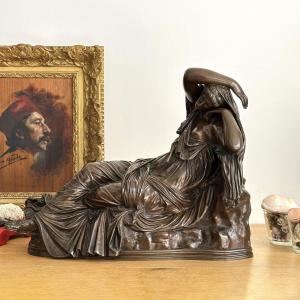


"Resting Cleopatra" or "Sleeping Ariadne" after the marble model by sculptor Pierre Julien dated 1785, currently in the Crozatier museum in Puy-en-Velay. Bronze figure with brown patina edited by Ferdinand Barbedienne, after one of the most renowned sculptures of Antiquity.
The Sleeping Ariadne was discovered at the beginning of the 16th century. It was bought in 1512 by Pope Julius II who placed it in the Belvedere Palace, now the Vatican Museum. The work was ceded to the French in 1797 by the Treaty of Tolentino and was sent to Paris. Exhibited for a time at the Louvre, it returned to Rome after the fall of Napoleon and found its definitive place in the Galerie des Statues of the Pio-Clementino Museum.
Initially identified as Cleopatra because of the serpent bracelet on her upper left arm, she is eventually considered by art historians to be a beautiful sleeping Ariadne. The reclining figure in a Grecian tunic, tied under her breasts, is half seated, her legs stretched out crossed at the calves, her head resting on her left arm, her right hand thrown above her head.
A bronze adaptation was made by Le Primatice at the request of François I. Primaticcio went to Rome in 1540 and then in 1545 to make molds of the famous marble. The position of the Sleeping Ariadne of Fontainebleau diverges from that of the antique original. It is more reversed, without knowing if this results from a deformation of the molds coming from Rome or from a choice on the part of Primaticcio. Other marble replicas will be made for the collections of Louis XIV by Jean-Baptiste Goy and Corneille Van Cleve. Finally, in the second half of the 18th century, the Italian sculptors Zoffoli and Righetti or even Pierre Julien sculpted their version of this sleeping beauty. Cleopatra or Sleeping Ariadne.
Bronze proof with brown patina.
Signed "F. Barbedienne, founder" and stamped "Mechanical reduction".
19th century work.
In a perfect condition.
The Sleeping Ariadne was discovered at the beginning of the 16th century. It was bought in 1512 by Pope Julius II who placed it in the Belvedere Palace, now the Vatican Museum. The work was ceded to the French in 1797 by the Treaty of Tolentino and was sent to Paris. Exhibited for a time at the Louvre, it returned to Rome after the fall of Napoleon and found its definitive place in the Galerie des Statues of the Pio-Clementino Museum.
Initially identified as Cleopatra because of the serpent bracelet on her upper left arm, she is eventually considered by art historians to be a beautiful sleeping Ariadne. The reclining figure in a Grecian tunic, tied under her breasts, is half seated, her legs stretched out crossed at the calves, her head resting on her left arm, her right hand thrown above her head.
A bronze adaptation was made by Le Primatice at the request of François I. Primaticcio went to Rome in 1540 and then in 1545 to make molds of the famous marble. The position of the Sleeping Ariadne of Fontainebleau diverges from that of the antique original. It is more reversed, without knowing if this results from a deformation of the molds coming from Rome or from a choice on the part of Primaticcio. Other marble replicas will be made for the collections of Louis XIV by Jean-Baptiste Goy and Corneille Van Cleve. Finally, in the second half of the 18th century, the Italian sculptors Zoffoli and Righetti or even Pierre Julien sculpted their version of this sleeping beauty. Cleopatra or Sleeping Ariadne.
Bronze proof with brown patina.
Signed "F. Barbedienne, founder" and stamped "Mechanical reduction".
19th century work.
In a perfect condition.
Explore similar pieces and discover your ideal find:
bronze sculptures