

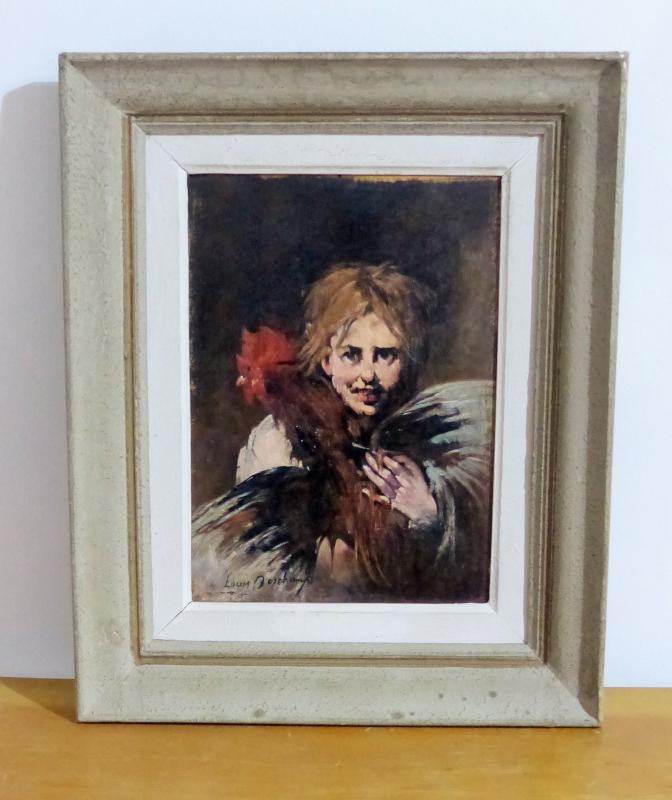
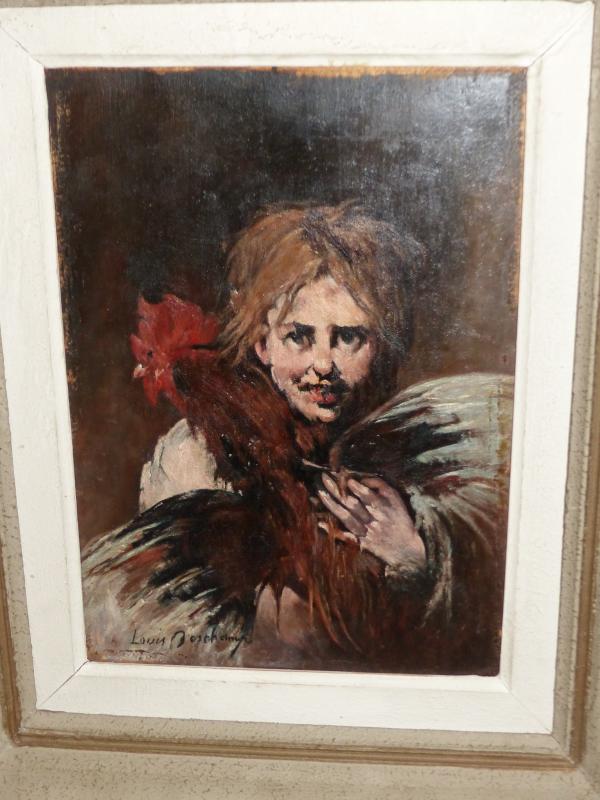
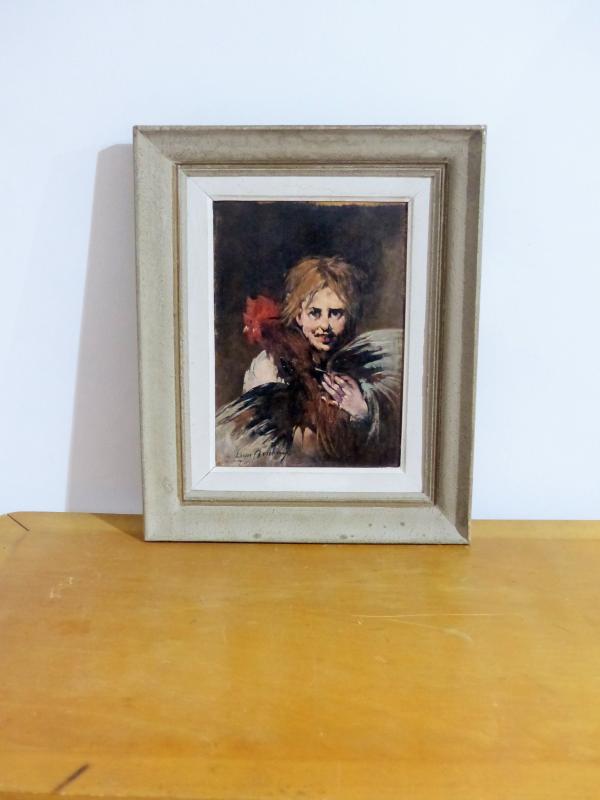

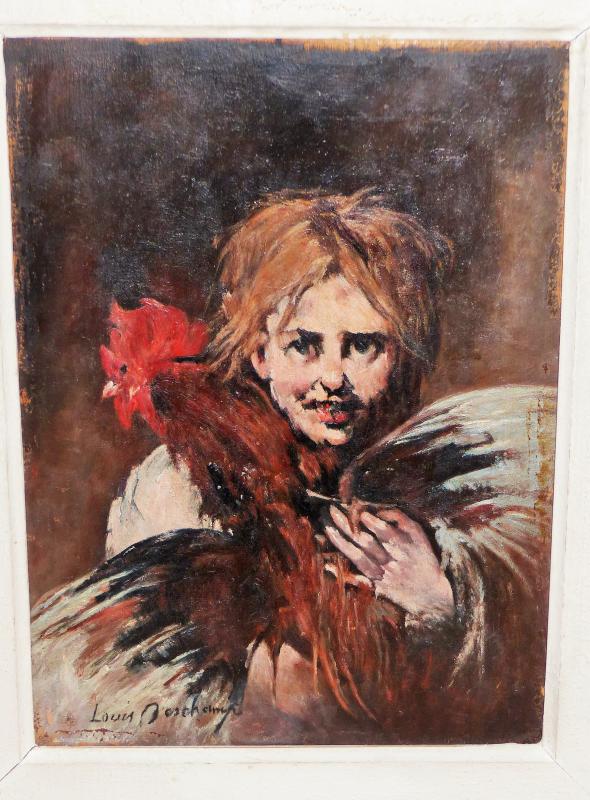

The Girl With The Rooster By Deschamps Louis Oil On Panel Painting XIX Eme France
Artist: Louis Deschamps, Né Le 23 Mai 1842 à Montélimar Et Mort Le 8 Août 1902 à Montélimar,
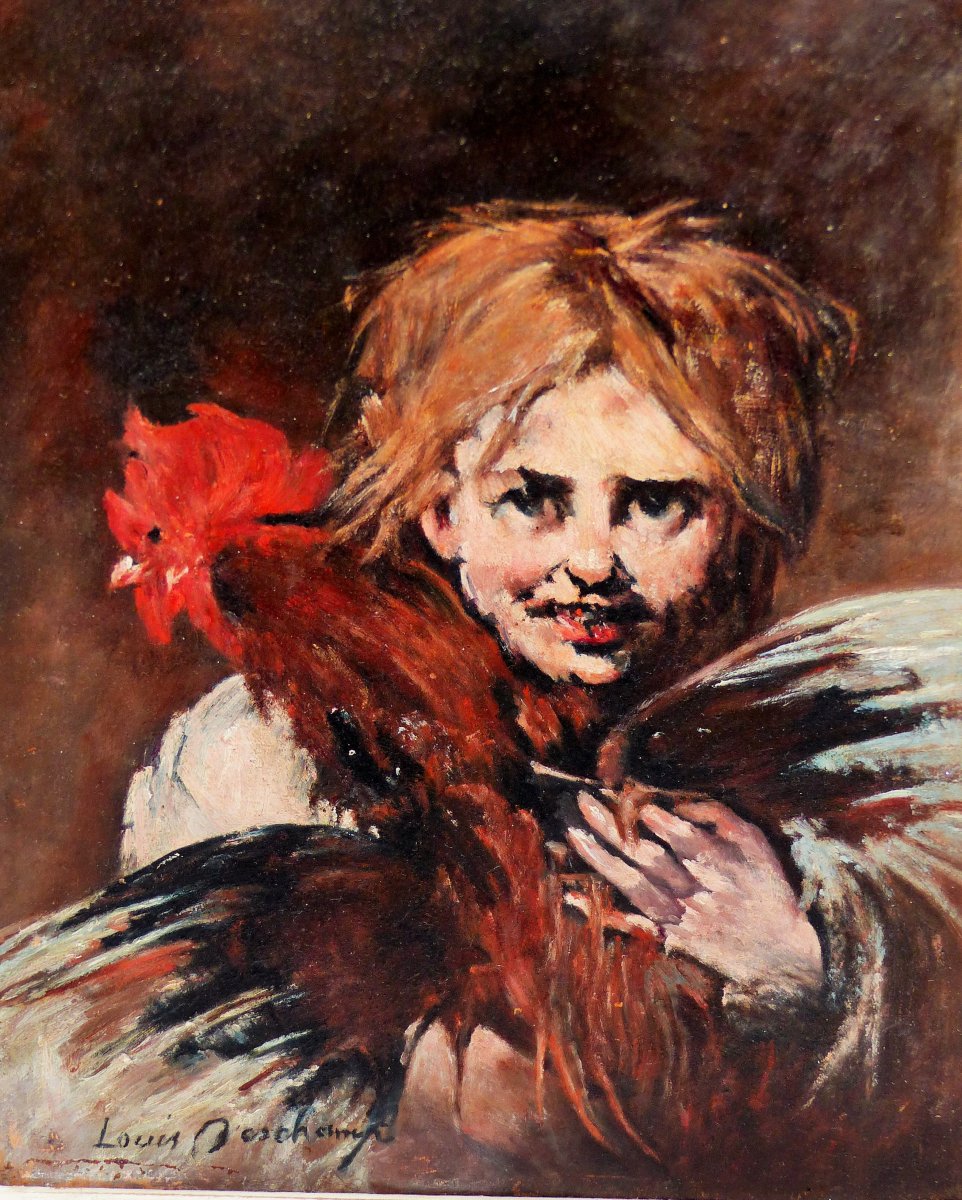
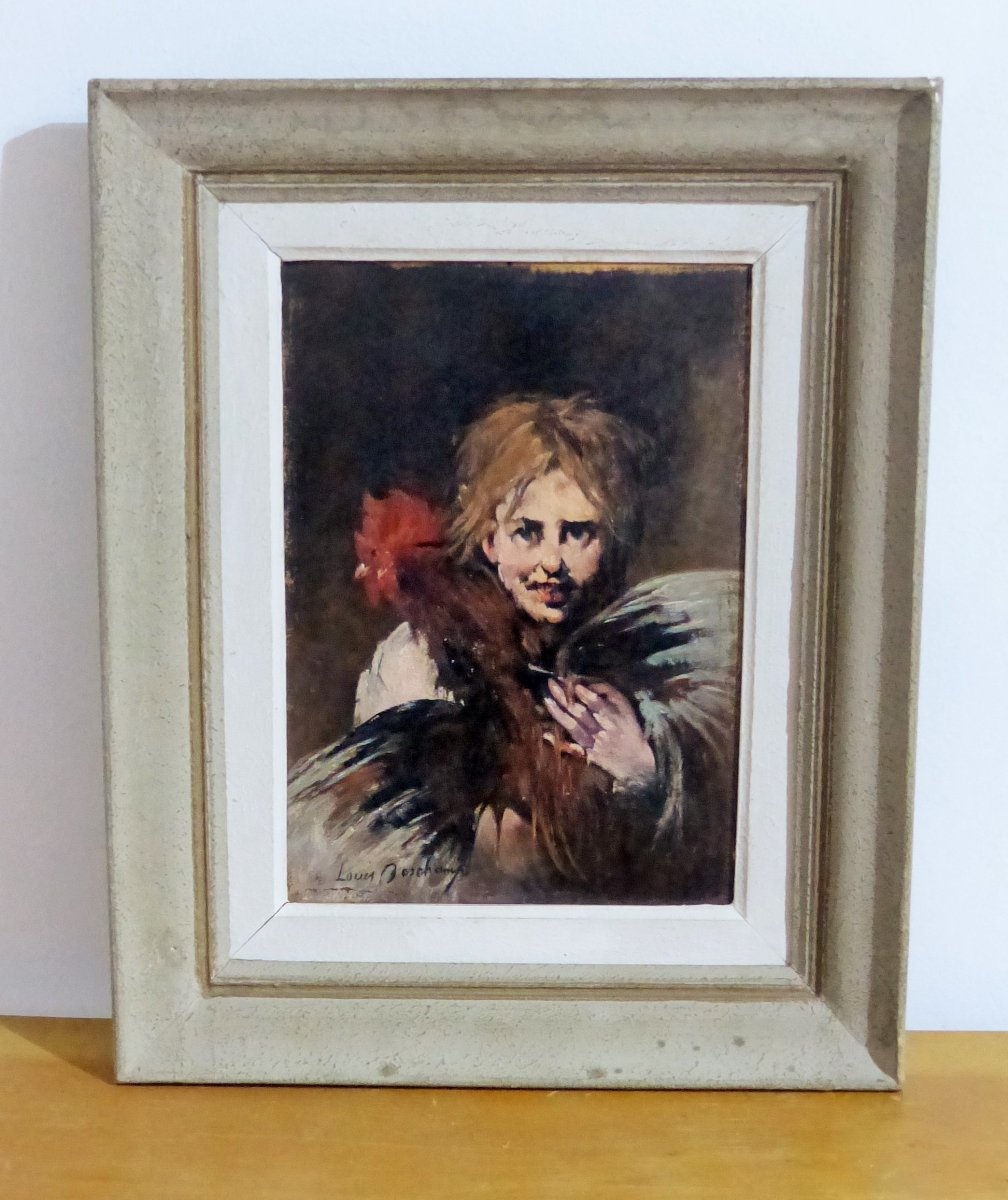
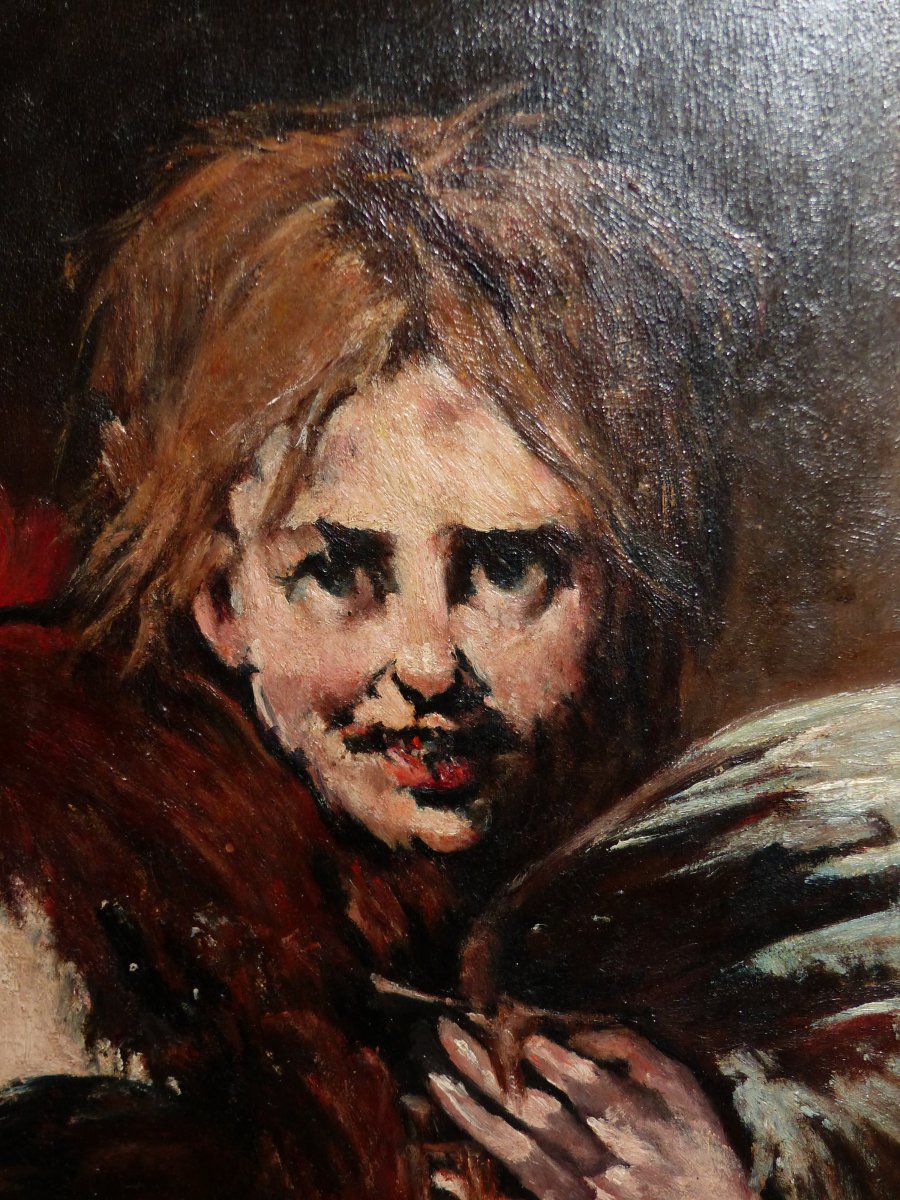
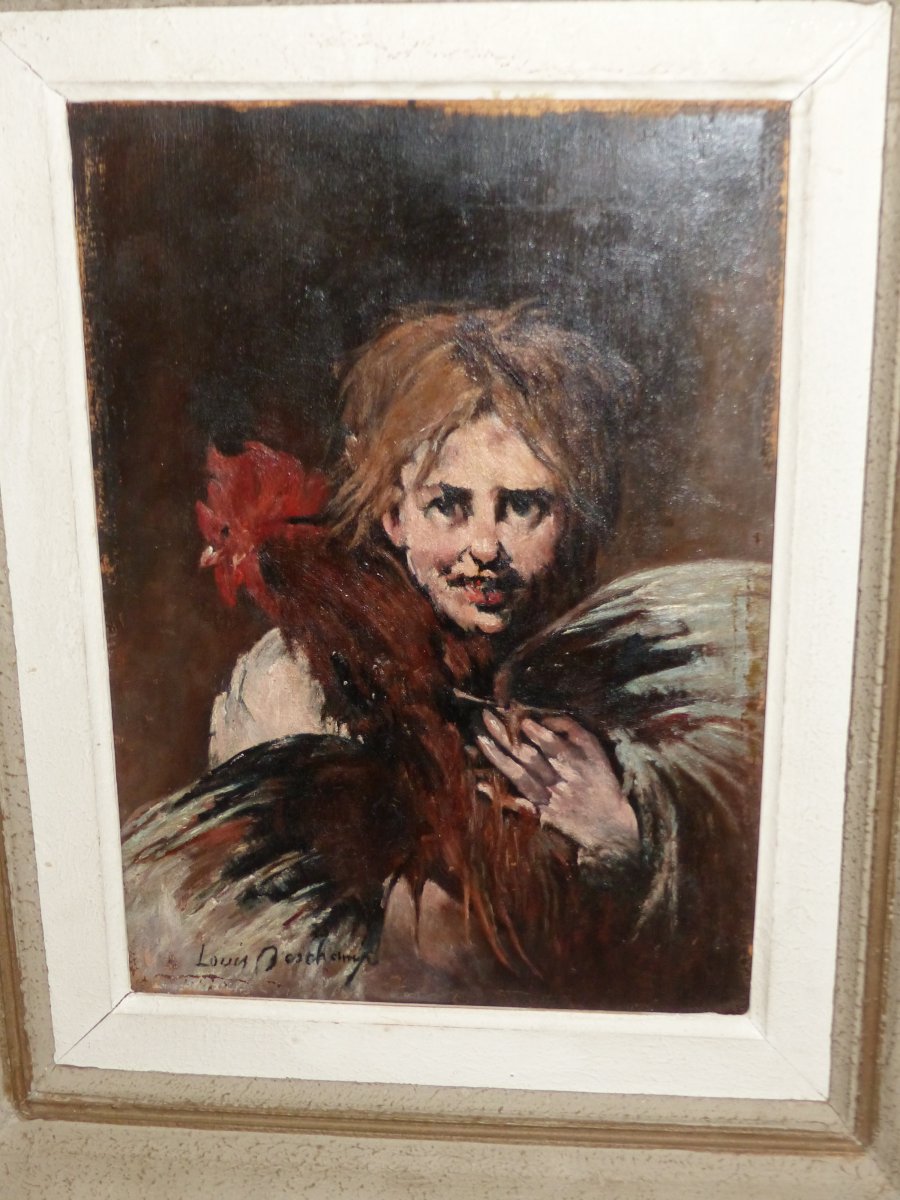
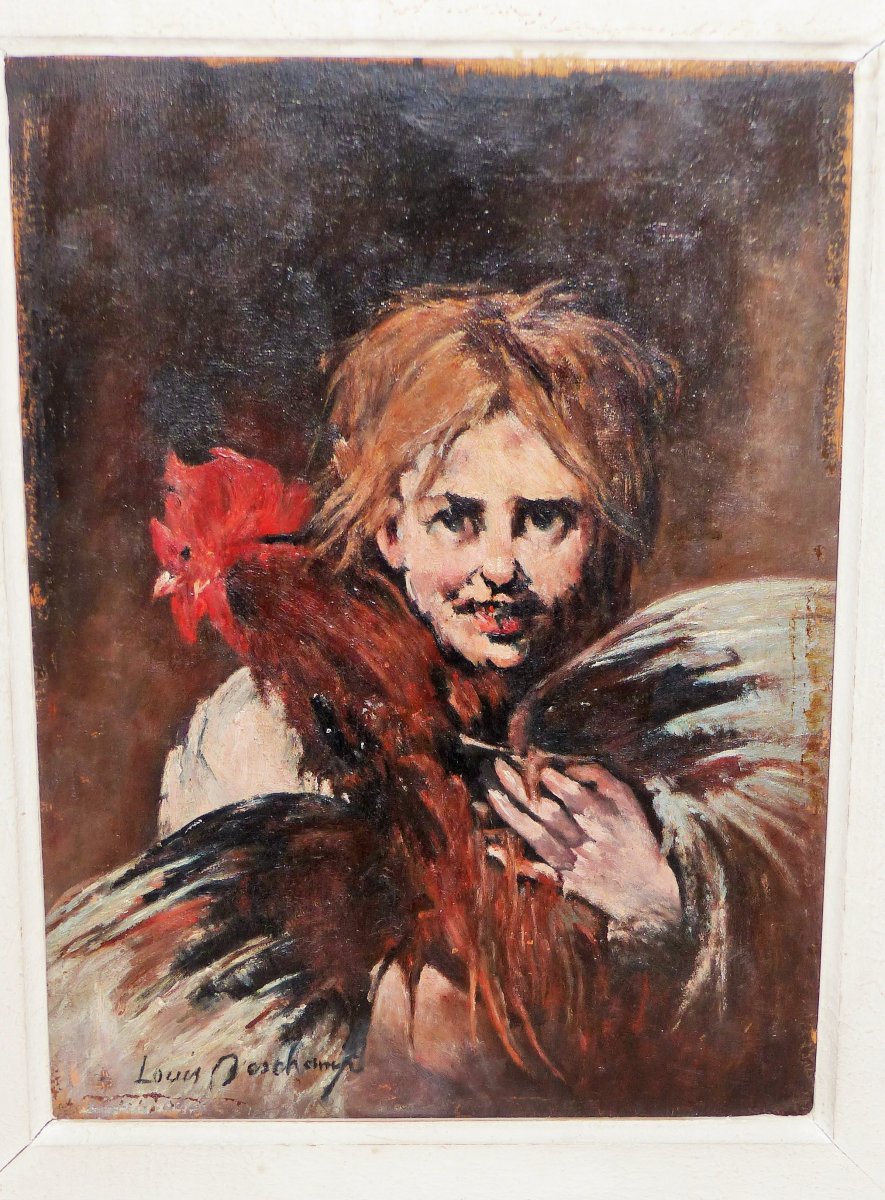
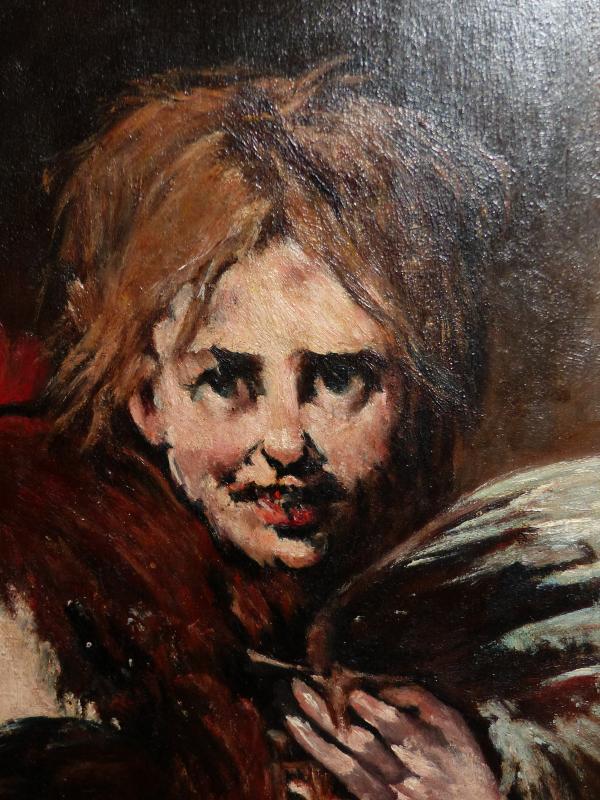
Louis DESCHAMPS (Montélimar, 1846 – 1902)The Young Girl with a Rooster, circa 1893Oil on panel, 33 × 23.5 cmSigned lower left “Louis Deschamps”Trained at the École des Beaux-Arts in Lyon and then, in Paris, in the studio of Alexandre Cabanel, Louis Deschamps belonged to that generation of the Third Republic that gently shifted the academic tradition towards an intimate naturalism, very attentive to ordinary people and the rural world. He debuted at the Salon in the 1870s and made his mark with compositions in which childhood, poverty, popular piety, and scenes of everyday life became noble subjects in their own right. Contemporary critics noted him for works of literary or religious inspiration, such as A Thing Seen One Spring Day after Victor Hugo, but also for his profoundly human scenes, centered on the gaze and presence of humble figures.Today, his work is firmly established in French public collections. Deschamps' work can be found at the Musée d'Orsay, notably with *La Charité* (Charity) and with the large group of works surrounding *Chose vue un jour de printemps* (Thing Seen One Spring Day), now on loan to the Musée de Brou in Bourg-en-Bresse. The Louvre Museum, in its Department of Prints and Drawings, holds studies of children such as the delicate *Bébé emmanloté* (Swaddled Baby Lying on the Floor), which reveals his virtuosity as a draftsman and his keen sense of expression. Other works are held at the Musée des Beaux-Arts in Nîmes, the Musée des Beaux-Arts in La Rochelle—where the moving *Folle* (Madwoman) already depicts a figure clutching an animal—and in the collections of the Petit Palais in Paris. This network of museums confirms that Deschamps is now considered an important figure in fin-de-siècle French naturalism, a period where social sensitivity and Symbolist tension intersected.The motif of *La Jeune Fille au coq* (The Young Girl with a Rooster) fits directly into this body of work. The composition is listed in the literature under the title *The Girl with the Rooster*, dated 1893, which places the subject at the artist's peak. Deschamps explored several variations of children with domestic animals—rooster, rabbit, goat—a theme echoed in public collections and in works that have come up for auction, such as *Young Boy Holding a Rooster*, dated 1897. In all these variations, the artist does not seek a picturesque scene in the anecdotal sense: he uses the presence of the animal to reinforce the emotional charge of the face and establish a very direct relationship between the figure and the viewer.The composition of this panel is deliberately compact. The girl is framed from the waist up, the rooster nestled against her, almost enveloped by its coat. The background, rendered in a range of warm browns and blacks, remains intentionally indeterminate. No rural setting, no interior, no landscape element distracts the eye. Everything is focused on the encounter of a face, a gaze, and a protective gesture. Deschamps extends the chiaroscuro tradition, but interprets it with a very free, vibrant style, typical of the late 19th century.Technically, the artist works on a dark, prepared panel, a deliberate choice. This support allows him to play with transparencies in the background areas, treated with light washes and glazes, where the paint is almost absorbed by the ground. Conversely, denser impasto is reserved for the essential areas: the flesh tones of the face and hands, certain light strands of hair, and the rooster's most illuminated feathers. In the plumage, the brushstrokes are short, nervous, almost claw-like; Deschamps uses numerous oblique and broken strokes that suggest the texture, volume, and fluttering of the feathers, as if the animal had just been captured. The face and hands, however, are rendered with a more academic precision: seamless transitions, superimposed thin layers of ochre, earth tones, and off-white, with rosy highlights on the cheeks and nose. Here and there, one can discern a few corrections, particularly around the contours of the face and the rooster's profile, which attest to a direct, unrigid approach to the subject.The palette is limited but remarkably subtle. Deep browns and blacks structure the background and the clothing. Reds and oranges are concentrated in certain feathers and accents of the hair, lending an inner warmth to the image. Bluish grays and off-whites punctuate the shirt and certain highlights. All of this forms a very controlled chromatic triangle, where the warmth of the reds, very slightly muted, is held back by the richness of the browns, while the cooler tones stabilize the whole. The light on her face, set against this dark background, becomes the true focal point of the painting, around which everything is arranged.The young girl's expression is the heart of the work. Her barely perceptible smile is ambiguous, somewhere between mischief and Childlike and precociously serious, as if the child had already seen more than one would imagine at her age.The direct gaze meets the viewer's, creating an almost theatrical intimacy.This is neither a society portrait nor a simple rural anecdote; the figure acquires an almost dramatic intensity, comparable to that of the children in The Abandoned Child or in Deschamps' well-known scenes of family mourning.The artist achieves the remarkable feat of breathing genuine inner life into a peasant girl's face, despite its modest format.Historically, the scene reflects the interest of naturalist painters in the rural world at a time when industrialization, the city, and the railways were profoundly changing the social landscape. Artists sensed that this peasant world, with its slow rhythms, its gestures, its animals, and its rituals, was transforming and perhaps disappearing.The rooster, an emblematic farm animal and also a traditional symbol of France, lends the scene a subtle allegorical dimension: in this child clutching her rooster, one can discern a rural France, proud and tenacious, which the artist captures one last time before time alters it.Through its themes and composition, The Girl with the Rooster naturally engages in a dialogue with works held at the Musée d’Orsay, the Musée de Brou, the Louvre, La Rochelle, Nîmes, and the Petit Palais.The empathy for vulnerable childhood recalls The Abandoned Child at Brou; the idea of protection and charity echoes the figures in Charity at the Musée d’Orsay; the delicacy of the children’s studies at the Louvre is reflected in the anatomical accuracy and restrained emotion of this face.At La Rochelle, the unsettling figure of Folle clutching a rabbit shows that Deschamps was already exploring this motif of ordinary bodies connected to animals, in a tension between gentleness and unease. The Girl with the Rooster condenses this research into a domestic format, easily hung, but with a real museum density in intention and writing.
In an interpretation inspired by Feng Shui applied to decoration, this painting also concentrates several extremely interesting symbols.The young girl, a figure of gentleness, loyalty, and promise, embodies an Earth-type energy: stability, roots, family continuity, and a connection to the village and lineage. The rooster, on the other hand, belongs to the Fire element: courage, assertiveness, vigilance, and the ability to announce a new cycle, like the animal that crows at dawn and ushers in the day.The encounter between the two, the child protecting the animal from herself, creates a kind of symbolic field of benevolent protection: strength does not dominate innocence, but rather safeguards and defends it. The light focused on the face and plumage reinforces this impression of a luminous core at the heart of the work, ideal for energizing a space without creating an aggressive atmosphere.
The dominant tones—deep browns, reds, and oranges of the plumage, and the warm complexion of the face—naturally fit into a highly sought-after Earth/Fire palette in decorative Feng Shui.Earth soothes, grounds, and conveys an impression of seriousness, confidence, and continuity, making it particularly well-suited to a living room, office, entryway, or display area.Fire adds a touch of charisma, presence, and personal radiance. Thus, The Girl with a Rooster is no longer simply a 19th-century "genre portrait": hung at the right height, it acts as a warm focal point that structures the room, draws the eye, and creates an intimate, lived-in, almost private atmosphere.
For placement, this artwork works particularly well in areas of the home associated with vitality, family, and symbolic recognition. From a sectoral perspective, one might favor the South for its image, visible projects, and influence; the East for its family dynamics, roots, and heritage; or the Southeast for its growth, maturing projects, and gradual expansion.
In an entryway, the young girl with the rooster welcomes visitors with a warm and human presence.
In a living room or office, she creates an atmosphere that is both sensitive and assertive, ideal for a space where one entertains, makes decisions, and develops projects.
In a dining room or breakfast nook, the sublimated rural theme and the presence of the rooster, a symbol of morning and daily life, create a subtle connection with the rhythms of the home.
From a decorative standpoint, the painting blends particularly well with natural materials—waxed wood, patinated brass, velvet, or heavy linen—and with understated color palettes, where it becomes the warm accent of the overall design. Against a slightly darker wall, in taupe, warm gray, or a very muted green, it gains depth and nobility.On a light wall, it stands out like a luminous medallion.In a more contemporary, minimalist interior, it can engage in a dialogue with very minimalist design pieces: the strength of its gaze and the density of the chiaroscuro allow it to stand up to very simple furniture and act as the "living heart" of the room.
For a collector or gallery, this is therefore a work that offers multiple levels of interpretation.
It is an emblematic and documented subject by Louis Deschamps, treated with a mature style, on a highly decorative panel, in direct resonance with works held at the Musée d'Orsay, the Louvre, Brou, La Rochelle, Nîmes, and the Petit Palais.
It is also an immediately recognizable and emotionally resonant image that naturally finds its place in a contemporary interior and, in a Feng Shui-inspired interpretation, acts as an object of radiance, protection, and grounding.
A museum-quality piece, but in an intimate format, ready to be a central part of any home.
In an interpretation inspired by Feng Shui applied to decoration, this painting also concentrates several extremely interesting symbols.The young girl, a figure of gentleness, loyalty, and promise, embodies an Earth-type energy: stability, roots, family continuity, and a connection to the village and lineage. The rooster, on the other hand, belongs to the Fire element: courage, assertiveness, vigilance, and the ability to announce a new cycle, like the animal that crows at dawn and ushers in the day.The encounter between the two, the child protecting the animal from herself, creates a kind of symbolic field of benevolent protection: strength does not dominate innocence, but rather safeguards and defends it. The light focused on the face and plumage reinforces this impression of a luminous core at the heart of the work, ideal for energizing a space without creating an aggressive atmosphere.
The dominant tones—deep browns, reds, and oranges of the plumage, and the warm complexion of the face—naturally fit into a highly sought-after Earth/Fire palette in decorative Feng Shui.Earth soothes, grounds, and conveys an impression of seriousness, confidence, and continuity, making it particularly well-suited to a living room, office, entryway, or display area.Fire adds a touch of charisma, presence, and personal radiance. Thus, The Girl with a Rooster is no longer simply a 19th-century "genre portrait": hung at the right height, it acts as a warm focal point that structures the room, draws the eye, and creates an intimate, lived-in, almost private atmosphere.
For placement, this artwork works particularly well in areas of the home associated with vitality, family, and symbolic recognition. From a sectoral perspective, one might favor the South for its image, visible projects, and influence; the East for its family dynamics, roots, and heritage; or the Southeast for its growth, maturing projects, and gradual expansion.
In an entryway, the young girl with the rooster welcomes visitors with a warm and human presence.
In a living room or office, she creates an atmosphere that is both sensitive and assertive, ideal for a space where one entertains, makes decisions, and develops projects.
In a dining room or breakfast nook, the sublimated rural theme and the presence of the rooster, a symbol of morning and daily life, create a subtle connection with the rhythms of the home.
From a decorative standpoint, the painting blends particularly well with natural materials—waxed wood, patinated brass, velvet, or heavy linen—and with understated color palettes, where it becomes the warm accent of the overall design. Against a slightly darker wall, in taupe, warm gray, or a very muted green, it gains depth and nobility.On a light wall, it stands out like a luminous medallion.In a more contemporary, minimalist interior, it can engage in a dialogue with very minimalist design pieces: the strength of its gaze and the density of the chiaroscuro allow it to stand up to very simple furniture and act as the "living heart" of the room.
For a collector or gallery, this is therefore a work that offers multiple levels of interpretation.
It is an emblematic and documented subject by Louis Deschamps, treated with a mature style, on a highly decorative panel, in direct resonance with works held at the Musée d'Orsay, the Louvre, Brou, La Rochelle, Nîmes, and the Petit Palais.
It is also an immediately recognizable and emotionally resonant image that naturally finds its place in a contemporary interior and, in a Feng Shui-inspired interpretation, acts as an object of radiance, protection, and grounding.
A museum-quality piece, but in an intimate format, ready to be a central part of any home.
1 200 €
Period: 19th century
Style: Napoleon 3rd
Condition: Good condition
Width: 23.5 cms
Height: 33 cms
Reference (ID): 709994
Availability: In stock
Print