"venetian School Of The Late 17th Century"
Artist: école Vénitienne De La Fin Du Xviie Siècle
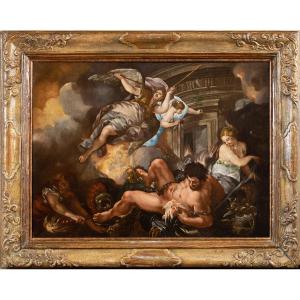
Numerous elements of the painting, such as the strong chiaroscuro contrast (the way the light falls on Susanna’s body while leaving the background in shadow) and the theatricality of the gestures, are direct references to the great 17th-century Baroque tradition.
The reasons why the work strikes a perfect balance between the late 17th and early 18th centuries are linked to the school to which it belongs:
• The stylistic transition: Painters active at the turn of the two centuries, such as the Veronese master Antonio Balestra (1666–1740) or the Venetian Giovanni Segala (1663–1720), were trained in the height of the 17th century. Consequently, they preserved the compositional vigor, marked contrasts, and dramatic intensity typical of the 17th century.
• Arcadia and Classicism: Compared to the darker or more naturalistic style of the 17th century, Susanna’s forms here are softened, moving toward a more tender and sentimental classicism typical of early 18th-century Venice.
• Attribution in Catalogs: Many paintings attributable to this circle or school are classified by experts as dating from the “late 17th / early 18th century,” as they combine the Baroque spirit of the 17th century with the elegance of the 18th century.For this reason, defining the work as “late 17th-century Venetian school” is a correct interpretation and consistent with the painting’s artistic rendering.
9 500 €
Period: 17th century
Style: Louis 14th, Regency
Condition: Fully restored
Material: Oil painting
Width: 86
Height: 112
Depth: 5
Reference (ID): 1860302
Availability: In stock
Print