René Seyssaud (1867–1952) Shepherd And His Flock On The High Plateaus
Artist: René Seyssaud (1867-1952)
Successive layers of color, stark contrasts between the orange of the path against the green and blue-violet, and the pink of the plowed fields against the yellow-green of the meadow.
Colors applied in broad, almost pure strokes, with a freedom reminiscent of Fauvism and the legacy of Van Gogh and Cézanne, two artists often associated with Seyssaud.
As is often the case with this artist, the brushstrokes are generous and directional; the streaks of the path follow the contours of the landscape, while the broom and bushes in the foreground are rendered in short yellow and green strokes.
The sky, rendered inlight, creamy paint, is brushed with fluid strokes.
The overall effect gives the impression of a “first draft”—quickly executed and likely painted from life.
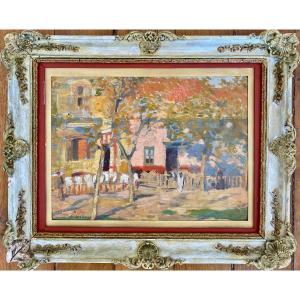
The work is presented in a gilded gadrooned frame measuring47 cm by 64 cm, with the canvas alone measuring 38 cm by 55 cm.
It depicts a shepherd and his flock on the high plateaus, certainly in the vicinity of Mont Ventoux, where the artist was a frequent visitor.
A luminous and fresh landscape, whose bold use of colorlends a truly modern character to this theme of the shepherd and hisflock on a path.
In good condition, the work is signed in the lower right corner.
A pioneer of Fauvism and a member of the Nouvelle École d’Avignon in 1892, Seyssaud submitted works to the Indépendants as well as to the Champs de Mars.
He exhibited at the Salon d’Automne from its inception, at the Parc de Bouteville in 1897, and in 1899 at Vollard’s gallery.
He achieved all the success he had hoped for.
Vollard offered Seyssaud a contract, but Seyssaud, out of loyalty to his friend and Marseille-based art dealer François Honnorat, declined.
In 1901, he began exhibiting annually at Bernheim Jeune.
Like Vollard, Bernheim Jeune offered to manage his interests.
Seyssaud again chose to reject this partnership, however lucrative it might have been.
After 1911, Seyssaud stopped exhibiting at Bernheim and chose instead to exhibit at Rosemberg (1914), Druet (1924), (1927), Printz (1929), Georges Petit (1930), Javal and Boudeaix (1933), and Printz (1933).
He exhibited in Marseille in 1905, 1907, 1920, 1921, 1922, 1928, 1947, 1949.
In Avignon, Aix-en-Provence, Tunis, etc...
In America in 1947.
Seyssaudparticipated in official exhibitions in Berlin (1903), Amsterdam (1912), Barcelona (1917, 1929), New York (1929), Wiesbaden (1921), Ghent (1922), Stockholm (1923), Geneva (1923, 1942), Turin (1951), the Colonial Exhibition in Marseille (1922), the Paris International Exhibition (1937), the of Marseille (1949), Menton Biennial (1951), Cantini Museum (1954), Zurich (1955), Galliera Museum (1956), Oxford, London, Edinburgh (1957), Aix-en-Provence, Festival (1957).
His works were acquired by the French government for the Luxembourg Museum (1903, 1904, 1921, 1927, 1929, 1930).
His works were alsoacquired by the museums of Marseille (1908, 1919), Lyon (1924), and Avignon (1920), the Bouches-du-Rhône Prefecture (1933), the City Hall of Saint-Chamas (1909), the National Museum of Modern Art (1957).
His works are on display at the Petit Palais, the Museum of Modern Art, the Léon Dierx Museum (Reunion Island), and in Moscow.
Also in Dijon, Nîmes, Aix-en-Provence, Arles, Grenoble, Montpellier, Albi, etc...
He has received various medals and awards.
Amongothers, the Gold Medal at the 1937 International Exposition in Paris,the Medal of the City of Marseille in 1947, and the Grand Prix of the French Provinces in 1951 at the Menton Biennale.
Seyssaud had been an Officer of the Legion of Honor since 1947.
Among the posthumous
retrospective exhibitions were those at the Calvet Museum (1953), the Cantini Museum (1954), the Salon d’Automne, Château d’Arbon in Switzerland (1955), and the Galliera Museum.
His paintings are included in the collections of Gustave Geffroy, Frantz Jourdain, Vollard, Georges Feydeau, Sacha Guitry, Armand Dayot, Lucien Poincaré, Maurice Sarraut, Albert Sarraut, Paulhan, Bernheim, Estaunié, Descaves, Morsolf, Fernand Bouisson, Drouant, André Marie, the Marquis de Biron, the Princess de la Tour d’Auvergne, de Wagram, etc.
4 800 €
Period: 20th century
Style: Other Style
Condition: Good condition
Material: Oil painting
Length: 55 cm
Height: 38 cm
Reference (ID): 1857510
Availability: In stock
Print